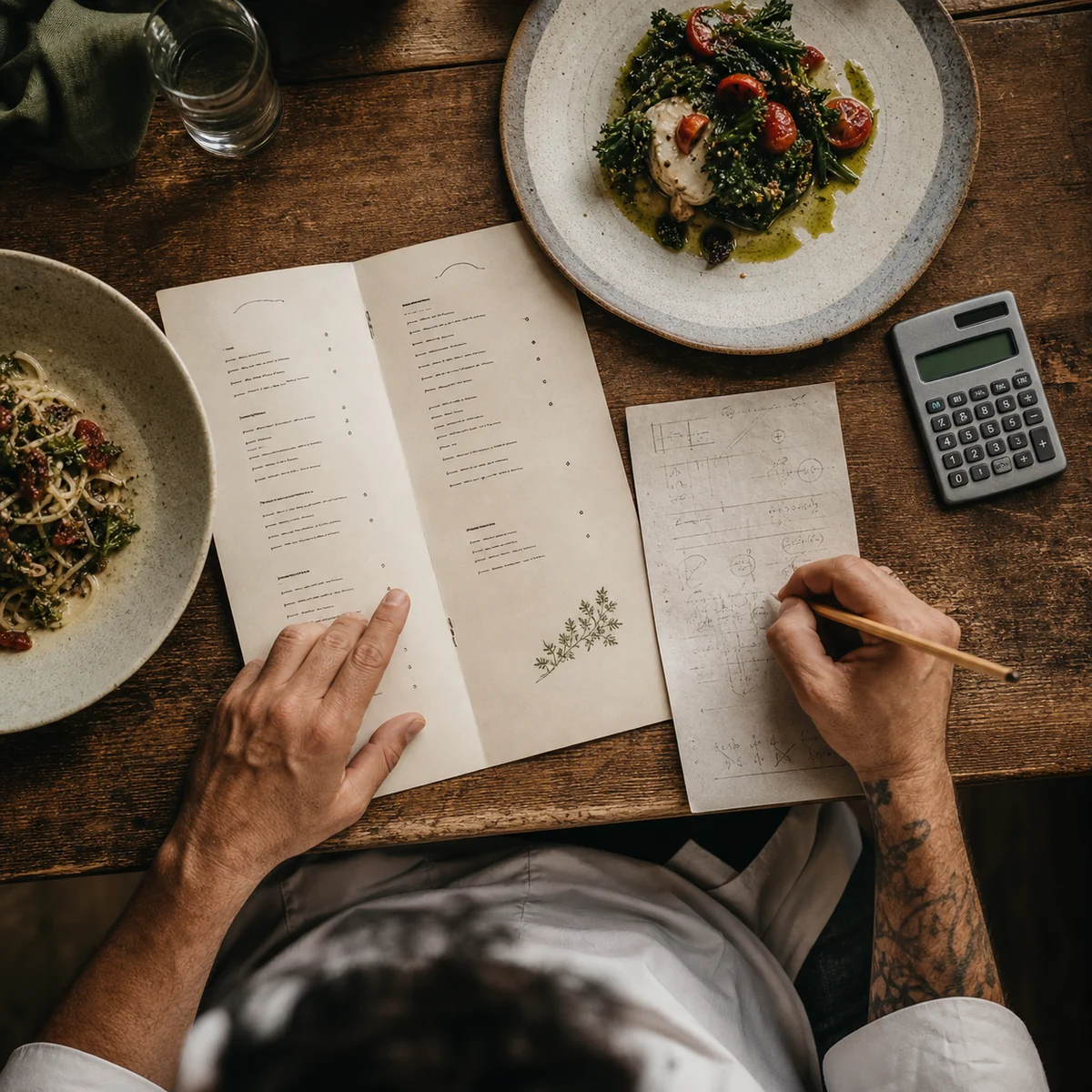
Menu engineering is often presented as a neat grid: high-popularity, high-contribution items are stars; low-performing items are removed. The grid is useful, but a food business is not a spreadsheet. A dish can carry the identity of a restaurant, introduce a guest to the kitchen, support profitable add-ons or create the photograph that makes somebody cross town.
The better question is not “Which items make the highest percentage?” It is “Which collection of items creates a healthy contribution, a clear promise and an operation the team can execute consistently?” That approach protects both commercial reality and the soul of the menu.
Start with contribution, not food-cost percentage alone
Food-cost percentage shows what share of the selling price is consumed by ingredient cost. Contribution margin shows the amount left after the variable costs included in your model. A lower food-cost percentage does not automatically mean a more valuable item if the absolute contribution is small.
Suppose one dish sells for $12 with $3.60 in direct variable cost. Its food-cost percentage is 30% and its contribution is $8.40. Another sells for $26 with $9.10 in direct cost. Its food-cost percentage is 35%, but its contribution is $16.90. The second dish may contribute more dollars to labour and fixed costs even with the higher food-cost percentage.
Define variable cost carefully. Ingredients and packaging belong in most models. Transaction fees, delivery commission, item-specific garnish, disposables and predictable waste may also matter. Labour and occupancy are important, but they are often analysed separately because allocating them per dish can introduce false precision. Record what is included and keep the comparison consistent.
Use recent sales data and real recipes
Choose a representative period rather than a single unusual weekend. Export item quantities from the point-of-sale system and match names carefully. Modifiers, sizes and delivery versions can hide the real volume. If the same sandwich appears under three buttons, combine it before judging popularity.
Update recipe costs from current purchase information. Count edible yield rather than invoice weight when trimming, cooking or spoilage materially changes the usable quantity. Include the sauce, garnish and small components that disappear from memory but not from the invoice. The goal is a decision-quality estimate, not an imaginary number accurate to the cent forever.
Create a repeatable review date. Volatile ingredients, supplier changes and portion drift can make an old costing sheet misleading even when sales data is current.
Build the popularity and contribution matrix
For each item, calculate total units, contribution per unit and total contribution for the period. Then compare items within a meaningful peer group. A starter should not compete directly with a celebration bottle or a family catering tray. Group by the way customers choose and the way the kitchen produces. A useful background reference is the Menu overview, which places this part of the discussion in context.
| Pattern | What it may mean | Useful response |
|---|---|---|
| Popular + strong contribution | A dependable commercial anchor. | Protect consistency, visibility and availability. |
| Popular + weak contribution | A traffic driver with cost or pricing pressure. | Review portion, purchasing, modifiers and price carefully. |
| Less popular + strong contribution | A valuable item customers may not notice or understand. | Improve naming, description, placement and staff guidance. |
| Less popular + weak contribution | Possible clutter or a strategically important niche item. | Investigate its role before changing or removing it. |
Thresholds should reflect the business. A simple average can be a starting point, but seasonal menus, dayparts and small item counts need judgement. Compare weekday lunch with weekday lunch, not with a holiday dinner.
Give every item a role
Some items exist to maximise contribution. Others create accessibility at an entry price, serve a dietary need, use a valuable by-product, reduce waste, speed a busy service or express the concept. Write the role beside the number. If the team cannot explain why an item is present, that is useful information.
A signature dish may deserve protection even if it is not the top contributor. Look for wider value: first-time visits, press mentions, repeat demand, beverage attachments, group ordering and the clarity it gives the brand. Do not use “signature” as a permanent exemption, however. Improve the economics around the dish before assuming nothing can change.
Improve a popular item with weak contribution
Begin behind the menu. Check yield, purchasing unit, waste, prep loss, portion tools and whether costly extras are being added inconsistently. A recipe card and the correct scoop can improve contribution without changing the guest experience.
Then inspect modifiers. Paid additions, side choices, serving sizes and bundles may create a fairer relationship between value and price. Avoid turning every request into a surprise fee. The offer should remain easy to understand.
If a price change is necessary, consider the whole category. A small, explained adjustment can be less damaging than quietly reducing quality. Test whether the description communicates the craft and portion accurately. Never invent provenance or inflate language to justify price.
Help a strong item get chosen
A less popular item with healthy contribution may have a visibility problem, a naming problem or a mismatch with the audience. Watch how people scan the menu. Ask staff what questions arise. Is the item hidden in an unexpected category? Does the description explain an unfamiliar ingredient? Is the photograph inaccurate or unappealing? For an independent reference, the shake shack’s strategic changes boosted profitability provides additional context for this point.
Use calm hierarchy. A menu where every item has a box, badge and adjective gives the eye nowhere to rest. Group choices logically, keep descriptions concrete and use emphasis sparingly. Train staff to recommend the item to the right guest rather than deliver a universal sales script.
Run one change at a time where possible. Rename the item, alter its position or update the description, then compare a similar period. Changing price, recipe, placement and staff incentive simultaneously makes the result difficult to interpret.
Know when to remove an item
Low popularity and low contribution justify a direct conversation, not an automatic deletion. Check whether the item serves allergies or dietary needs, completes a category, uses shared mise en place, fulfils a contract or supports a group decision. If its strategic role is weak and its operational burden is high, removal may simplify purchasing, prep and guest choice.
Retire items cleanly. Update the website, printed menus, ordering platforms, structured data and staff guidance at the same time. Redirect valuable old pages to the closest useful alternative rather than leaving search visitors on a dead end.
Include operational difficulty
Two items with the same contribution can create very different pressure. Record prep time, number of stations touched, pickup risk, specialist storage, waste sensitivity and training requirements. An item that collapses at peak service can damage the experience of every table.
Look for shared components. A focused menu can support better purchasing and execution when ingredients work across several dishes without making them feel identical. Conversely, one slow-moving item that requires unique stock can create hidden waste beyond its recipe cost.
Apply the same thinking beyond restaurants
Markets and food retailers can analyse category contribution, spoilage, basket attachment and the role of destination products. A low-margin loaf may bring a weekly shopper who buys cheese and produce. Food brands can compare pack sizes, channels and fulfilment costs. Suppliers can examine contribution by product family, customer type and delivery pattern.
The principle stays the same: calculate comparable contribution, observe demand, document strategic role and include operational reality before changing the assortment.
A monthly menu review rhythm
- Update costs for the ingredients or products that changed materially.
- Export unit sales and combine duplicate item names.
- Calculate contribution per unit and total contribution.
- Review popularity within sensible categories and dayparts.
- Add operational and strategic notes from the team.
- Select no more than a few changes with a clear hypothesis.
- Update every customer-facing version of the menu.
- Review the result after a comparable trading period.
Frequently asked questions
What is a good food-cost percentage?
There is no universal percentage that describes every concept, category or item. Use your own costs, prices, labour model and fixed obligations. Compare contribution and role, not one percentage in isolation.
Should the highest-margin items always be highlighted?
No. Highlight items that are a good fit for the guest and the business. Strong contribution is useful evidence, but relevance, quality and operational consistency matter too.
How often should menu prices be reviewed?
Monitor important input changes continuously and use a regular review rhythm. Review sooner when suppliers, portion sizes, delivery fees or demand change materially.
Standardise the base quantities with the Recipe Scaler & Portion Calculator before comparing item costs, contribution and demand in your own operating data.