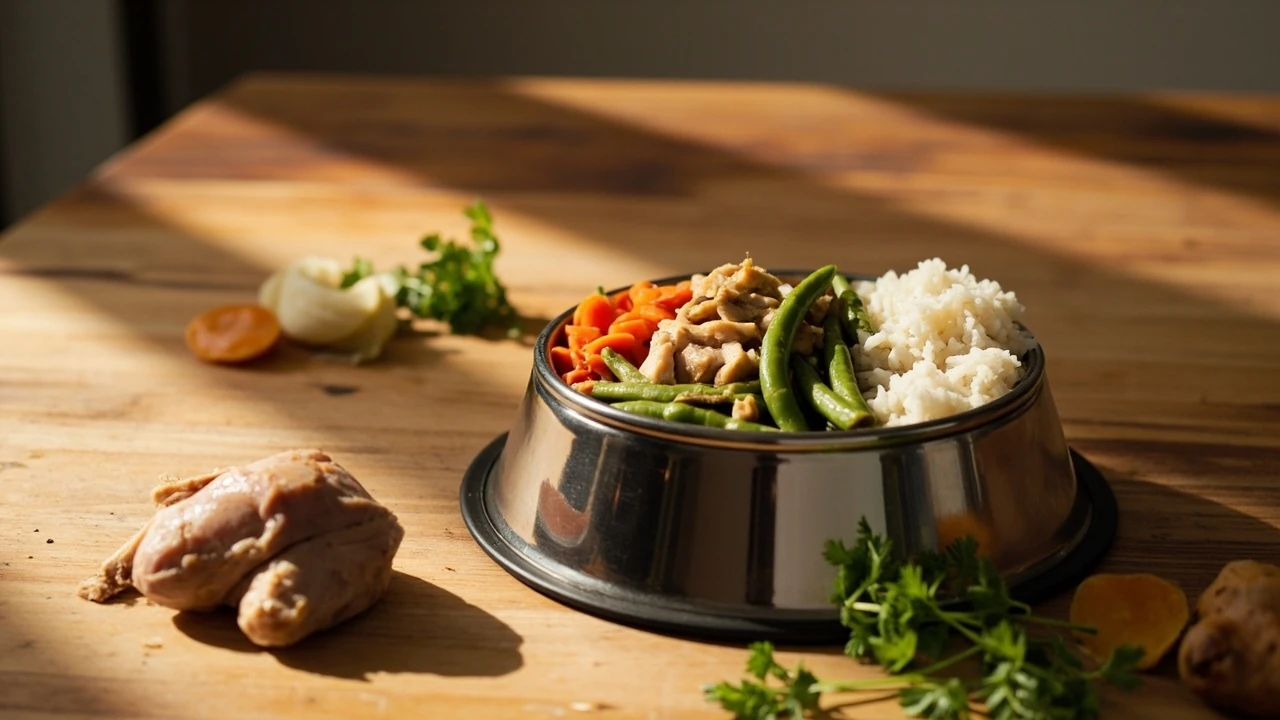
Just food for dogs: what the phrase actually means
A dog stands in the kitchen while its owner opens a can of something pale and uniform, then mixes a spoonful into a bowl of brown kibble. The dog eats it. The owner feels a quiet sense of having done the right thing. The phrase that often comes to mind in moments like this is just food for dogs, a shorthand for meals built from recognizable, minimally processed ingredients rather than a long list of manufactured compounds. The phrase shows up in dog owner forums, on packaging in the refrigerated pet aisle, and in marketing copy from a growing set of small fresh-food companies. It is part philosophy, part product category, and part feeding decision that every dog household makes several times a day.
The interesting thing about the phrase is that it is doing two different jobs at once. In one sense, “just food for dogs” is a critique of highly processed pet food, the argument that dogs eat best when their bowl looks more like a plate of food and less like a science experiment. In another sense, it is a quiet promise to the dog, an attempt to feed a species that evolved alongside humans on a diet that looks a little more like the human side of the kitchen. The two readings are not always the same, and the practical feeding decisions underneath them can differ sharply.
For restaurant operators, food marketers, and brand builders who read this site, the topic is worth taking seriously for an additional reason. Fresh, recognizable, minimally processed dog food is one of the most interesting category stories in the broader food market right now. It borrows language, packaging cues, and trust signals from the human side of fresh food, and it gives a useful case study in how a category earns trust when the product itself cannot speak. The rest of this article works through what “just food for dogs” actually delivers nutritionally, what to look for in a recipe or product, what mistakes are easy to make, and how the category is being built and sold.
Why the phrase has spread so quickly
Three forces pushed the phrase into the dog-owner vocabulary. The first is the simple observation that the inside of a kibble bag or a can of wet food looks very different from the food in a human kitchen. Owners who already cook from scratch for themselves started to ask why their dog’s bowl looked so unrecognizable. The second is a generation of veterinarians and animal nutritionists who began publishing more openly about the limits of certain feed-grade ingredients, the overuse of starches, and the way palatants and humectants can keep a dog eating a food that does not necessarily serve its long-term health. The third is a wave of direct-to-consumer brands that built their entire identity around short ingredient lists, refrigerated shelves, and a quiet visual language borrowed from farmers’ markets and farm-to-table restaurants.
None of those forces is new on its own, but together they have made “just food for dogs” a phrase that does real work. It tells a buyer what is not in the food, and it implies what is. It also positions the product against a vague, faceless competitor that owners have started to distrust without quite knowing what to replace it with. That positioning has a real cost, which is that the phrase gets attached to products of very different quality. Some of them are excellent. Some are simply human-grade in name only. A serious look at the category has to separate the principle from the marketing.
What nutritionists actually mean by minimally processed dog food
When a veterinary nutritionist uses the language of minimally processed or fresh food for dogs, they are usually pointing to a small set of concrete attributes. The food contains named whole ingredients. The protein source is a recognisable muscle meat or organ rather than a generic “meat by-product” or rendered meal. The carbohydrate component, when there is one, comes from a recognisable grain, tuber, or legume rather than a refined flour or starch isolate. The food has not been extruded at very high temperatures or cooked for long enough to break down the structure of the protein and the fat. The shelf life is short, or the food has been preserved by chilling, freezing, or gentle cooking rather than by heavy chemical preservation.
Those attributes matter because heat and pressure change the structure of nutrients. Extrusion, the process that turns wet dough into dry kibble, is genuinely useful for shelf stability, but it does alter proteins, oxidises some fats, and changes the way carbohydrates are digested. Cooking at lower temperatures for shorter times preserves more of the original nutrient structure. It is also more expensive and more fragile, which is why this kind of food is sold refrigerated, frozen, or in small-batch cans rather than in 15-kilogram bags on a warehouse pallet.
It is worth saying plainly that “minimally processed” is not a regulated term in pet food. Two products on the same shelf can both use the phrase, and one can be gently cooked chicken and vegetables while the other is a kibble reformulated to look fresher on the label. Buyers who care about the principle have to read the ingredient list, the guaranteed analysis, and the manufacturing description rather than the front of the pack.
Nutritional balance: the part home-cooked diets often get wrong
The single biggest practical problem with the “just food for dogs” idea is nutritional balance. A home cook can put chicken, rice, and green beans in a bowl and feel good about it, and the dog will probably eat it happily. Over weeks and months, the same bowl can quietly create deficiencies. Adult dogs need specific levels of calcium, phosphorus, zinc, copper, iodine, vitamin D, vitamin E, and a handful of B vitamins in ratios that are hard to hit by intuition. A chronic imbalance shows up first as a dull coat or loose stool and later as skeletal, joint, or immune problems that are hard to reverse.
This is the reason that the phrase “just food for dogs” can be misleading if it is taken to mean that any human-style meal will do. The phrase is at its best when it describes a product or recipe that has been designed by someone who understands canine nutrition requirements and then made from a small set of whole ingredients. It is at its worst when it describes a home-cooked meal assembled without a recipe, without supplements, and without a periodic review by a veterinarian or a board-certified veterinary nutritionist. The intent is good, but the long-term outcome can be poor.
For owners who want to cook at home, the practical path is well established. Use a published recipe that has been formulated to AAFCO or FEDIAF nutritional profiles, follow it precisely, and avoid the temptation to substitute freely. Add the specified supplement blend rather than guessing. Recheck the recipe every time the dog’s life stage changes, because puppy, adult, and senior dogs do not have the same requirements, and large breeds have their own calcium-to-phosphorus considerations during growth.
How to read an ingredient list for a “just food” product
The ingredient list is the most useful document a buyer of fresh dog food will ever read, and it is also the most often skimmed. A useful habit is to read the first five ingredients and ask, separately, what each one is and where it came from. “Chicken” is a muscle meat. “Chicken meal” is a rendered, dried protein concentrate. “Chicken by-product meal” is a rendered mix of organ and connective tissue. “Meat by-products” is a broader catch-all category. Each of those ingredients has a different nutritional profile and a different cost structure, and they are not interchangeable in a finished recipe.
Beyond the protein source, a strong fresh-food ingredient list tends to be short, named, and free of vague categories. Whole vegetables appear by name. Whole grains appear by name. There is no need for a long list of vitamin and mineral premixes to appear in the first five lines, because those are added to balance the recipe and they will be present in any complete food. A list that is dominated by premixes and processed derivatives is a list that has replaced whole food with a manufactured substitute, and the “just food” promise quietly disappears.
A simple way to evaluate the list is to ask whether the food, if you cooked it yourself with no further processing, would still look like the label. If the answer is yes, the product is doing what the phrase promises. If the answer is no, and the label is full of named chemicals that the buyer has never seen in a kitchen, then the product is using the language of fresh food without the substance.
Fresh, raw, gently cooked, and air-dried: a clear comparison
The phrase “just food for dogs” gets attached to several very different manufacturing formats, and they are not interchangeable. The table below compares the four most common formats in the fresh and minimally processed space.
| Format | How it is made | Typical shelf life | Cost per day for a 15 kg dog | Main trade-off |
|---|---|---|---|---|
| Fresh, gently cooked | Low-temperature cooking, then chilled | 5 to 10 days refrigerated, several months frozen | Higher than kibble, lower than most raw | Needs cold storage, more expensive than extruded food |
| Raw, frozen or freeze-dried | No cooking, preserved by freezing or freeze-drying | Several months frozen, weeks to months once thawed | Often the highest cost per day | Pathogen handling risk for people in the household |
| Air-dried | Slow warm-air drying without extrusion | Several months at room temperature | Mid to high | Dense, calorie-rich; portions are easy to overfeed |
| Lightly cooked, shelf-stable in pouches | Heat-treated in a sealed pouch, similar to ready meals | 1 to 2 years ambient | Mid | Texture and nutrient profile depend heavily on the cook cycle |
The right format depends on the dog, the household, and the budget. A working dog that burns calories quickly may do well on air-dried food because of its calorie density. A senior dog with a sensitive stomach may do better on gently cooked fresh food. A household with very young children or immunocompromised adults may want to avoid raw feeding because of the pathogen handling risk. The phrase “just food for dogs” does not, on its own, point to a single format, and a careful owner chooses the format before the brand.
Cost, convenience, and the daily feeding decision
Cost is the part of the “just food for dogs” conversation that the marketing material tends to avoid. A 15-kilogram adult dog eating a good fresh diet can easily cost two to three times as much per day to feed as a dog on a mainstream extruded kibble. That is a real difference, and it changes who the category is genuinely for. Households on tight budgets can still feed their dogs well, and a well-formulated mid-range kibble is a perfectly reasonable choice for many dogs. The point is that the fresh food promise is not free, and pretending otherwise makes the category less honest.
Convenience is the second real trade-off. Fresh food is heavier, often frozen, and has to be portioned, stored, and used up before it spoils. Some brands ship pre-portioned packs; others ship in bulk. A household that travels with the dog, or that leaves the dog with a sitter for long weekends, has to plan around the cold chain. None of this is a reason to avoid the format, but it is a reason to walk into it with open eyes.
A useful way to think about the trade-off is to ask what the food is actually replacing in the household budget. If it is replacing a mid-range kibble plus a few treats, the upgrade is modest. If it is replacing a premium kibble plus a supplement routine plus a daily home-cooked topper, the upgrade can be a small step up in price with a real step up in simplicity. The honest cost comparison is not “kibble versus fresh,” it is “kibble plus everything else I do for this dog versus the fresh food that replaces all of it.”
The ingredient choices that matter most
Inside the “just food for dogs” category, a small number of ingredient choices drive most of the nutritional and quality differences between products. The list below is a starting point, not a complete shopping guide, and it is the kind of list a buyer can use while scanning shelves in a refrigerated pet aisle.
- Named protein first. The first ingredient should be a specific muscle meat, organ, or named fish. Vague proteins (“meat,” “animal protein”) and rendered meals are a step removed from the principle.
- Whole vegetables and grains, not purees and starches. Carrots, peas, sweet potato, brown rice, barley, and oats are visible in the recipe. Refined flours and starch isolates are not.
- Added omega-3 sources. Fish oil, ground flaxseed, or whole oily fish bring the fatty acids that a dog cannot make in useful quantities and that hot extrusion tends to damage.
- Limited synthetic preservatives. Mixed tocopherols and rosemary extract are gentle and common. BHA, BHT, and ethoxyquin are older preservatives that some owners prefer to avoid.
- No added sugar, caramel colour, or generic “animal digest.” These are palatability tools borrowed from the extruded food world. They are not necessary in a fresh product.
- Clear calcium and phosphorus sources. Ground eggshell, calcium carbonate, or specific bone meal should appear in the analysis, because home-style recipes often miss this balance.
Reading a label against this list, rather than against a marketing claim, is the most reliable way to know whether a product lives up to the idea behind the phrase.
What to skip, even if the marketing is appealing
The “just food for dogs” shelf is not a place for trust by default. A few patterns are worth watching for, because they show up often and they tend to weaken the claim a product is making. The table below lists some of the most common ones and what to do about them.
| Claim on the pack | Why it is worth checking | What to look at instead |
|---|---|---|
| “Human grade” | Defined for the entire facility, not the individual ingredient. A product can carry the phrase and still be heavily processed. | Manufacturing process, ingredient origin, third-party audit |
| “Grain free” | Not a guarantee of quality. Grain free formulas often replace grains with legumes, and some studies have linked certain legume-heavy diets to heart issues in dogs. | Full ingredient list, including protein and starch sources |
| “Vet recommended” | Often an individual practitioner endorsement or a paid relationship, not a nutritional certification. | Whether the recipe was formulated by a board-certified veterinary nutritionist |
| “All natural” | Not a regulated term in pet food. Almost any ingredient, including synthetic vitamins, can sit under this label. | The ingredient list itself, not the marketing phrase |
| “Limited ingredient” | Useful in genuine allergy cases, but often used as a marketing line for ordinary recipes with shorter lists. | Whether the limited list is genuinely necessary for the dog or just shorter for marketing |
The pattern across these claims is that they trade on words that sound meaningful and are not. A useful habit is to take the marketing claim, write it on a piece of paper, and then look for the specific evidence behind it. When the evidence is missing, the claim is doing the work of a fact that has not been provided.
When “just food for dogs” is the wrong choice
It is easy to talk about the “just food for dogs” idea as if it were always an upgrade, and for many dogs it is. For some dogs and some households, however, it is the wrong choice, and a careful owner will say so before the first bag or tray is opened. The cases below are the most common ones where the simpler kibble or canned option is genuinely a better fit.
- Dogs on prescription diets. A dog with diagnosed kidney, liver, or urinary disease is usually on a diet that controls minerals and protein in ways a generic fresh recipe does not. The principle of “just food” does not override the need for a prescription formula.
- Households that cannot store the food safely. A fresh diet that loses its cold chain, or an air-dried diet kept in a humid kitchen, can spoil in ways that are not always obvious. If the cold chain is unreliable, a stable extruded or canned diet is safer.
- Multi-dog households with very different needs. A senior dog and a puppy do not eat the same food. A small household with one dog has a much easier time with fresh food than a household with four dogs of different ages and sizes.
- Dogs with confirmed food allergies that need a specific novel protein. Some allergies are best managed with a tightly controlled hydrolyzed diet rather than a fresh recipe with several whole ingredients.
- Owners who cannot afford a steady supply. Switching a dog back and forth between fresh food and kibble is harder on digestion than picking one stable, well-formulated option and staying with it.
The honest version of the “just food for dogs” idea is that fresh, minimally processed food is a strong default for many dogs, not a moral obligation for all of them. The right feeding plan is the one the household can sustain without strain.
How the category is being built as a brand
For readers who build food brands for a living, the “just food for dogs” category is worth studying in its own right. The brands that have done well in the space have built their identities around a few consistent choices. They have leaned into short ingredient lists and a quiet, kitchen-style visual language. They have invested in transparent communication about sourcing and manufacturing, often showing the kitchen rather than a polished studio. They have used veterinary nutritionists as named authorities on the brand, not as decoration in a footer. They have resisted the temptation to expand into too many recipes too quickly, and they have kept the menu tight enough that each recipe can be explained properly.
The category has also borrowed the trust signals of the broader fresh food movement. Refrigerated shelves, simple packaging, “small batch” language, named farms, named fishers, named growers. The visual grammar of the farmers’ market has moved into the pet aisle, and it works because the underlying promise is the same. The brands that have stumbled are usually the ones that have copied the visual grammar without doing the underlying work, or the ones that have stretched the “just food” idea across too many formats at once.
It is a useful mirror for the human side of the food world. The lesson is the same. The phrase is not a brand. The brand is what the phrase points to in the ingredient list, the kitchen, the supply chain, and the way the company answers the questions a serious customer actually asks. Owners of dogs in this category tend to be skeptical, label-reading consumers. The brands that win are the ones that treat that skepticism as a feature, not a problem to manage.
Veterinary guidance and the limits of one article
No article can replace a conversation with a veterinarian who knows a specific dog. The “just food for dogs” idea is a category of products and a feeding philosophy, and neither of those is a substitute for a feeding plan that has been checked against the dog’s age, weight, breed, activity level, and any medical conditions. For owners who want to move their dog to a fresh or home-cooked diet, the most useful first step is a single appointment with a primary care veterinarian to discuss goals and to ask for a referral to a board-certified veterinary nutritionist if the diet will be home-cooked.
It is also worth saying that the science of canine nutrition is still moving. The relationship between certain grain-free, legume-heavy diets and a form of heart disease in dogs is the most prominent example, and it is a reminder that a “natural” or “fresh” label is not a guarantee of safety. A serious approach to feeding a dog well is one that combines a careful reading of labels, a willingness to ask the vet, and a steady eye on the dog itself, because the dog is the only honest source of feedback on whether the plan is working.
Frequently asked questions
What does “just food for dogs” actually mean?
It is a shorthand for dog food made from a short list of minimally processed, recognizable whole ingredients rather than a long list of rendered, extruded, or heavily manufactured components. The phrase is not a regulated label, so the meaning depends on the specific product or recipe.
Is fresh or home-cooked food better than a good kibble?
For many dogs, a well-formulated fresh or gently cooked diet is easier to digest and closer to a whole-food profile than an extruded kibble. For other dogs, a well-formulated kibble is a perfectly good choice. The right answer depends on the dog, the household, the budget, and the quality of the specific product being compared.
How do I know if a fresh dog food is nutritionally complete?
Look for a statement on the label that the food meets AAFCO or FEDIAF nutritional profiles for the dog’s life stage. For home-cooked diets, use a recipe that has been formulated by a board-certified veterinary nutritionist and follow it exactly, including the supplement blend.
Is raw dog food safer or less safe than gently cooked food?
Raw food carries a real pathogen handling risk for people in the household, particularly children, older adults, pregnant people, and anyone who is immunocompromised. Gently cooked fresh food delivers many of the same nutritional benefits with a lower pathogen risk. The choice depends on the household as well as the dog.
Are grain-free fresh diets healthier for dogs?
Not necessarily. Grain free formulas replace grains with other starch sources, often legumes. Some studies have linked certain grain-free, legume-heavy diets to a form of heart disease in dogs. A fresh diet that uses whole grains, or that uses named starch sources in moderation, is not automatically worse than a grain-free one.
How much more expensive is fresh dog food?
It depends on the brand, the format, and the size of the dog, but a typical fresh or gently cooked diet costs roughly two to three times as much per day as a mainstream extruded kibble for the same dog. The honest comparison is the cost of the fresh diet versus the cost of a premium kibble plus the treats, toppers, and supplements the household is already using.
Can I feed my dog a home-cooked diet without a nutritionist?
You can, but it is risky over the long term. Home-cooked diets that are not formulated to a complete nutritional profile can quietly create deficiencies in calcium, phosphorus, zinc, copper, iodine, and several vitamins. A safer path is to use a published recipe that has been formulated by a veterinary nutritionist and to follow it precisely.
How long can fresh dog food be stored?
Refrigerated fresh food is usually good for 5 to 10 days after opening, and several months in the freezer. Air-dried food keeps for several months at room temperature in a sealed container. The specific storage time depends on the product, and the manufacturer’s instructions should always take priority over general rules.
Is “human grade” the same as “just food for dogs”?
No. “Human grade” is a manufacturing claim that applies to the facility, not to the ingredient or the recipe. A product can carry the “human grade” label and still be heavily processed, and a “just food” product can use named, whole ingredients without making the human grade claim. The two phrases point to different things, and it is worth reading the label rather than relying on either phrase alone.
What is the most important question to ask before switching my dog to a fresh diet?
Whether the specific recipe or product has been formulated to meet AAFCO or FEDIAF nutritional profiles for the dog’s life stage. If the answer is yes, the diet is at least nutritionally complete on paper. If the answer is unclear, the diet is a guess, and a guess is a poor foundation for a daily feeding plan.