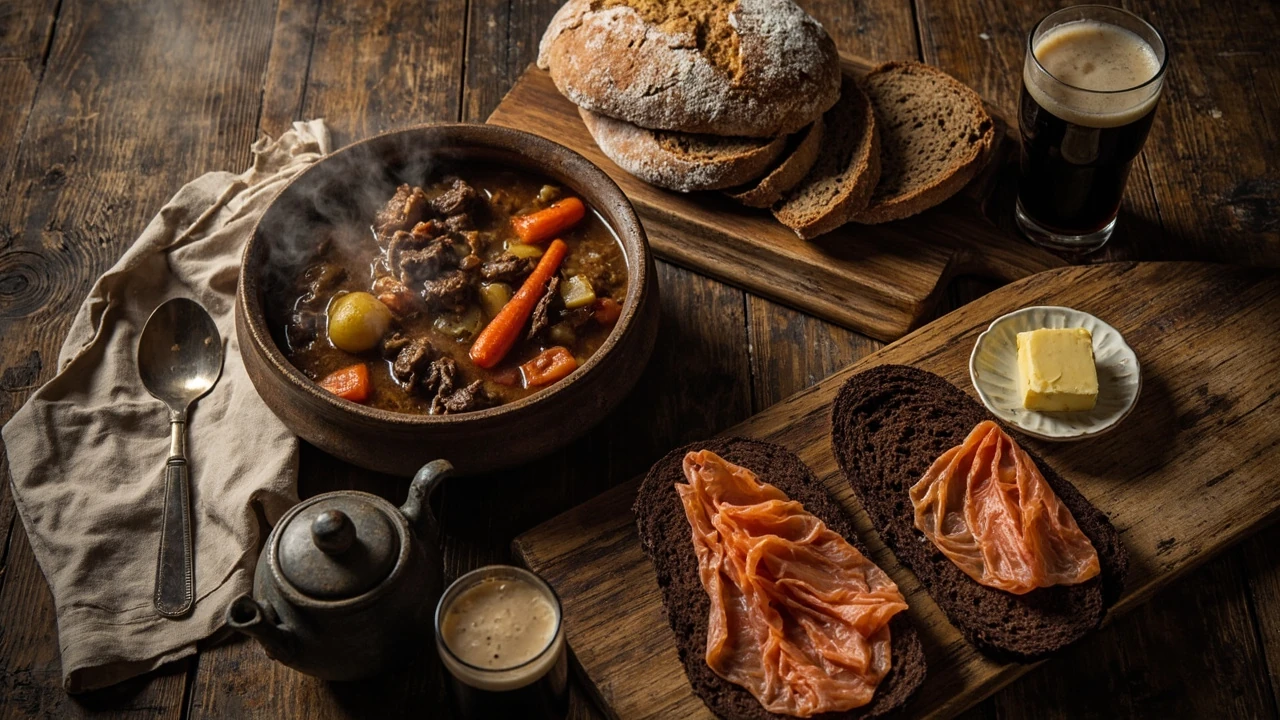
A plate of brown soda bread next to a bowl of lamb stew, with a pot of tea poured and a glass of stout waiting, is one of the most recognizable food scenes in Northern Europe. Irish food is shaped by a wet climate, a long coastline, an island-sized pasture system, and a history in which ordinary households had to stretch ingredients across lean months. The result is a cuisine that rewards cooks who care about technique, timing, and the quality of a few core ingredients rather than a long list of techniques.
This guide works through what Irish food actually is, the ingredients and methods that define it, the regional differences that matter, and how to plan a menu, photograph a dish, or price a plate so the food reads as Irish rather than as a vague idea of “comfort food.” If you are running a pub, a restaurant, a catering brand, or simply cooking at home, the framework below is meant to be useful on a Tuesday, not just on St. Patrick’s Day.
Irish food: what the term actually covers
Irish food is the everyday cooking of the island of Ireland, developed from what the land, sea, and trade routes could reliably provide. It is not a single tradition but a cluster of regional patterns, with a strong backbone of dairy, grain, root vegetables, and preserved or smoked fish. Modern Irish cooking keeps that backbone but adds influences from French technique, Italian pasta, and the cafe cultures of Dublin, Galway, and Cork.
When chefs and food writers use the term, they usually mean one of three things:
- Traditional Irish food: dishes that were common in Irish homes in the 19th and early 20th centuries, built around stews, boiled bacon, soda bread, and potatoes.
- Modern Irish food: the restaurant-led style since the late 1990s, which keeps Irish ingredients but uses contemporary technique, plating, and sourcing language.
- Irish pub food: a practical subset served in pubs and gastropubs, where the menu must work for a quick lunch, a family table, and a late evening drink.
Understanding which of these you are working with matters, because the rules of the table, the price points, and the way you photograph the dish all change.
Core ingredients that define Irish food
A small set of ingredients shows up in Irish recipes often enough that a cook who learns them well can improvise most of the rest. These are the building blocks used in everything from a Dublin coddle to a brown bread ice cream.
Dairy and butter
Ireland has some of the best pasture in Europe, and dairy is the single most important category in Irish cooking. Irish butter, particularly the cultured, lightly salted style, has a higher fat content and a tangier finish than standard European butter. That flavor carries soda bread, champ, and any number of savory sauces.
Buttermilk is the second pillar. It is used in scones, in soda bread, in pancakes, and in marinades for chicken. Most of the recipes that read as Irish rely on the gentle acidity of buttermilk rather than on heavy seasoning.
Potatoes, cabbage, and root vegetables
Potatoes anchor the table, but they are not interchangeable. Floury potatoes like Rooster and Maris Piper break down into stew; waxy potatoes like Charlotte hold their shape in a salad. The same recipe can feel completely different depending on which type you choose.
Cabbage, kale, leeks, carrots, turnips, and onions appear in nearly every savory dish. The classic combination of potato and cabbage, mashed together with butter and scallions, is called champ and is one of the simplest markers of Irish home cooking.
Bread, oats, and grains
Brown soda bread, made with whole wheat flour, buttermilk, baking soda, and salt, is the most iconic bread in Irish food. It is quick, requires no yeast, and depends on the reaction between acidic buttermilk and alkaline baking soda for its rise.
Oats appear as porridge at breakfast, as a topping on fruit crumbles, and in some savory dishes. The cool, damp climate is well suited to oats, and they remain a low-cost, high-quality ingredient for menus that need a breakfast option beyond eggs.
Meat, fish, and seafood
Lamb, beef, pork, and chicken are the most common meats. Bacon, particularly the back bacon style, is used in breakfasts, in coddle, and as a flavor base for soups. Pork features in sausages and in puddings.
For seafood, smoked salmon from the west coast, oysters from Galway and Cork harbors, Dublin Bay prawns, mussels, and Atlantic cod are the most recognizable products. Freshness, rather than technique, is the main selling point.
Cooking methods and techniques
Irish food relies on a small set of techniques applied patiently. The most common are slow braising, gentle simmering, baking, and smoking or curing. The goal is usually depth of flavor without heavy spicing.
| Technique | Typical dishes | What it contributes |
|---|---|---|
| Slow braise | Irish stew, lamb shank, beef and Guinness | Tender meat, thick glossy sauce, deep savory flavor |
| Simmer in stock or milk | Coddle, fish chowder, chicken and parsley sauce | Soft texture, gentle flavor, comfort-food character |
| Bake in a Dutch oven or pot | Soda bread, brown bread, bread and butter pudding | Even crumb, deep crust, no yeast required for bread |
| Smoke or cure | Smoked salmon, bacon, air-dried ham | Concentrated flavor, longer shelf life, plate contrast |
| Pan-fry on a griddle | Boxty, farls, bacon and cabbage | Crisp edges, simple plating, fast service |
| Whisk dairy into sauces | Champ, parsley sauce, colcannon | Smooth texture, buttery finish, restaurant-quality feel |
Most of these techniques are forgiving, which is part of why Irish food works well in casual kitchens. A stew that simmers for two hours is hard to ruin, and a soda bread dough that is slightly sticky will still bake into a good loaf.
Classic dishes and how to recognize them
You can identify Irish food on a plate by a short list of signature dishes. Each one has variations, but the structure stays the same.
Irish stew
Irish stew is a slow-braised dish of lamb or mutton, potatoes, onions, carrots, and parsley in a light stock. The meat is cooked until it falls apart, the potatoes partly dissolve into the liquid to thicken it, and the dish is served in a deep bowl with bread on the side. A properly made stew should taste of meat, root vegetables, and thyme, with no need for heavy spice.
Dublin coddle
Coddle is a Dublin working-class dish of sliced pork sausages, back bacon, potatoes, and onions simmered together in a covered pot with a little stock. It is one of the simplest and most identifiable Irish food dishes, and it is a good option for a pub menu because the ingredient cost is low and the cooking is hands-off.
Boxty
Boxty is a traditional potato pancake made from a mix of grated raw potato and mashed cooked potato, bound with flour and buttermilk, then pan-fried. It is often served with smoked salmon, sour cream, or as a side for breakfast. Boxty is useful on a menu because it reads as distinctly Irish and can be plated as a starter or a main.
Colcannon and champ
Colcannon is mashed potato mixed with cooked kale or cabbage and butter. Champ is mashed potato mixed with chopped scallions, milk, and butter, served with a well of melted butter in the center. Both belong in a list of Irish food because they are simple to make and signal the cuisine clearly.
Soda bread and scones
Soda bread is so central to Irish food that a meal without bread on the table is unusual. The bread is made with whole wheat or a mix of whole wheat and white flour, buttermilk, baking soda, salt, and sometimes a little butter or oats. The loaf is scored across the top and baked in a hot oven for about 40 minutes.
Regional differences across the island
Although the headline dishes are shared, Irish food changes as you move around the island. A menu that only draws on Dublin traditions will miss a lot.
| Region | Signature ingredients and dishes | What it adds to a menu |
|---|---|---|
| Dublin and the east | Coddle, breakfast rashers, dulse, seafood from the Irish Sea | Working-class comfort food and accessible fish dishes |
| West coast (Galway, Clare, Mayo) | Atlantic seafood, soda bread with seaweed, smoked salmon, oysters | Premium, terroir-led plates that lean on provenance |
| Southwest (Cork, Kerry) | Butter, tripe and drisheen, farmhouse cheese, lamb from the Ring of Kerry | Strong dairy, slow-cooked meats, distinctive breads |
| Midlands and inland counties | Stews, boiled bacon, root vegetables, oats | Honest, hearty, low-cost plates for pubs and casual service |
| Northern Ireland | Ulster fry, soda farls, potato bread, champ | Distinct breakfast culture and griddle cooking |
For a restaurant, picking a clear regional anchor is usually more useful than trying to cover the whole country. A Galway seafood menu and a Cork farmhouse menu will both read as Irish, but they will not look the same on the page.
Modern Irish food and how it developed
Until the 1990s, Irish food outside the home was often treated as a joke. Chefs who trained in France, the UK, and the US returned to Ireland and began to write menus that took the local ingredients seriously. Groups like Euro-Toques Ireland and producers like Sheridan Cheeses, Ballymaloe, and Gubbeen built a supply chain that restaurants could rely on. The result is the modern Irish food scene, where the same butcher who would have sold stew cuts 40 years ago now dry-ages beef and cures small batches of bacon for tasting menus.
If you are building a modern Irish food menu, the key moves are:
- Source as visibly as possible: name a farm, a county, a producer, or a boat.
- Keep at least one dish that uses a traditional Irish technique, even if the plating is modern.
- Use Irish dairy in places where other restaurants would use generic cream, including in desserts.
- Avoid novelty. Modern Irish food is not fusion; it is local ingredients with sharper technique.
For a deeper look at how modern restaurants frame their menus, the approach in Menu Engineering Without Killing the Soul of the Menu is a useful companion read.
Planning a menu built on Irish food
Whether you run a pub, a hotel restaurant, or a catering brand, an Irish-led menu needs the same structural decisions as any other: how many dishes, what margin, what photograph. The following framework works for most operations.
Pick a regional anchor
Choose one region of Ireland and build around it. A menu that tries to cover Dublin coddle, Galway oysters, and Cork tripe at once usually ends up feeling like a list rather than a point of view. A clear anchor also makes photography, signage, and copy easier to write.
Set the ratio of traditional to modern
A useful starting point for a casual Irish food menu is 60 percent traditional dishes, 40 percent modern. For a fine-dining setting, the reverse works better. The mix is more important than the absolute count: a menu that is 100 percent traditional will feel stuck, and a menu that is 100 percent modern will lose the Irish anchor.
Decide the breakfast story
Breakfast is where Irish food has the strongest cultural pull. The full Irish breakfast, the Ulster fry, and the more modern “healthy Irish” option of porridge, fruit, and soda toast all have customers. Pick one, and make sure the menu and the photograph agree on what you are offering. Mismatched breakfasts are one of the most common reasons an Irish menu reads as confused.
Price for the table, not for the dish
Irish food lends itself to generous portions, which is good for guest satisfaction but bad for margin if every plate is priced by the weight of meat. Build in a couple of higher-margin sides, including a butter, a relish, a soda bread plate, and a dessert that uses Irish cream or stout, to bring the check average up without raising the price of the main.
For a structured approach to that kind of pricing, the method in Menu pricing strategies that protect margin without losing guests is a useful reference.
Sourcing, suppliers, and provenance
Provenance is half the brand for Irish food. The story of a single farm, a single boat, or a single creamery is more persuasive than a list of generic claims. The practical question is how to source without making the operation unmanageable.
- Anchor with one named producer per category. Pick one butcher, one fishmonger, one creamery, one bakery. Build the menu around what they reliably supply.
- Track seasonality. Irish food is seasonal by default, and the calendar of oysters, wild salmon, lamb, and game is part of the story. A menu that quietly shifts with the season reads as more honest than a static one.
- Document the supply chain in plain language. “Sourced from the family farm in West Cork” is more useful than “locally sourced.” A short line on the menu is enough.
- Plan for substitution. Bad weather closes boats. Build two or three backup dishes that use the same technique but a different protein, so the menu does not collapse when one supplier falls short.
Photographing Irish food so it reads on the plate
Irish food photographs well when the lighting is warm, the props are matte, and the dish is shown with the bread, the butter, or the drink it is meant to be eaten with. The look is unfussy, slightly dark, and tactile. A bowl of stew on a dark board with a slice of brown bread and a glass of stout will sell Irish food better than a tightly cropped overhead shot on a white background.
For restaurants that need a workflow for getting those images without a full studio, the practical steps in Food photography that actually sells the dish cover the basics. The point is to give the menu a consistent visual language, not to win a food magazine award.
Irish food outside Ireland: what travels and what does not
Not every Irish dish survives a move abroad. Some depend on Irish dairy, Irish butter, or Irish sea conditions that are hard to replicate. Others translate cleanly.
| Dish or ingredient | Travels well | Notes for menus outside Ireland |
|---|---|---|
| Soda bread | Yes | Use a local cultured buttermilk; the rise depends on real acidity |
| Champ and colcannon | Yes | Irish-style butter makes a measurable difference |
| Stews and coddle | Yes | Slow cook times are forgiving, ingredients are widely available |
| Boxty | Yes | Works as a brunch item outside Ireland |
| Smoked salmon | Yes | Source from Ireland if the story is part of the menu, otherwise use a quality local cure |
| Fresh oysters | Harder | Depends on local water quality and a trusted supplier |
| Drisheen and tripe | No | Cultural expectation and supply chain are difficult to reproduce |
| Soda farls and potato farls | Yes | Useful for an Ulster-style breakfast outside Ireland |
The dishes that travel are the ones built on technique rather than on a single ingredient. A stew can be made anywhere with patience. A plate of fresh Galway oysters cannot be faked convincingly.
Common mistakes when building an Irish food menu
Most problems with Irish food in restaurants come from a small set of recurring mistakes. These are the ones worth guarding against.
- Going all green. Green food coloring, green plates, and green signs are a fast way to make a serious menu look like a souvenir shop. The food itself is the point.
- Sticking only to St. Patrick’s Day dishes. Corned beef and cabbage is more associated with Irish-American cooking than with Irish food in Ireland, and leaning on it makes a menu feel thin.
- Undercooking the bread. Soda bread that is pale, dense, or underbaked will sink the rest of the plate. It is the simplest item on the menu and the easiest to over-promise.
- Overpricing the stew. Stew is a working-class dish. Charging restaurant prices for a bowl of stew with no clear differentiator is a hard sell.
- Ignoring the breakfast trade. A hotel or cafe that markets Irish food without a proper breakfast option leaves the strongest part of the story on the table.
- Writing generic provenance. “Locally sourced” is not a story. A name, a county, or a producer is.
A practical checklist for a new Irish food menu
Use the list below to test whether a menu is ready to print. It covers the decisions that most often get skipped.
- Pick one regional anchor and write it down.
- Choose the ratio of traditional to modern dishes for the venue.
- Confirm breakfast, lunch, and dinner each have at least one signature Irish dish.
- Decide the bread program: soda bread daily, or a rotation of two breads.
- Name the producers for meat, fish, and dairy on the menu or on a side card.
- Photograph every dish in the same style and lighting setup.
- Test each stew and slow-cook dish at service speed, not just in development.
- Check the price mix: at least one premium dish, one mid-range, and one low-cost high-margin plate.
- Plan a seasonal refresh: which dishes change in spring, summer, autumn, and winter.
- Train the floor team on the provenance story so they can answer the obvious questions.
Where to start if you only have a small menu
If you are a small operation with a tight menu, three Irish food dishes will do most of the work. A bowl of stew with brown bread, a piece of fish with champ, and a soda bread plate at the start of the meal will signal the cuisine clearly without crowding the menu. From there, add a fourth dish that is local to your region, and a fifth that reflects your own cooking style, and the menu has both an anchor and a personality.
For more on building a small, distinctive menu, the approach in From Scratch: Why Specificity Wins Food Marketing is worth reading alongside this guide.
Frequently asked questions
What is traditional Irish food?
Traditional Irish food is the everyday cooking that developed in Irish homes over the last two centuries, built on dairy, oats, potatoes, root vegetables, preserved fish, and slow-cooked meats. The best-known traditional dishes are Irish stew, coddle, soda bread, colcannon, champ, and boxty.
Is Irish food the same as British food?
No. Irish food shares some ingredients with British food, but the cooking tradition is distinct. Irish food leans more on dairy, on soda bread rather than yeast bread, on oats, and on the flavor of lamb and mutton rather than beef, and the regional dishes such as coddle and boxty are not common in British cooking.
What makes a dish Irish rather than just “comfort food”?
A dish reads as Irish when it uses at least one of the signature ingredients, including Irish-style butter, buttermilk, oats, soda bread, lamb, smoked salmon, or champ-style mashed potato, and applies a traditional technique such as slow braising, griddle cooking, or baking with baking soda rather than yeast.
What is the most famous Irish food?
Irish stew is the most internationally recognized Irish dish. Soda bread is the most recognized Irish food item, and the full Irish breakfast is the most recognized Irish food occasion.
Is soda bread difficult to make?
No. Soda bread is one of the simplest breads in any European tradition. It uses no yeast, no proving time, and only a few ingredients. The most common mistake is overmixing the dough, which makes the loaf dense.
Can Irish food be healthy?
Yes. Many Irish dishes, including fish chowder, champ, grilled salmon with brown bread, and oat-based breakfasts, are built on whole grains, fish, vegetables, and dairy. As with any cuisine, the choices made in the kitchen determine how healthy the plate is.
What is the difference between colcannon and champ?
Colcannon is mashed potato mixed with cooked cabbage or kale and butter. Champ is mashed potato mixed with chopped scallions, milk, and butter, often served with a well of melted butter in the center. Both belong in Irish food and are common side dishes.
What drinks pair with Irish food?
Stout, dry Irish cider, and a traditional Irish breakfast tea are the most common pairings. A simple, dry white wine works with fish dishes, and a light red such as a Beaujolais works with stews. For a non-alcoholic option, a small glass of apple juice or a strong black tea matches the table.
What is modern Irish food?
Modern Irish food is a restaurant-led style that started in the 1990s. It keeps Irish ingredients but uses contemporary technique, lighter sauces, sharper sourcing, and clearer plating. It is the style most likely to be found in food-led restaurants in Dublin, Galway, Cork, and Belfast.
Where can I learn more about Irish food in a restaurant context?
Beyond this guide, the journal at David’s World Famous covers how to turn a small set of signature dishes into a working content and marketing system, including How to Turn One Signature Product Into a Month of Content, which is useful for any restaurant leaning into a specific cuisine.