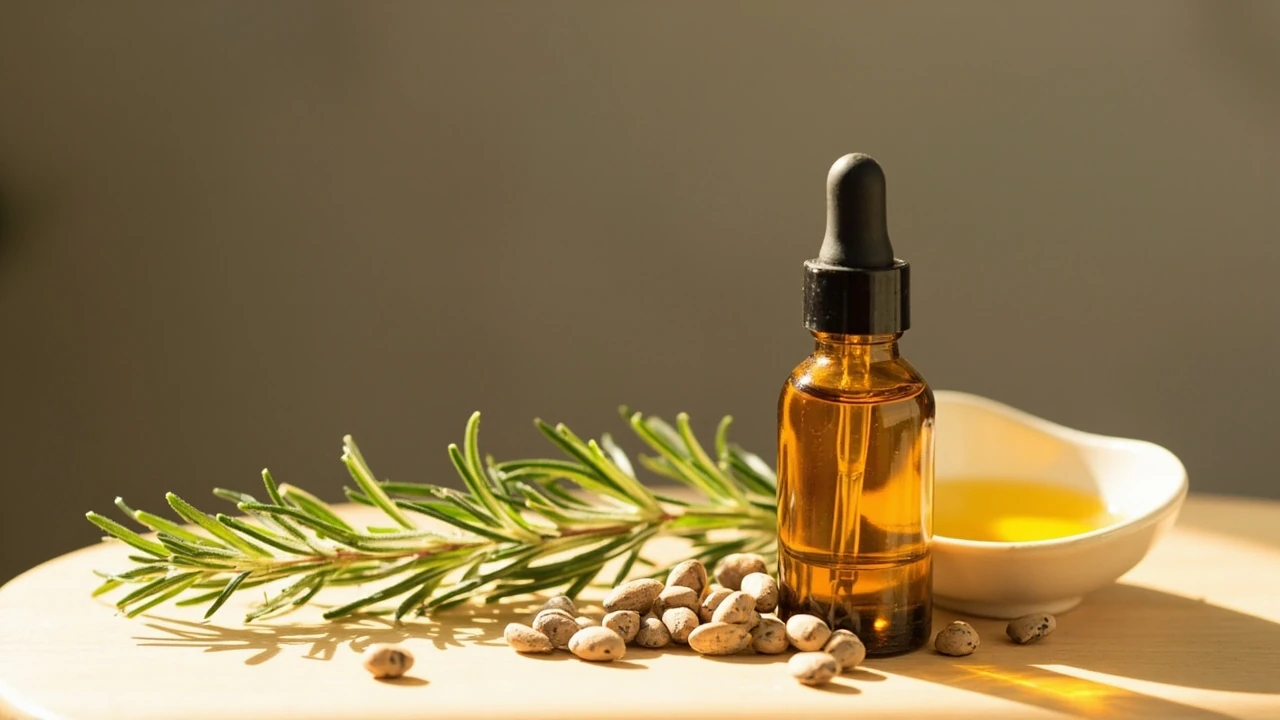
Hair growth oil: what it actually does for the scalp and strand
A hair growth oil is a leave-on or pre-wash treatment built around carrier oils, plant extracts, and sometimes essential oils that are massaged into the scalp or smoothed along the hair shaft. The honest version of the promise is narrow: a well-formulated hair growth oil can support a healthier scalp environment, reduce breakage, and protect lengths from mechanical damage, which together make new growth more visible as it emerges. It will not reactivate dead follicles, override a medical cause of shedding, or replace a treatment plan for conditions such as androgenetic alopecia, alopecia areata, or scarring alopecia. Those limits matter because they tell you what to expect and what to escalate to a clinician.
Most readers searching for a hair growth oil are dealing with one of three situations: slow perceived length gain because breakage is canceling out new growth, seasonal or stress-related shedding that has changed the part line or temples, or a scalp that feels dry, tight, or inflamed and seems to be holding hair back. Each situation calls for a slightly different approach, and a single bottle rarely solves all three. The rest of this article walks through the mechanisms, the ingredients that have some evidence behind them, the application techniques that actually matter, the trade-offs between popular formulas, and the safety checks worth running before you commit to a routine.
How hair growth actually works, and where an oil fits in
Hair grows from follicles in cycles: anagen (active growth), catagen (transition), and telogen (rest and release). On a healthy scalp, roughly 80 to 90 percent of follicles sit in anagen at any given time, and the average growth rate is about 0.3 to 0.5 millimeters per day, or roughly half an inch per month, depending on age, genetics, hormones, and nutrition. The follicle’s job is to produce a new shaft. The oil you apply cannot change the follicle’s intrinsic growth rate, but it can influence the conditions that allow the cycle to run smoothly.
Three levers matter most:
- Scalp environment. A dry, inflamed, or microbially imbalanced scalp can shorten anagen and push more follicles into telogen. Oils that reduce friction, support the skin barrier, and lower surface inflammation can keep the local environment calmer.
- Breakage and mechanical loss. Strands that snap at the mid-shaft or at the ends look like slow growth because the visible length never accumulates. Oils that seal the cuticle and reduce friction at the point of contact with combs, pillowcases, and hats directly improve apparent length retention.
- Blood flow and cellular activity around the follicle. Massage and certain active ingredients (notably peppermint and rosemary oil in some studies) appear to increase microcirculation in the scalp, which supports the metabolic demand of anagen.
Put together, a hair growth oil is best understood as a supporting player. It maintains the surface the follicle lives in, it protects the shaft as it exits the scalp, and it can help deliver ingredients that target local inflammation or circulation. It does not replace systemic factors: iron, ferritin, vitamin D, protein intake, thyroid function, and hormonal balance all set the ceiling. A useful test, after eight to twelve weeks of consistent use, is whether you see shorter new fibers at the part line and less hair collecting on the brush. That is a real signal; a marketing claim is not.
Ingredients that have some evidence behind them
The phrase “hair growth oil” covers a wide range of formulas, and the ingredients inside determine whether the product is a light styling aid, a scalp conditioning treatment, or something closer to a topical active. The table below summarizes the ingredients that show up most often and what the current evidence actually supports. Where studies exist, the strength of the evidence is noted; where evidence is mostly traditional or anecdotal, that is flagged as well.
| Ingredient | Role in a hair growth oil | What the evidence says | Cautions |
|---|---|---|---|
| Rosemary essential oil (in a carrier) | Antioxidant, possible 5-alpha reductase inhibition, scalp circulation | A 2015 randomized trial compared rosemary oil to 2% minoxidil over six months and found similar increases in hair count, with less reported itching. Evidence is promising but limited in scale. | Must be diluted; neat essential oil can irritate the scalp. |
| Peppermint essential oil (in a carrier) | Cooling, vasodilation, increased microcirculation | Animal studies show faster anagen re-entry and thicker follicles versus placebo and minoxidil; human data is still sparse. | Dilute carefully; peppermint is a known dermal irritant at higher concentrations. |
| Castor oil (Ricinus communis) | Heavy emollient, occlusive, ricinoleic acid content | Strong tradition of use for lashes, brows, and scalp. Limited controlled trials for scalp hair growth specifically. | Very thick; can weigh hair down and is hard to wash out of fine or low-porosity hair. |
| Coconut oil (Cocos nucifera) | Penetrates the hair shaft, reduces protein loss, emollient | Compared to mineral oil and sunflower oil in studies, coconut oil uniquely reduced protein loss from damaged hair. Strong for breakage reduction, indirect for growth. | Can feel heavy on fine hair; comedogenic for some skin types around the hairline. |
| Jojoba oil | Closely mimics human sebum, balances oiliness, lightweight | Limited specific growth trials, but well tolerated and useful as a carrier for heavier oils and actives. | Few; one of the safer carrier options for most scalps. |
| Argan oil | Rich in oleic and linoleic acid, vitamin E, lightweight finish | Strong evidence for conditioning, shine, and friction reduction; less direct evidence for growth stimulation. | Rare allergic reactions, especially in those with nut sensitivities. |
| Black seed oil (Nigella sativa) | Anti-inflammatory, thymoquinone content | Small human studies have explored oral use for telogen effluvium; topical data is thinner. | Topical concentrations above 5% can sting on compromised skin. |
| Biotin (in oil, as a topical) | Co-factor for keratin production | Topical biotin is poorly absorbed and unlikely to help unless there is a documented deficiency. | Supplements can interfere with lab tests; do not start high-dose biotin without a clinician’s review. |
| Caffeine (topical) | Stimulates follicle cells in vitro, may extend anagen | Lab and small clinical studies show some benefit; the effect size in real-world use is modest. | Drying if formulated with high alcohol content. |
Two points stand out from the table. First, the ingredients with the strongest signals for actually affecting the follicle are essential oils that must be diluted, which means a well-made hair growth oil is mostly carrier oil with a measured dose of active. Second, several ingredients that are heavily marketed, including biotin in oil and very heavy butters, are doing useful but different work, mostly protecting the shaft rather than stimulating the follicle. Both kinds of work are valuable, but they are not interchangeable, and good labels make the role clear. For broader context, the oil overview provides a concise reference for this section.
Common formula styles and what each is good for
Walk down the hair care aisle and you will see a hair growth oil marketed in roughly five styles. Each one has a real use case, and matching the style to your hair type and concern is a faster path to results than chasing the strongest-sounding ingredient list.
| Formula style | Texture and feel | Best suited for | Less suited for |
|---|---|---|---|
| Light single-carrier oil (jojoba, argan, grapeseed) | Thin, fast-absorbing, no residue | Fine hair, oily scalp, daily use, summer humidity | Severe dry scalp that needs occlusion |
| Heavy oil blend (castor, olive, coconut-dominant) | Thick, glossy, slow to absorb | Coily, thick, or very dry hair; protective styles; pre-shampoo treatment | Fine, low-porosity, or easily weighed-down hair |
| Herbal-infused oil (carrier oil infused with herbs, then strained) | Medium, often with a visible color tint | Scalp conditioning routines, traditional Ayurvedic or Caribbean-style regimens | Anyone sensitive to botanical allergens in the specific herb used |
| Active serum with oil carrier (caffeine, peptides, or minoxidil in an oil base) | Light to medium, often with a dropper | Targeted scalp application where an active ingredient is the priority | Those who want a pure, fragrance-free conditioning oil |
| Oil-in-cream or oil-butter (anhydrous balm) | Soft solid at room temperature, melts on contact | Sealing ends, very dry lengths, protective styles | Scalp application for oily or acne-prone skin |
For readers who are new to scalp oils, the simplest rule is to start light. A jojoba or argan-based hair growth oil applied sparingly to the scalp two to three times a week tells you how your skin reacts without leaving you looking like you skipped a wash day. You can graduate to heavier blends or herbal infusions once you know how your scalp tolerates the formula and how your hair responds to the finish.
How to apply a hair growth oil so it actually does something
The single biggest variable you control is the application technique. A hair growth oil that sits on top of dry hair without reaching the scalp is, at best, a styling product. A few minutes of method make the same bottle meaningfully more useful.
- Start on a schedule that matches your wash day or the day after. Applying to a clean, slightly damp scalp reduces friction and helps the oil spread. For most people, twice a week is a useful starting rhythm.
- Use a dropper or pipette to part the hair in sections. Target the part line, the temples, the crown, and the area just behind the ears. These are the spots where shedding shows up first.
- Massage with the pads of the fingers, not the nails. Use small, slow circles for three to five minutes total. The goal is gentle pressure that moves the scalp tissue, not aggressive rubbing.
- Leave it on for at least thirty minutes, ideally overnight. Overnight application under a silk or satin cap gives the oil time to soften sebum and let active ingredients sit on the skin.
- Wash out with a gentle, sulfate-light shampoo, possibly two rounds. Heavy oils need a proper cleanse to avoid buildup, which itself can suffocate the scalp.
- Track what you see in a simple way. A phone photo of the part line, taken in the same light every four weeks, is a more honest measure than memory.
If you are short on time, even a thirty-minute pre-wash application is worth doing. If you are seeing new short fibers along the part line after eight to twelve weeks, the routine is doing its job. If the part line looks the same or wider, escalate: see a dermatologist, get ferritin and vitamin D checked, and reassess the formula.
Real reasons hair seems to stop growing, and how an oil addresses each one
The phrase “my hair is not growing” usually means one of three things is happening, and each has a different solution. Naming the right one matters because the same hair growth oil cannot fix all three.
- Breakage is canceling out growth. The strand is producing fiber, but the fiber snaps before length shows. Heat styling, rough towel drying, tight elastics, and bleached or relaxed hair all raise breakage risk. Oils that seal the cuticle, particularly coconut and argan, reduce this loss. From Scratch: Why Specificity Wins Food Marketing uses the same idea in a different field: specifics outperform vague generalities, and the same is true of a hair routine.
- More follicles are in telogen than usual. Stress, illness, postpartum changes, low iron, low vitamin D, and some medications shift the cycle. An oil cannot reverse telogen on its own, but a calmer, less inflamed scalp supports anagen when the follicle re-enters it. Address the underlying cause with a clinician at the same time.
- Androgenetic thinning is underway. Follicles are physically shrinking, and no cosmetic oil can reverse that. The honest move here is to talk to a dermatologist about evidence-based options such as minoxidil, low-level laser therapy, or prescription treatments, and use a hair growth oil as a complement, not a substitute.
Mixing the three together is common. Someone with postpartum shedding on top of a winter-dry scalp on top of mid-shaft breakage from heat tools needs a routine that addresses all three, not a single bottle that promises to do it all. Readers can also consult the scientists validate more herbs for hair for an independent source related to this section.
Choosing a hair growth oil without getting fooled by the label
The marketing around hair growth oil can be loud. A few practical checks separate useful formulas from expensive fragrance. None of these are insider tricks; they are just things a careful buyer can do in two minutes.
- Read the ingredients in descending order. The first five ingredients make up the bulk of the bottle. If a heavy oil is at the top, the formula is heavy; if jojoba is on top, the formula is light. Marketing claims on the front of the bottle do not change this.
- Look for the dilution ratio of any essential oils. A hair growth oil with peppermint or rosemary listed at position 15 of 18 is doing very little. Listed in the first five, with a known carrier, it is doing real work.
- Check the carrier oil for your hair type. Jojoba and argan are forgiving for most people. Coconut is excellent for damaged, high-porosity hair and less ideal for fine, low-porosity hair. Castor is an end-sealer more than a scalp oil for many users.
- Watch the fragrance list. A strongly fragranced hair growth oil applied to the scalp twice a week is a recipe for contact dermatitis in some users. Fragrance-free or lightly scented formulas are safer for sensitive scalps.
- Ignore the before-and-after photos unless they are independently verified. Lighting, parting, and styling change the appearance of density more than any oil can in a short time. Independent trials and clinician-supervised photography are the only kind worth weighting heavily.
- Price is not a proxy for efficacy. A simple, well-formulated hair growth oil in a plain bottle can outperform a luxury version with the same active at a fraction of the cost.
Two more practical notes. First, the best time to buy a hair growth oil is the same time you start a hair-friendly routine elsewhere, including a silk pillowcase, a wide-tooth comb, and a gentler wash schedule. A bottle alone rarely moves the needle. Second, give any new formula eight to twelve weeks before judging it, because the follicle cycle runs on a longer clock than the marketing implies.
Safety, side effects, and when to see a professional
Most carrier oils are well tolerated, but scalp skin is sensitive, and concentrated essential oils are not interchangeable with carrier oils. The safety profile of a hair growth oil depends almost entirely on what is in it and how it is used.
- Patch test first. Apply a small amount behind the ear or to the inner forearm, leave it for 24 hours, and watch for redness, itching, or swelling. This matters most if you have a history of eczema, psoriasis, or contact allergies.
- Dilute essential oils properly. A standard dilution for scalp application is around 1 to 3 percent essential oil in a carrier, which works out to roughly 6 to 18 drops of essential oil per fluid ounce of carrier. Higher concentrations increase irritation without adding measurable benefit.
- Avoid the eye area. Oils and especially peppermint and tea tree can cause serious eye irritation. Wash hands after application and keep the bottle away from children.
- Skip essential oils during pregnancy and on young children unless a clinician has cleared the specific oil and dilution. Some oils commonly used in hair growth formulas, including rosemary and clary sage, have specific guidance in pregnancy.
- Treat a sudden increase in shedding, bald patches, painful scalp, or scalp sores as a medical issue, not a product issue. A hair growth oil is the wrong tool for alopecia areata, lichen planopilaris, severe telogen effluvium, or scarring hair loss. A dermatologist can confirm the cause and start a treatment plan.
The wider point is that a hair growth oil is a support, not a treatment. When used that way, the risks are low and the upside is real. When used to delay a clinical evaluation of a real condition, the cost is lost time, because some hair loss conditions are easier to address early.
What a realistic routine looks like for three common situations
Rather than abstract advice, here are three concrete routines built around a hair growth oil for the situations described earlier. They are starting points, not rules; the right schedule is the one you can keep up with.
| Situation | Weekly routine | Products to combine | Expected signal at 12 weeks |
|---|---|---|---|
| Breakage-dominant, length seems stuck | Twice-weekly pre-wash oil on scalp and ends; gentle sulfate-light wash; satin pillowcase | Light oil (jojoba or argan) on scalp, heavier sealer on ends (coconut or argan) | Less hair on the brush, ends feel softer, more visible length retention |
| Stress or seasonal shedding | Twice-weekly scalp massage with diluted rosemary or peppermint in jojoba; daily gentle scalp stimulation with fingertips | Herbal-infused or essential-oil-forward formula, plus a balanced diet and a ferritin check | New short fibers along the part line, less shedding in the shower |
| Dry, tight, easily inflamed scalp | Once-weekly oil treatment, three times a week hydrating toner on non-oil days, gentle wash | Jojoba or squalane-based hair growth oil, fragrance-free, low active load | Scalp feels less tight, less flaking, less itching between wash days |
The routines share three habits: a measured, twice-weekly application rhythm, a focus on the scalp rather than just the lengths, and a wash step that fully removes the oil. They also share one constraint: results show up on a hair-cycle clock, not a marketing clock, and the first checkpoint should be set at around twelve weeks.
Frequently asked questions
How long does it take for hair growth oil to show results?
Most users need at least eight to twelve weeks of consistent, twice-weekly use to see a real change, because the hair cycle is slower than the marketing suggests. The first honest signal is usually less shedding on wash days, followed by shorter new fibers at the part line.
Can hair growth oil help with bald spots?
It depends on the cause. A small bald patch that is shiny and smooth may be alopecia areata, which needs a clinician. A widening part or thinning at the crown may be androgenetic, where a hair growth oil is a support, not a treatment. Either way, a dermatologist should evaluate the spot before you commit to an oil routine.
Is it safe to leave hair growth oil on overnight?
Yes, for most well-formulated products applied to a non-irritated scalp, overnight use under a satin or silk cap is a useful way to extend contact time. Avoid overnight use if the formula contains a high concentration of essential oils or alcohol, which can irritate the skin over a long exposure.
Which oil is best for faster hair growth?
No single oil has been proven to grow hair faster in a large, independent trial. Rosemary oil in a carrier has the strongest current evidence for affecting the follicle directly, while coconut and argan are the best-supported choices for reducing breakage, which makes growth more visible.
Can I use hair growth oil on a sensitive or eczema-prone scalp?
Yes, with care. Choose a fragrance-free, low-essential-oil formula built around jojoba or squalane, patch test behind the ear for 24 hours, and avoid the product during a flare. If stinging or redness appears, stop and switch to a simpler carrier.
Does hair growth oil work for men and women differently?
The mechanics of a hair growth oil do not depend on gender, but the most common underlying cause of perceived slow growth does. Women more often face shedding related to iron, postpartum changes, and thyroid function, while men more often face androgenetic thinning at the crown and temples. The oil can help in both cases, but the supporting routine and the medical workup will look different.
Should I apply hair growth oil to wet or dry hair?
For scalp application, slightly damp hair is usually best because the oil spreads more evenly and absorbs with less friction. For ends and lengths, dry or barely damp hair is fine, especially if you are sealing in moisture after a leave-in conditioner.
Can I mix hair growth oil with minoxidil or other treatments?
Apply oils at a different time of day from minoxidil or other prescription topicals, because oils can affect absorption. A common pattern is minoxidil in the morning and a hair growth oil as a pre-wash scalp treatment in the evening. Confirm the timing with the prescribing clinician, especially if you are using tretinoin, topical steroids, or peptide-based actives.
How do I know if a hair growth oil is actually working?
Take a part-line photo in the same light every four weeks and compare it to the baseline. Track shedding by counting the hair collected on a wash day, using the same brush and the same number of strokes. After twelve weeks, the photo and the count tell a more reliable story than the mirror.
Are expensive hair growth oils worth the price?
Not necessarily. Price often reflects packaging, fragrance, and brand positioning rather than the dose of the active ingredient. A simple formula with a well-known carrier and a clear dilution of an evidence-backed essential oil can be a better buy than a luxury bottle with the same ingredients at three times the cost.
A practical way to start this week
If you have read this far, the clearest next step is a small one. Pick a lightweight, fragrance-free hair growth oil with jojoba or argan as the main carrier and a measured dose of either rosemary or peppermint essential oil. Patch test it tonight, apply it to a clean, slightly damp scalp twice this week using the section-and-massage method, and leave it on under a satin cap for at least thirty minutes before washing. Take a part-line photo in the same light you will use in four weeks. Reassess at twelve weeks with the photo, the wash-day count, and a quick check of how your scalp feels. If the part line is improving and shedding has dropped, keep the routine. If nothing has changed, the bottleneck is somewhere else, and a clinician is the next right call. Restaurant branding: how to build an identity guests remember covers a very different subject, but the same principle applies: a clear, consistent routine that you can actually maintain beats a flashy one that you abandon in three weeks.