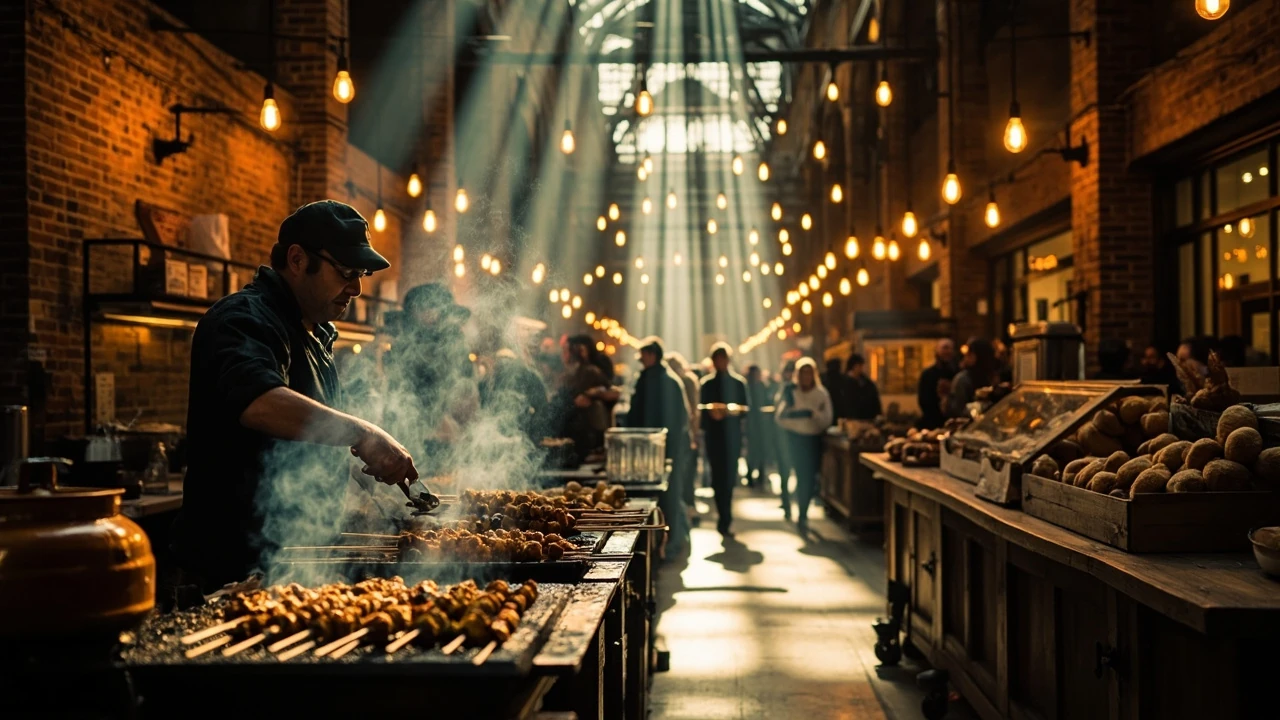
Food bazaar: how to plan, run, and grow one that actually sells
A line of thirty people at 11:40 a.m. is a good problem for a food bazaar. An empty hall at the same hour is a problem that compounds. The difference is rarely the food itself; it is the mix of vendors, the layout, the price points, and the small operational details that decide whether visitors linger, share photos, and come back the following weekend. This guide walks through how a food bazaar actually gets built, from the first vendor shortlist to the Sunday-night reconciliation, and where the common money leaks sit.
Most new organizers treat a food bazaar like a farmer’s market with more grease. The format is closer to a temporary food hall: visitors expect seating, lighting, and a sense of discovery, not just produce crates. Treating it that way changes the vendor brief, the layout, the marketing copy, and the budget. The rest of this article breaks those decisions into the parts an organizer can act on, with examples drawn from working bazaars rather than aspirational ones.
What a food bazaar really is, and what it is not
A food bazaar is a multi-vendor event built around prepared and semi-prepared food, with shared seating, a single entry, and a clear end time. A farmer’s market leans on raw ingredients, weekly regulars, and quick transactions. A food hall is permanent infrastructure with leases. A food bazaar borrows the energy of both and compresses it into a day, a weekend, or a week.
Because the format borrows from both, it inherits both sets of risks. You need the vendor curation of a market, because one weak stall drains foot traffic from everyone nearby. You also need the visitor experience of a hall, because guests will leave within ninety minutes if the room feels chaotic or the seating is wrong. The list below shows where organizers usually misread the format.
- Treating it as a market that happens to serve hot food. Hot food needs power, ventilation, hoods, and grease handling that a produce market never thinks about.
- Charging per linear foot without setting a minimum product mix. Vendors can fill a booth with low-effort items that drag the average ticket down.
- Skipping the seating plan. A bazaar without a place to sit becomes a takeout window with extra steps.
- Marketing as a single event instead of a recurring series. The economics usually only work from week three or four onward.
- Ignoring the local noise, fire, and street closure rules until the week of the event.
Reading the term on its own, food bazaar traces to the Persian bazâr, a covered market, and the modern sense keeps that idea of a covered, multi-vendor space where prepared food is the headline. Wikipedia’s Bazaar entry sketches the long history, including the role of permanent food markets across the Middle East, South Asia, and the Mediterranean.
The four jobs a food bazaar has to do well
Every working bazaar quietly performs four jobs at once. If any one of them fails, the whole event feels off even if the food is excellent.
| Job | What it means in practice | Failure signal |
|---|---|---|
| Curate the mix | Balance cuisines, price points, and dietary needs so visitors feel there is something for them without duplication. | Three stalls selling nearly the same grilled meat; long lines, low average spend per visitor. |
| Move the crowd | Plan the entrance, the flow, the seating, and the visible anchor stall so visitors keep moving and discovering. | Bottlenecks at one stall, dead zones in the back, empty seating near the bar. |
| Hold the line on quality | Set tasting standards, temperature rules, and a re-stock plan for the busiest two hours. | Long waits, cold food, vendors selling out by 1 p.m. with nothing to fall back on. |
| Make the math work | Cover rent, staffing, insurance, power, and marketing with a per-visitor target that vendors can actually hit. | Strong opening, organizer losses money, vendors quietly do not return. |
The order matters. Most failed bazaars tried to fix math first and never fixed the crowd. Visitors drive vendor revenue, and vendor revenue covers the rent. If you only have time to obsess over one number, obsess over visitors per hour per vendor.
Choosing the format: single day, weekend, or recurring series
The right format depends on the city, the season, and the venue you can actually book. Each has a different cost shape, a different vendor pitch, and a different marketing calendar.
| Format | Best fit | Main costs | Risk to plan for |
|---|---|---|---|
| One-day pop-up | New market, untested vendor list, or a single festival slot. | Short venue rental, one-day staffing, light marketing. | Weather, low awareness, no chance to learn from week one. |
| Weekend run (Fri–Sun or Sat–Sun) | Tourist traffic, holiday weekends, or a venue that needs a short activation. | Three-day staffing, two days of marketing, longer insurance. | Vendor fatigue on day three if the layout is hard to reset. |
| Recurring weekly series | Established food cities, neighborhoods with a built-in regular crowd. | Recurring rent, longer insurance, paid social cadence, a small ops team. | Cannibalizing local restaurants if the price points sit too low. |
| Seasonal residency (4–8 weeks) | Tourist season, a vacant retail space, or a partnership with a city district. | Longer lease, deeper build-out, heavier permitting. | Burnout from a fixed location once novelty wears off. |
For a first event, a one-day pop-up is the cheapest teacher you can hire. The goal is not profit; the goal is to learn what your local audience actually orders when given a choice. If the pop-up’s average ticket per visitor is north of the city’s casual-dining average, a recurring series is worth testing. If it sits below, the vendor mix or the price ceiling is the problem, not the format.
Vetting and recruiting vendors that pull their weight
A bazaar is only as strong as the worst vendor. A bad stall does not just lose its own sales; it sours the room. The vendor list needs to be built with the same care a restaurant group uses when opening a new location. Two things help most: a written vendor brief, and a tasting session before the event.
The vendor brief, in plain language
A short one-page brief prevents most arguments. Cover the dates, the load-in window, the power available, the equipment the vendor must bring, the portion sizes, the price ceiling, the waste plan, and the insurance certificate the vendor has to provide. Mention photography rules, social handles, and the cut the organizer takes, if any. Keep it readable. Vendors are busy, and a dense contract signals that future disagreements will be dense too.
What to taste for
Tastings catch problems that résumés hide. The questions to ask in a tasting are practical: does the dish travel well across a counter, does it hold for fifteen minutes under a heat lamp, and does the price match the portion? A great dish that collapses on a paper tray is the wrong dish for a bazaar. A modest dish that holds, photographs well, and tastes better than it looks is often the right one.
- Taste at the actual price the vendor will charge. Tasting menus are not the test; full portions are.
- Watch the plating speed. A dish that takes four minutes per order will cap the vendor at fifteen covers an hour.
- Ask what the vendor will do when the first ingredient runs out. The honest answer is a better sign than any menu.
- Check the allergen and dietary story. A vendor who can name the swaps for gluten, dairy, and pork without blinking will save you on event day.
Vendor recruitment is also where the event’s identity gets set. A bazaar built on mom-and-pop stalls will attract a different crowd than one built on chef-driven pop-ups. Neither is wrong, but mixing the two without a plan confuses visitors. Pick a lane for the first season, then broaden in the second.
Layout and capacity: getting the room to breathe
Most first-time organizers pack too many stalls into the room. The instinct is to fill the floor, because empty space looks like failure on a render. In practice, visitors move through space that has a clear front, a clear back, and a reason to walk the length of the hall. Crowding the floor blocks that walk and pushes people to the perimeter.
A simple capacity rule
For a seated, indoor bazaar, a workable starting point is one stall per 250 to 350 square feet of usable floor, including the seating footprint. Outdoor events with circulation-only layouts can run tighter, but indoor events pay for that density with lines, heat, and noise. The number is a starting point, not a rule. A heavy-drinks bazaar can run more stalls because guests spend longer at tables. A grab-and-go bazaar should run fewer, because guests never sit down and the floor needs wider lanes.
Anchor, perimeter, and rotation
Every good bazaar has an anchor: a stall or feature that draws the eye from the entrance. It can be a grill, a bar, a dessert counter, or a photo wall, but it has to be visible from the door. The anchor sets the tone. The perimeter holds the queue-heavy stalls, especially the bar and the main grill. The middle of the room is for seating, for browsing, and for the rotation stalls that change week to week. When the anchor is in the back of the room, queues form across the entrance and the event feels blocked from the moment a guest walks in.
| Zone | What belongs there | Why it works |
|---|---|---|
| Anchor | Open-flame grill, signature bar, dessert stage, or photo feature. | Visible from the entrance, draws the eye inward, sets the sensory tone. |
| Perimeter | Heavy-queue stalls, bar, takeaway, ticketing, lost and found. | Keeps queues off the main aisle and away from seating. |
| Middle | Seating, communal tables, low-queue browsing stalls, rotating vendors. | Slows visitors down, increases dwell time, raises the average ticket. |
| Back | Family-friendly or dessert stalls, quieter seating, sponsor activations. | Pulls the crowd past the anchor and the strongest-spending stalls first. |
Pricing, tickets, and how visitors actually pay
A food bazaar can run on three payment models, and the choice shapes both the crowd and the vendor relationship. Most events blend at least two.
- Free entry, vendors pay a stall fee. Works when the venue already draws traffic, because visitors expect to pay market prices for food and the organizer is selling access.
- Ticketed entry with a small food-credit bundle. Works when the vendor mix is high-end and the organizer wants to control the price ceiling. The bundle pulls cash out of the front of the room and lets the organizer pay vendors on a clean reconciliation.
- Cover charge with a drink minimum. Works for evening events, especially those with a bar program, but it requires a stronger security and ID plan.
Whatever the model, the price ceiling is the most important number to set. If the ceiling is too high, visitors compare the bazaar to a casual restaurant and walk away when the total hits twenty-five dollars. If the ceiling is too low, vendors cannot make the math work and stop returning. For most mid-size U.S. cities, a working ceiling in 2026 sits between fourteen and twenty-two dollars for a main dish, with smaller dishes between six and ten. Local catering association data and the National Restaurant Association’s consumer trends research give a useful benchmark, but the real test is whether the bazaar’s average ticket beats the city’s casual-dining average for the same time slot.
Cash, card, and the closed-loop question
Decide before the event whether the bazaar will be card-only, cash-friendly, or closed-loop with a token system. Card-only is the simplest for reconciliation and the cleanest for vendors, but it cuts out a slice of visitors and slows lines when networks wobble. Closed-loop tokens feel slick and lift average spend slightly, but they add staffing at the top-up counter and create a settlement headache at the end of the night. For a first event, card-only is usually the right call.
Marketing that fills the room without burning the budget
Food bazaars live or die on the last seven days of marketing, not the last seven weeks. The plan needs a press hook, a creator plan, a paid social plan, and a neighborhood plan. Each pulls a slightly different visitor.
The press hook
Local press rarely covers a generic “food event.” They cover a list, a first, or a story. The hook is the reason a journalist can write the headline in five minutes. Examples that work: a first-of-its-kind cuisine for the city, a charity tie-in with a specific dollar target, a heritage-month activation, or a chef collab that has never happened in public before. Without a hook, the press email goes nowhere.
The creator plan
Food creators are the most cost-efficient channel for a food bazaar. A single local creator with 20,000 engaged followers can fill a Saturday afternoon if the visit is well-timed and the food is genuinely good. The trick is to invite a small group rather than one big name, and to give each creator a specific window so the room never feels like a press shoot. Pay in food and credit, and follow up with usable photos the same day.
The neighborhood plan
Foot traffic from the surrounding three to five blocks is the most underused channel. Flyers in nearby cafes, a chalkboard on the sidewalk, a small discount for anyone who shows a receipt from a neighboring business, and a partnership with the closest hotel front desk can fill the slow hours between lunch and dinner. None of it is glamorous. All of it converts.
- Press hook written as a one-line headline before the venue is booked.
- Three to five local creators invited with a 48-hour RSVP window.
- Neighborhood flyer drop the Tuesday before the event.
- Paid social budget focused on the last 72 hours, not the last three weeks.
- A reminder email or text the morning of the event, with a map and the entry rule.
Operations: the hours that decide whether the day is fun or a fire
The visible part of a food bazaar is the food. The invisible part is the operations: load-in, power, water, waste, and the small crises that pop up between noon and four. Most organizer stress comes from a missing operations plan, not from a marketing problem. The list below covers the day-of items that most often get missed.
- Power: confirm amps per stall, where the panels are, and who carries spare breakers. A single tripped breaker at 1 p.m. can take out four stalls.
- Water: food stalls need a fill plan and a grey-water plan. Buckets under prep tables are not a plan.
- Waste: separate bins for compost, recycling, and landfill, with a hauling schedule, not a single dumpster at the back.
- Allergen signage: a single printed sheet at the entrance listing the dietary story for each stall. Visitors ask, and the answer is on the wall.
- Quiet room or shaded area: even a small one signals that the event is set up for real life, not a stock photo.
- First aid and weather: a stocked first aid kit, a lightning plan for outdoor events, and a heat plan for summer days. Local public health guidance is the right place to start; the CDC heat and health pages give a useful baseline for hot-day operations.
The single biggest operational mistake is treating load-in as a single window. It rarely is. Late vendors, missed deliveries, and last-minute equipment swaps will happen. A two-wave load-in, with the heavy stalls in the first wave and the small stalls in the second, absorbs the chaos. So does a printed run sheet taped to the wall backstage.
Money: the per-visitor math that decides the season
The most useful number for a food bazaar is cost per visitor. It bundles rent, staffing, insurance, marketing, and power into a single figure the organizer can compare against the average ticket. When the average ticket covers cost per visitor with margin, the season is worth running. When it does not, the next event is a fundraising problem dressed as a hospitality problem.
| Line item | One-day pop-up | Weekend run | Recurring weekly |
|---|---|---|---|
| Venue rental | Often the largest single cost; can be waived for a cut of vendor fees. | Two to three days at a negotiated rate; check minimum spend clauses. | Monthly lease or weekly rate; ask for a trial month before signing. |
| Insurance | Single-day event policy, usually modest. | Three-day policy plus liquor liability if alcohol is served. | Annual general liability plus liquor liability, with a per-event rider. |
| Staffing | Small ops team plus contracted security. | Rotating ops plus dedicated bar back and a load-out crew. | Core staff with weekend rehires; plan for turnover in month two. |
| Power and water | Generator plus water tanks if the venue cannot support stalls. | On-site power with metered usage; negotiate the meter in advance. | Connected power, metered, with a cap-and-bill clause to avoid surprise bills. |
| Marketing | Print, local press, and a paid social burst in the final 72 hours. | Longer paid window plus a creator program. | Recurring social calendar, an email list, and a press rhythm. |
Vendor revenue share is the cleanest part of the math, but it has to be set early. Two common models: a flat stall fee plus a small percentage of vendor sales, or a flat fee with no percentage. The first model rewards the organizer for driving traffic and rewards the vendor for high sales. The second is simpler to administer and easier to communicate in the vendor brief. Both work. Mixing them across the same event usually creates friction.
Permits, insurance, and the part nobody wants to read
A food bazaar touches health, fire, alcohol, and street use rules. The exact rules depend on the city and the venue. A few items are common enough to plan for in any market.
- Health department sign-off for any stall handling open food, especially with hot holding or sampling.
- Fire marshal review of any open flame, fryer, or salamander; some cities require a permit per stall.
- Liquor license for any paid bar; a beer-and-wine license is faster and cheaper than a full one in most states.
- Street closure or sidewalk permit for any outdoor flow that crosses a public right-of-way.
- General liability insurance with the venue named as additional insured; expect a certificate request within 48 hours of any signed contract.
None of this is interesting, and all of it will end the event if missed. The right move is to ask the venue what they have already filed and to copy their packet for the first event. The second event is when the organizer can start customizing.
Brand, signage, and the part visitors actually photograph
Food bazaars are visual businesses. The signage, the menus, and the small props are what visitors photograph and share. The work does not have to be expensive, but it has to be intentional. A few rules of thumb help.
- One typeface across the entire event, used in two sizes. Anything more reads as chaos.
- Menu boards above eye level, with prices visible from the queue. Visitors decide in the line, not at the counter.
- Names that travel. Stall names should be readable on a phone photo and searchable on a map app. If the name is a private joke, change it.
- Lighting that flatters food. Warm, directional light at the counter beats overhead fluorescents every time. Vendors who care about presentation will work with it; vendors who do not will look worse, and the contrast helps the rest of the room.
This is also the place where the bazaar’s identity lives. The signage, the music, the staff T-shirts, and the way the event is described online are the brand. A small investment here pays back in shareable photos, which pay back in lower paid-social costs.
After the event: what to capture and what to change
The week after a food bazaar is when the next event is won or lost. Three things should happen in that week: a vendor debrief, a visitor survey, and a financial reconciliation. The vendor debrief is best as a short call, not a form. A ten-minute call catches the small frustrations that never make it into text. The visitor survey should be one question on a single screen, sent the morning after the event. The financial reconciliation is the part that decides whether the next event is on the calendar at all.
| Debrief item | What to capture | How it changes the next event |
|---|---|---|
| Vendor sales and queue times | Top sellers, slowest sellers, peak hour per stall. | Re-balance the mix, adjust stall placement, swap the slowest vendor out for a rotation slot. |
| Visitor survey | One question: how likely are you to come back, on a 0 to 10 scale, plus a single open text field. | A score below 7 means the price, the wait, or the variety is the problem. Read the open field before guessing. |
| Financial reconciliation | Total sales, cost per visitor, vendor share, organizer share, marketing cost, staff cost. | Sets the date and the budget for the next event, and the price ceiling for the next vendor brief. |
| Operational notes | Power trips, water issues, late vendors, weather, and any safety incidents. | Feeds the run sheet for the next event. The format matters less than the habit. |
The honest version of this work is unglamorous. It is also the difference between a one-off event and a series that lasts four seasons. Treat the post-event week as part of the event, not as cleanup after it, and the next event will be cheaper to run and easier to fill.
Common mistakes, in order of how often they happen
Most failed food bazaars fail in the same handful of ways. Listing them in order helps because the order is also the order to fix them.
- Wrong vendor mix. Too many stalls selling near-identical dishes, or too few covering basic dietary needs. Fix with a written brief and a tasting session.
- Underestimating the load-in. Vendors arriving to a room without power, water, or a working line. Fix with a printed run sheet and a two-wave load-in.
- Pricing the visitor out. A main dish above the city’s casual-dining ceiling pushes the average ticket into “restaurant” territory. Fix with a written price ceiling in the vendor brief.
- Skipping the seating plan. Visitors will not stay, and the average ticket collapses. Fix with a layout that puts seating in the middle of the room.
- Treating the first event like a business. It is a paid experiment. The second event is when the math has to work.
The fifth item is the one most organizers miss. The first event is the most expensive lesson in the series. The second is where the real business starts, because the vendor list is vetted, the layout is tested, the marketing list is warm, and the operations run sheet has been through one full cycle.
A short checklist for the week of the event
- Venue contract signed, insurance certificate filed, health and fire sign-off in writing.
- Vendor brief sent, signed, and returned with insurance certificates.
- Run sheet printed, load-in windows confirmed, power map posted backstage.
- Marketing calendar running: press hits, creator visits, neighborhood flyers, paid social burst.
- Reconciliation plan ready for the Sunday after: vendor sales, cost per visitor, attendee survey, debrief calls.
Print the checklist. Tape it to the wall. Use it twice. After the second event, the checklist will be longer and more specific, because the second event always teaches something the first one did not.
Frequently asked questions
How is a food bazaar different from a food hall or a farmer’s market?
A food bazaar is a temporary, multi-vendor event built around prepared food, with shared seating and a defined run of days. A food hall is permanent infrastructure with leases. A farmer’s market leans on raw ingredients, growers, and quick transactions. A food bazaar borrows the energy of both, which is why it needs the curation of a market and the visitor experience of a hall.
How many vendors should a first food bazaar have?
For an indoor venue with seating, a workable starting point is one stall per 250 to 350 square feet of usable floor. That usually lands between ten and eighteen stalls for a mid-size hall. Fewer stalls can work if each one is strong; more stalls start to compete for the same customers.
What price range should a food bazaar target?
For most mid-size U.S. cities in 2026, mains between fourteen and twenty-two dollars and smaller dishes between six and ten dollars keep the average ticket above the casual-dining average. The right ceiling for a specific market depends on the city’s median income, the venue’s rent, and the vendor mix.
Do I need a liquor license to run a food bazaar?
Yes, if you are selling alcohol. A beer-and-wine license is faster and cheaper than a full license in most states, and many cities will issue a one-day permit for a single weekend event. Plan on liquor liability insurance regardless of the license type.
How do I keep the average ticket high without raising prices?
Build a layout that slows visitors down. Anchor stalls, mid-room seating, and a clear path to the back of the room all raise dwell time, which raises the average ticket. A small, well-priced dessert or coffee stall near the exit is also a reliable add-on sale.
What is the biggest avoidable cost for a new food bazaar?
Underused marketing in the final seventy-two hours. A focused paid social burst, a creator visit, and a neighborhood flyer drop in the last three days do more than three weeks of generic posting. The reverse is also true: a long, unfocused marketing window burns cash without filling the room.
How do I pick a date for a food bazaar?
Avoid the first weekend of the month, when many households are paying rent and recovering from the previous month’s bills. Local market data from the city’s tourism board or a chamber of commerce will show the high-traffic weekends. Pair the date with a hook the press can use, and avoid dates that conflict with a major local sports or cultural event.
What insurance does a food bazaar need?
At minimum, general liability for the organizer, with the venue named as additional insured. Liquor liability is required for any paid bar. Each vendor should also carry their own policy and add the organizer and venue as additional insureds. The exact limits depend on the venue’s contract; one million dollars per occurrence is a common floor.
How do I keep the line moving at the busiest stalls?
Use a printed menu at the queue, a separate order taker and runner at the counter, and a small pre-made section for the most popular dish. Pre-payment at the order taker, when the format allows it, removes a meaningful share of the bottleneck. None of this requires new technology; it requires a written plan for the busiest two hours.
When does a food bazaar become a permanent food hall?
When the weekly event clears its cost per visitor with margin for at least eight consecutive weeks, the venue’s lease becomes negotiable for a longer term, and the vendor list is stable enough to support a permanent program. Until all three conditions hold, the weekly event is the cheaper and safer way to keep building the audience.