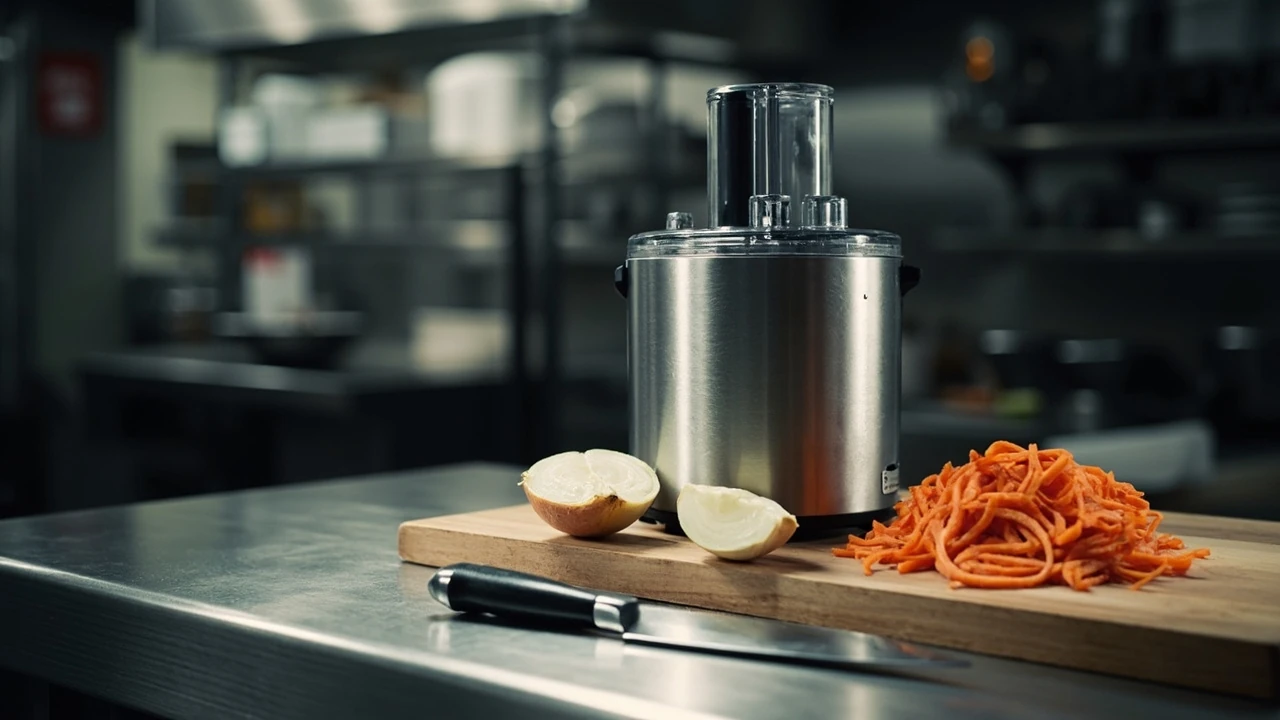
Cuisinart food processor: how to pick the right model for real kitchen work
A line cook chops three kilos of mirepoix before service. A recipe developer tests pesto until the basil loses its color. A food entrepreneur preps a salsa recipe sixty jars at a time. In every one of those kitchens, the same brand tends to come up: a Cuisinart food processor. It is the default machine a lot of serious cooks reach for, and for good reason, but the catalogue is wider than most buyers realize, and the wrong model will sit on a shelf for years before anyone admits it was the wrong call.
This guide is written for people who actually run a kitchen, not for someone decorating one. It focuses on how a Cuisinart food processor performs against real prep tasks, how to match the bowl size to the work, and how to avoid the most common buying mistakes. The goal is simple: by the end, you should know which model makes sense for your volume, your menu, and your tolerance for cleanup.
Why the Cuisinart food processor keeps showing up in professional kitchens
Cuisinart has been a recognizable name in small kitchen equipment since the 1970s, when the original food processor helped change how home cooks approached prep. The brand did not invent the appliance, but it pushed it into American kitchens in a way that few others managed, and it built a repair, parts, and attachment ecosystem that has held up for decades.
For a food business or a working test kitchen, that history matters. Replacement bowls, lids, and blades tend to stay in production for years, which means a Cuisinart food processor bought today can still be supported long after the warranty expires. That is one of the quiet reasons it ends up in restaurant back-of-house areas, in catering operations, and in culinary schools. Reliability and parts availability matter more than a slightly sleeker motor housing.
The other reason is the bowl size range. Cuisinart offers compact three-cup machines, mid-size eight and nine-cup workhorses, and full-size eleven, twelve, and fourteen-cup processors. That range covers most prep tasks a small food business actually runs into, from a single portion of tapenade to a large batch of dough.
The main Cuisinart food processor families, explained simply
Before comparing features, it helps to understand the rough shape of the line. Cuisinart organizes its food processors into a few recognizable families, and the differences between them are mostly about size, motor power, and the included accessories.
Custom and Core: the everyday mid-size workhorses
The Custom and Core lines are the heart of the brand. They typically run from about eight to fourteen cups and are designed for general prep, slicing, shredding, and dough. They are the models that show up most often in restaurant settings because the capacity and the price are both reasonable for the work expected of them.
Elemental and Prep: smaller bowls for side tasks
The smaller Elemental and Prep series machines sit in the three to seven-cup range. They are best for sauces, dressings, small batches of chopped vegetables, and quick tasks where pulling out a full-size machine is overkill. For a single cook or a small café, one of these plus a larger machine is often a smarter buy than two mid-size units. Readers who want more background can use the Food overview as a reference while reviewing this point.
Pro and Specialty: aimed at specific tasks
The Pro and specialty models focus on extra power, larger feed tubes, or features such as a continuous feed attachment. They are usually worth the extra cost when the kitchen actually runs those tasks every day, and overpriced when it does not.
Cuisinart food processor sizes compared
Bowl size is the single most important decision, because it determines what tasks feel easy and which feel like a fight. The table below gives a realistic view of how each size actually performs, not just what the box claims.
| Bowl size | Best for | Typical prep volume | Limits to expect |
|---|---|---|---|
| 3 to 4 cup | Dressings, small sauces, single-portion chopping | Up to about 300 g at a time | Too small for dough, slow for large vegetable batches |
| 7 to 9 cup | Family or small café prep, hummus, pesto, salsa | Up to about 1 kg of vegetables or dough | Feed tube may be narrow; slicing whole vegetables can require precutting |
| 11 to 12 cup | Restaurant prep, batch sauces, larger dough | Up to about 2 kg per load | Heavier on the counter, more parts to wash |
| 14 cup | Catering, recipe development, soup bases at scale | Up to about 2.5 to 3 kg per load | Bowl is tall; some shallow cabinets will not store it, motor draw is higher |
A practical rule is to buy the size that handles your largest realistic batch without overfilling, not the largest size on the spec sheet. A Cuisinart food processor that runs at 80 percent capacity lasts longer and chops more evenly than one that is always maxed out.
Real tasks and which Cuisinart food processor handles them best
Marketing copy rarely talks about the actual job, so it is worth thinking through the work first. The list below matches common kitchen tasks to the kind of Cuisinart food processor that handles them without frustration.
- Chopping onions, garlic, and aromatics in volume: an 11 or 12-cup bowl with a sharp metal chopping blade, working in pulses rather than continuous run.
- Salsa, pesto, and herb sauces: a 7 to 9-cup machine is usually enough, and a smaller bowl keeps the herbs from being thrown too far by the blade.
- Homemade nut butter: requires a powerful motor, often 600 watts or more, and patience. A 9-cup Cuisinart food processor is the minimum worth attempting.
- Shredding cabbage for slaw or sauerkraut: a wide feed tube and a quality shredding disc save serious time; smaller bowls require pre-cutting.
- Pie dough, tart dough, and pizza dough: needs a 9 to 14-cup machine with a metal dough blade, and ice-cold fat for a clean result.
- Emulsified dressings and mayonnaise: a smaller 3 to 4-cup machine is actually preferable because the blade sits closer to the side walls, which helps the emulsion form.
How motor power actually changes the work
Wattage is one of the most over-quoted numbers on a food processor box. A 600-watt motor and a 1000-watt motor can both chop an onion, but the larger motor is less likely to stall on hard cheese, dense root vegetables, or frozen dough. The risk is treating wattage as a proxy for quality. A well-engineered 500-watt machine can outperform a poorly cooled 1200-watt machine, especially for long prep sessions.
For a working kitchen, the relevant question is whether the motor can sustain its work without overheating. Two signs suggest a Cuisinart food processor is built for heavy use: a metal drive shaft rather than plastic, and a motor housing that feels substantial in the hand. Reviews from restaurant suppliers and from repair technicians are a better signal than the number on the box.
Blades, discs, and attachments that actually earn their storage space
The included accessories are where a lot of value is hidden or wasted. A Cuisinart food processor typically ships with a metal chopping blade, a dough blade, and one or two slicing or shredding discs. Whether those are enough depends on the menu. Another relevant reference is the processors in tried and tested by, which adds context without changing the practical guidance here.
| Attachment | Function | Worth keeping if |
|---|---|---|
| Metal chopping blade | Mincing, pureeing, emulsifying, making nut butter | Always; this is the core tool. |
| Dough blade | Pie, tart, and bread dough | You bake at least weekly with a Cuisinart food processor. |
| Slicing disc | Even slices of vegetables, fruit, and cheese | Your menu has slaws, gratins, or layered prep work. |
| Shredding disc | Cheese, cabbage, carrots | You prep cheese or cabbage often enough to justify the storage. |
| Whisk disc | Whipped cream, light batters | Only if your menu needs it; a hand whisk is often faster. |
| Continuous feed attachment | Long slicing sessions | You prep very high volumes of sliced vegetables. |
One detail that gets ignored is disc material. A Cuisinart food processor with a stainless steel disc tends to hold an edge longer and survive dishwashing better than a coated or plastic one. That detail is worth checking before buying, especially for kitchens that wash equipment in a commercial dishwasher.
Common buying mistakes with a Cuisinart food processor
Most regret about a food processor purchase comes from a small number of repeatable errors. The list below is not theoretical; it is what cooks and food business owners most often report after the fact.
- Buying the biggest bowl to future-proof. A 14-cup machine is awkward for a two-person prep, and the blade sits too far from small batches, so chopping quality drops.
- Choosing on wattage alone. A high-watt motor with a weak drive coupling is a common failure point. Build quality matters more than headline power.
- Ignoring the feed tube width. A narrow feed tube forces pre-cutting and slows prep more than the motor ever will.
- Underestimating the storage footprint. A 14-cup Cuisinart food processor with all discs needs a real cabinet. Measure before ordering.
- Skipping a check of the lid latch. A loose or wobbly lid is the most common complaint in long-term reviews, because it affects every single use.
- Assuming all blades are dishwasher safe. Some older or third-party blades are not, and hand-washing is the only safe path.
Care, cleaning, and parts that extend the life of a Cuisinart food processor
A Cuisinart food processor rewards a small amount of maintenance. The motor housing needs almost nothing; the bowl, lid, and blades are where the work happens, and that is where the wear shows up.
Wash the bowl and lid in warm soapy water soon after use. Tomato, turmeric, and beet-based mixtures can stain plastic bowls, so a quick rinse before the pigments set is worth the habit. Blades should be dried immediately, because they will spot or even rust depending on the model. For storage, lay the discs flat rather than stacked, which keeps the cutting edges from pressing into each other.
Replacement parts are part of the value. Cuisinart sells replacement bowls, lids, and blades directly, and many third-party suppliers carry compatible parts for older machines. That is the practical case for staying inside the brand: a Cuisinart food processor bought today is more likely to be serviceable in five years than many competitors, and that matters for a working kitchen on a budget.
When a Cuisinart food processor is not the right tool
Honest advice is more useful than enthusiasm, and there are a few situations where a different tool is the right answer. A stand mixer is better for very large or stiff doughs, an immersion blender is faster for soup and smooth sauces, and a dedicated mandoline produces cleaner slices than any disc. The Cuisinart food processor is at its best when one machine needs to handle many different prep tasks in a single service or recipe run. If the kitchen only does one or two of those tasks, a specialty tool will often be faster and produce better results.
Practical checklist before you buy
Before clicking order, run through this short list. It covers the questions that most often change the buying decision, and it only takes a few minutes.
- What is the heaviest single load you will actually process in one batch?
- Will the machine live on the counter, or does it need to fit in a specific cabinet?
- How many discs do you really need, and where will the rest live?
- Is there a dishwasher nearby, and are the parts rated for it?
- Are replacement bowls, lids, and blades available for the exact model you are considering?
- Does the lid latch feel solid, and is the bowl-to-base connection tight and centered?
Related reading on the site
Frequently asked questions
What is the most useful Cuisinart food processor size for a small food business?
For most small food businesses, an 11 or 12-cup Cuisinart food processor is the most useful size. It handles a kilogram or two of vegetables per load, fits a reasonable amount of dough, and still works for smaller batches. Larger 14-cup machines are great when volume justifies them, but they are clumsy for everyday work.
Can a Cuisinart food processor make dough for pizza or bread?
Yes, most 9 to 14-cup Cuisinart food processors can handle pizza, pie, and light bread dough using the metal dough blade. Use very cold butter or water, work in short pulses, and stop as soon as the dough comes together. Overworking dough in a food processor is the most common reason for tough results.
Is a Cuisinart food processor worth it compared to a cheaper brand?
For a working kitchen, the question is not whether a Cuisinart food processor is the cheapest option, but whether the replacement parts, the disc selection, and the long-term support make the total cost of ownership lower. In most cases, the answer is yes, especially if the machine will run several times a week.
What is the difference between a Cuisinart Custom and a Core food processor?
The Custom and Core lines are both mid- to large-size workhorses, and the differences tend to be in the motor, the included discs, and the control layout rather than in the core function. For most users, the choice comes down to which disc set is included and which one is on sale, because the bowls, lids, and many parts are interchangeable across the two lines.
How long does a Cuisinart food processor usually last?
With reasonable care, a Cuisinart food processor can last ten years or more in a home kitchen, and several years in a small commercial setting. The motor is usually the first part to fail, followed by the lid latch. Replacement bowls and blades are widely available, which means a working machine rarely has to be retired because of one broken part.
Can a Cuisinart food processor replace a blender?
Not for everything. A blender is better for very smooth liquids, frozen drinks, and large batches of smoothies, because the jar shape and blade geometry are designed for that work. A Cuisinart food processor is the better tool for chopping, slicing, shredding, dough, and chunky sauces. Many kitchens end up owning both, and that is a reasonable answer.
What should I do if my Cuisinart food processor leaks from the bowl?
Leaks from a Cuisinart food processor usually come from a misaligned lid, a worn seal, or an overloaded bowl. First, unload the bowl, dry the seal area, and reseat the lid. Then check the rubber gasket on the bowl for cracks or stretching. If the leak persists, a replacement bowl or gasket is usually cheaper than a new machine.
Are Cuisinart food processor parts interchangeable between models?
Some are, especially within the same family of bowl sizes, but not all. Bowls, lids, and discs are often interchangeable across similar models, while motor bases and drive shafts usually are not. The safest move is to match parts by part number rather than by appearance, and the Cuisinart customer service line can confirm compatibility before ordering.
Is a Cuisinart food processor loud enough to be a problem in a small kitchen?
All food processors make noise, and a Cuisinart food processor is no exception. The larger the motor and the harder the load, the louder it gets. Sound enclosure boxes and running the machine on a folded towel can help, but the practical answer is to use the machine in short pulses rather than continuous runs whenever possible.
Where can I find a repair technician for a Cuisinart food processor?
Independent small-appliance repair shops in most cities will service a Cuisinart food processor, and Cuisinart itself can sometimes authorize out-of-warranty repairs through its support channels. If the motor is burned out, replacing the machine is often more cost-effective than repairing it, but for a broken latch, a worn gasket, or a chipped gear, repair is usually the better option.