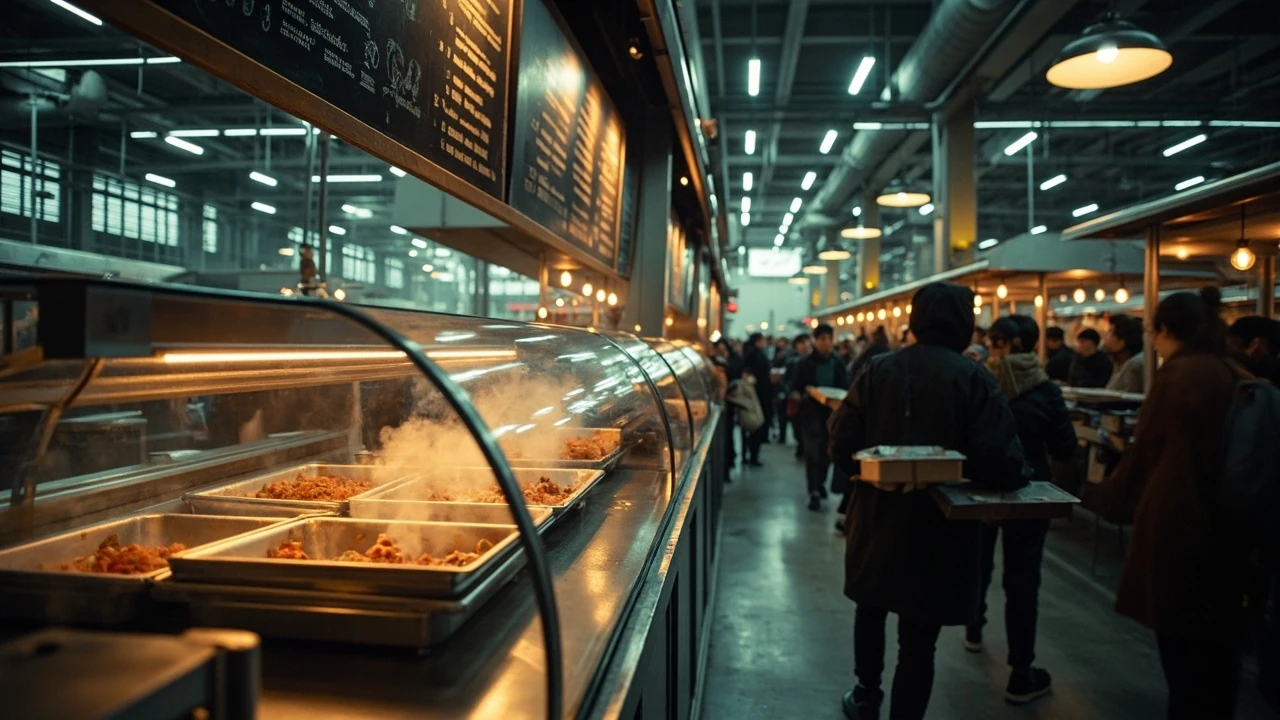
A walk through any Costco warehouse on a Saturday afternoon usually ends the same way: with a hot dog in one hand, a soft drink the size of a forearm in the other, and a tray balanced on the curb outside because every seat inside is taken. The Costco food court is not designed to be a destination restaurant. It is designed to feed a member who just pushed a flatbed through 27 aisles, and it is built with the same philosophy as the rotisserie chickens in aisle seven: high volume, low margin, and a price point that almost feels like a dare.
For restaurant operators and food business owners, the food court is one of the most studied case studies in the industry. It moves a staggering number of meals per day at prices that most operators would call unsustainable, and it does this without losing the parent company money on the food itself. Understanding how the Costco food court actually works, what is on the menu, why the pricing model is so aggressive, and where the operation makes its real money, is useful context for anyone running a high-volume, low-cost food program.
What the Costco food court is in 2026
The Costco food court is the in-warehouse quick service operation attached to most Costco Wholesale locations. Members can order a limited menu of hot food, pizza, salad, frozen yogurt, and drinks at a counter near the exit, eat at shared tables, or take food to go. The program is built around speed, throughput, and a small number of items that can be produced in very high volume with minimal labor.
As of 2026, the food court is still treated as a member benefit rather than a profit center. Costco has said publicly for years that the food court is not expected to be a major contributor to net income, and the company has long held a line on the price of its most famous item, the hot dog and soda combo, that has become part of the brand identity.
For restaurant operators, three things about the food court are worth understanding at the start:
- It is run as a volume operation with a deliberately tiny menu.
- It is anchored by an iconic price point that has not moved in decades.
- It exists partly as a reason to walk into the warehouse, not as a standalone food business.
Those three facts drive almost every decision inside the operation, from portion size to staffing to menu design.
The current Costco food court menu at a glance
Costco has trimmed and adjusted the food court menu several times in recent years, and the most commonly seen lineup in 2026 looks like this. Prices vary slightly by region and by currency, but the structure is consistent across the United States.
| Item | Typical US price | What it actually is |
|---|---|---|
| Hot dog and 20 oz soda combo | $1.50 | Quarter-pound all-beef hot dog, bun, free refills at the fountain |
| Cheese pizza slice | $1.99 | Large slice of 18 inch cheese pizza, reheated on a pan |
| Pepperoni pizza slice | $1.99 | Large slice of pepperoni pizza |
| Whole cheese pizza (take and bake or in-store) | $9.95 | 18 inch cheese pizza |
| Chicken bake | $3.99 | Stuffed bread with chicken, cheese, bacon, and Caesar dressing |
| Rotisserie chicken Caesar salad | $6.99 | Chopped romaine, rotisserie chicken, cheese, croutons, dressing |
| Turkey and provolone sandwich | $6.99 | Pre-made sandwich, often with tomato and Italian seasoning |
| Churro | $1.50 | Cinnamon sugar churro, often warmed |
| Chocolate or vanilla frozen yogurt with topping bar | $1.50 | Soft serve in a cup, self-serve toppings |
| 20 oz soda, lemonade, or frozen drink | $0.65 to $1.50 | Fountain drink, often with free refills in-store |
A few things stand out in the menu. The first is how short it is. Most food courts run 8 to 12 items, and several of those items use the same base components. The second is the price discipline. The food court has not chased premium pricing, and the company has actively resisted menu creep in the direction of higher-margin items.
For a restaurant operator, the takeaway is that a Costco food court menu is the opposite of a typical quick-service menu. It is built to be made quickly, shipped in bulk, and sold at a price that gets people into the building rather than to optimize the average ticket.
Why the $1.50 hot dog combo is the most studied price in foodservice
The hot dog and soda combo at $1.50 is the single most important product in the Costco food court. The price was set in the mid-1980s and has not changed. Former CEO Jim Sinegal and current leadership have both publicly stated that the price will not go up. The story has become a recurring business press anecdote, and it is worth understanding because the strategy behind it is more interesting than the price itself.
The hot dog combo is treated as a brand promise. If Costco raised the price, the company would gain a small amount of revenue per combo but would lose a much larger amount of goodwill, member trust, and press coverage. The combo is also a useful gateway product. Members who come in just to use the food court still walk past the rotisserie chicken display, the bakery, and the seasonal merchandise on the way in and out.
For a restaurant operator, the lesson is not that you should set a $1.50 price point. The lesson is that one anchor product on a menu can do a lot of work beyond its own margin, and that protecting the anchor is often more valuable than optimizing it.
How the Costco food court operation is actually built
The food court is built to do a small number of things at extreme volume. There are three pieces of the operation worth understanding: menu design, kitchen layout, and staffing.
Menu design as a labor and waste tool
Every item on the food court menu has been chosen because it can be produced in bulk, held for a known period, and sold quickly. The rotisserie chicken Caesar salad uses chicken that is already being roasted for the warehouse. The pizza is cooked in large pans and held in warming ovens. The churros are often produced off-site and reheated. The hot dog is boiled and held in a steam table for short periods.
None of the items require a skilled line cook to assemble at order time. The crew at the counter is mostly reheating, portioning, and finishing. That is a deliberate choice, and it is the reason the food court can run with fewer employees per dollar of food sold than a typical quick-service restaurant.
Kitchen and counter layout
The food court is usually placed near the exit of the warehouse, often between the main checkout and the door, so members pass it on the way out. The seating area is in a separate space, usually with a high ceiling and shared tables. The kitchen itself is set up as a production line rather than a finished-to-order station. Steam tables, warming ovens, and holding cabinets do most of the work.
The counter is usually a straight line with a glass sneeze guard, a register, and a topping bar. There is little customization at the counter, and order accuracy is high because the menu is small and the crew rotates through the same motions all day.
Staffing model
Most food courts run with a small crew, often between four and eight people per shift depending on volume. The roles are usually:
- One or two people at the register and drink station.
- One or two people on the assembly and finish line for hot food.
- One person managing the churro and frozen yogurt area.
- One person running restock, trash, and bussing in the seating area.
Labor cost as a percentage of sales at the food court is well below industry averages for quick service, in part because the menu is small and the equipment does most of the cooking.
The economics of the Costco food court
The food court does not generate a large profit in absolute terms relative to the rest of the Costco business. Costco makes far more money on memberships, on bulk grocery, and on non-food categories like tires, optical, and travel. The food court is, in many ways, a marketing expense disguised as a food operation.
That framing matters because it changes how the operation is judged. The food court is measured on member satisfaction, throughput, and the degree to which it drives incremental warehouse traffic, not on food cost percentage in the way a standalone restaurant would be.
Even so, the food court is not run at a loss. The menu items are priced to cover direct cost and a small contribution margin, and the rotisserie chicken program in particular is one of the most efficient poultry operations in the United States. According to Costco leadership, the rotisserie chickens are sold at a loss at the retail level, and the company offsets the loss by selling the legs, thighs, and remaining parts to its own food court and prepared food programs at internal transfer prices.
For an outside operator, the practical lesson is that an internal supply chain and a willingness to accept a lower margin on a flagship product can support a very efficient food program downstream.
What is new or changing in the Costco food court in 2026
Costco has continued to adjust the food court menu in recent years. A few patterns are worth noting for anyone tracking the operation.
First, there has been a slow shift toward better-for-you options. The rotisserie chicken Caesar salad and the turkey and provolone sandwich both reflect a wider company interest in fresh and protein-forward items. Costco has tested acai bowls, plant-based options, and other additions in specific regions, and some have rolled out more widely.
Second, the frozen yogurt program has changed. For years, the food court ran a self-serve frozen yogurt with a topping bar. In 2024 and 2025, Costco began removing the topping bar at some locations, citing food safety concerns, and several locations have experimented with pre-portioned toppings or no toppings at all. The $1.50 price point has remained, but the experience is slightly different than it was a few years ago.
Third, regional variation has increased. Some international locations, including Costco warehouses in the United Kingdom, Canada, Japan, and Mexico, run slightly different menus with local items like poutine, teriyaki chicken, and bulgogi bake. The US menu is the most standardized, but it is not identical across all states.
Fourth, mobile order and self-service kiosks have been tested in some larger US locations, although most food courts still run on a single register line and a human cashier.
How the Costco food court compares to a typical quick-service restaurant
Comparing the Costco food court to a typical quick-service restaurant is a useful exercise for operators. The differences go deeper than the menu.
| Factor | Costco food court | Typical quick-service restaurant |
|---|---|---|
| Number of menu items | 8 to 12 | 30 to 80 |
| Average ticket | About $3 to $7 | About $9 to $15 |
| Customization at the counter | Minimal | Significant |
| Cook-to-order vs. hold-and-serve | Largely hold-and-serve | Mixed, often cook-to-order |
| Seating model | Shared tables, no service | Booths, counters, full service |
| Payment model | Cash, card, and member-only access | Cash and card, open to the public |
| Primary goal | Member benefit and warehouse traffic | Unit-level profit and growth |
The cost structure of a food court is unusual in three ways. First, real estate and utilities are bundled into the warehouse lease and effectively zeroed out at the food court level. Second, ingredient sourcing is consolidated at a massive scale, often through the same suppliers that serve the warehouse. Third, advertising is essentially zero because the parent brand drives all the traffic.
A standalone quick-service restaurant has to pay for all three of those things. That is a large part of why the food court can run on such a small margin and still cover its direct costs.
What restaurant operators can actually learn from the Costco food court
There is a temptation to treat the Costco food court as a curiosity because the price points are so different from the rest of the industry. That is a mistake. Several of the operating principles translate well to other food businesses, especially high-volume, low-cost operations.
1. Protect a flagship price point
If you have one product that customers associate with your business, do not raise the price casually. The hot dog combo at $1.50 is a brand asset, not a margin problem. Many restaurants have one product like this, and protecting it is often worth more than the small revenue gain from increasing it.
2. Use a small menu as a labor strategy
A small menu is not just a marketing decision. It is a labor decision. Every item you remove from a menu is one fewer set of skills your line needs, one fewer prep task in the morning, and one fewer potential failure point during service. The food court is the extreme example of this, but the principle applies to any high-volume operator.
3. Treat the food program as a traffic driver
The food court is not expected to make a large standalone profit. It is expected to bring people into the warehouse and to leave them in a good mood. If you run a food business inside a larger ecosystem, like a hotel, a stadium, a campus, or a retail concept, the same logic applies. The food program can be measured on traffic and satisfaction, not only on food cost.
4. Use the supply chain as a margin tool
Costco sources at a scale that few operators can match, but the principle of integrating the supply chain is universal. If you can buy your protein and produce in a way that feeds both your retail and your food service, you will have a structural cost advantage that competitors will struggle to copy.
5. Design the space for throughput, not ambiance
The food court is a concrete floor with shared tables and fluorescent lights. It works because it is designed to move a lot of people through quickly, not to keep them there. For a quick-service operation, throughput per square foot matters more than the quality of the dining experience.
What the Costco food court does not do well
It is also worth being honest about where the Costco food court model does not work, because the limitations matter for anyone thinking about copying it.
- The food court depends on the warehouse. Standalone, the same menu and price points would not work.
- The seating area is functional but not comfortable, and the experience is not something a standalone restaurant could sell.
- Customization is limited, and customers with dietary restrictions, allergies, or strong preferences are poorly served.
- The menu is narrow enough that food fatigue is real, and the food court does not attract a destination crowd.
- The labor model is built around high-volume predictability, and it does not transfer well to a small, variable-volume operation.
For an outside operator, the takeaway is that the food court model only works inside a Costco warehouse. The principles can be borrowed, but the structure cannot be transplanted.
How the food court fits into Costco’s broader strategy
Costco’s business is built on three things: a paid membership model, a tightly curated assortment, and a relentless focus on value. The food court is a small but visible expression of all three. The membership model means the food court is not open to the public, which simplifies the operation. The tight assortment means the menu is small and the cost of adding new items is high. The focus on value means the prices are set below what the market would bear.
In a 2025 earnings context, the food court is best understood as part of the member experience. Members who use the food court rate their overall warehouse experience higher than members who do not, and the food court is one of the most visible and tactile signals of Costco’s pricing discipline. For a food business owner, the lesson is that the food program is part of a larger brand, and it should be designed to reinforce that brand rather than to optimize its own P and L.
Practical questions operators ask about the Costco food court
Over the years, restaurant operators and food business owners have asked a small set of recurring questions about how the food court actually works. The answers are useful to think through because they reveal the logic of the operation.
Does the Costco food court make a profit?
On a fully loaded basis, the food court is roughly break-even on a direct cost basis and contributes a small amount to overhead. On a standalone basis, the same operation at the same prices would lose money. The food court is profitable because the parent warehouse absorbs real estate, utilities, marketing, and most of the overhead.
How many meals does a Costco food court sell per day?
Volume varies sharply by location, day of the week, and season. High-volume warehouses can sell several thousand transactions per day at the food court, with the busiest days being weekends and the days before major holidays. The rotisserie chicken and the hot dog combo are by far the highest-volume items.
Why does the food court not offer delivery?
Costco has tested delivery from the food court in some markets, but the model is difficult to scale because the food is designed to be eaten quickly and the prices are below the level that would support delivery fees, packaging, and third-party platform costs. The food court is built around an in-person, in-warehouse experience.
Can non-members use the Costco food court?
In the United States, the food court is generally accessible to non-members, although some locations have tightened access in recent years. The food court is treated as a benefit for members but is not strictly enforced as a member-only space in every market.
Why did Costco remove the churro from some menus?
Costco has tested removing and adding back the churro in various regions as it adjusts the menu. The churro is a high-margin item, but the labor and equipment required to produce it at volume are significant, and the company has occasionally substituted other items to simplify the line.
What is the most underrated item on the menu?
Most regulars would say the chicken bake or the whole pizza. The chicken bake is filling, reheats well, and has a strong protein-to-cost ratio. The whole pizza is one of the best values per square inch of any pizza sold in the United States.
Frequently asked questions
What is on the Costco food court menu in 2026?
The standard menu includes a hot dog and soda combo, cheese and pepperoni pizza by the slice, a whole cheese pizza, a chicken bake, a rotisserie chicken Caesar salad, a turkey and provolone sandwich, a churro, and a soft-serve frozen yogurt, plus fountain drinks. Some regions have local items.
How much is the hot dog combo at Costco food court?
The hot dog and 20 oz soda combo is $1.50 in most US locations. The price has not changed since the mid-1980s and is treated as a brand promise by the company.
Does the Costco food court still serve a churro?
Most US locations still serve a churro, but availability varies. Costco has removed the churro at some locations and tested other items in its place, so the menu depends on the warehouse.
Can I order a whole pizza from the Costco food court?
Yes. Most locations sell a whole 18 inch cheese pizza for about $9.95, either ready to eat in the food court or as a take-and-bake option to finish at home. Pepperoni pizza is also available in some locations.
Is the Costco food court open to non-members?
In most US locations, the food court is open to non-members, although some warehouses have tightened access in recent years. The food court is treated as a member benefit but is not strictly enforced as a member-only space in every market.
Why is Costco food court food so cheap?
The food court is part of a larger warehouse operation, so it does not pay separately for real estate, utilities, marketing, or most overhead. The company has also chosen to keep prices low as a brand and member benefit, and treats the food court as a traffic driver rather than a profit center.
Does the Costco food court make money?
The food court covers its direct costs and contributes a small amount to overhead, but it is not a major profit driver for the company. The food court is designed to support the member experience and the warehouse traffic, not to be a standalone food business.
What happened to the frozen yogurt topping bar at Costco food court?
Costco has been removing the self-serve frozen yogurt topping bar at some locations due to food safety concerns. The $1.50 frozen yogurt is still available at most warehouses, but the topping bar has been reduced or removed at several sites.
Is the Costco food court the same in every state?
The US menu is largely standardized, but there is some regional variation, especially in areas near international borders. International locations in Canada, Mexico, the UK, Japan, and Korea run different menus with local items, and the prices vary by country and currency.
Can restaurant operators learn from the Costco food court?
Yes. The food court is a useful case study in menu simplification, labor efficiency, anchor product pricing, and integrating a food program with a larger business. The prices and the structure are not transferable, but the operating principles apply to many high-volume, low-cost food operations.
If you are designing a high-volume food program and want a working example of what a tightly run, low-margin operation looks like, the Costco food court is one of the cleanest case studies in the industry. Visit one, eat the hot dog, and then go look at your own menu with fresh eyes. The model is not for everyone, but the discipline is worth borrowing.