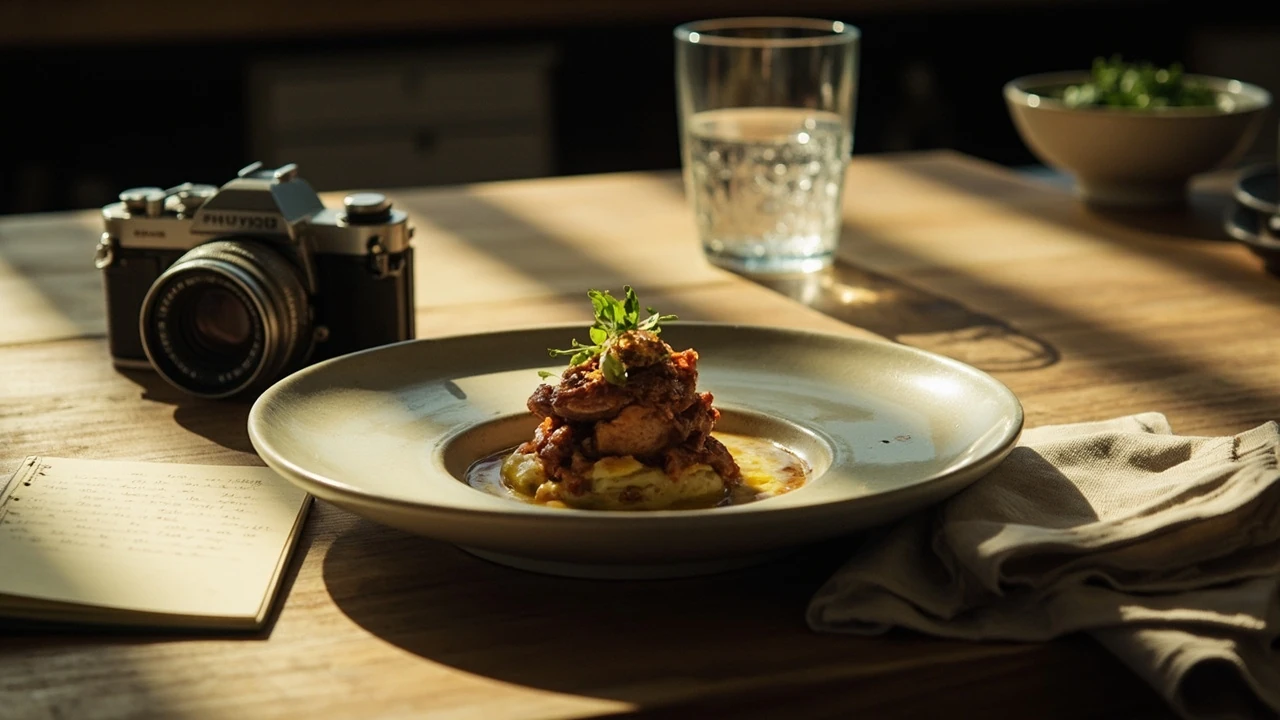
Two restaurants open on the same street with the same oven, the same produce supplier, and the same opening hour. Eighteen months later one has a line out the door and a small but loyal group of regulars who drive past three other places to sit at its bar. The other is still wondering why the food is good and the room is empty. The dish is rarely the difference. The difference is what the operator did with the word food long before a plate ever reached a guest.
This guide is a working definition of food marketing for restaurant owners, chefs, and small food brand founders. It is not a brand of campaigns, hashtags, or aesthetic advice. It is the set of decisions that turn a kitchen, a product, or a counter into a recognizable, repeatable business. We will move from the abstract question of what food marketing actually is, into the concrete mechanics operators can use this week, and end with the limitations every honest food operator has to live with.
Food marketing: the working definition operators can actually use
Food marketing is the disciplined work of making a specific food offer legible, credible, and worth a return visit. It is not photography, social media management, or the design of a logo. Those are channels. Food marketing is the upstream thinking that decides what a kitchen is for, who it is built for, and what a guest should remember after the second bite.
Three working components sit inside that definition, and they matter because each one changes the kind of work the marketing function has to do.
- Positioning is the reason a guest chooses one food business over another that is equally good. It is the answer to the question, “Why here, and not somewhere similar?”
- Story is the specific set of facts, choices, and people that makes the positioning feel true rather than advertised.
- Channel craft is the use of menus, signage, photography, social posts, and website content to carry that positioning and story to the people who are most likely to care.
Most food businesses that feel stuck have one of these three working, sometimes two, and almost never all three in alignment. A chef can have a beautiful, original menu, a real story about why the recipes are the way they are, and still feel invisible, because the menu and the story are not pointed at the same guest. That mismatch is what the rest of this guide is designed to fix.
What food marketing is not
Operators often inherit a vocabulary from agencies and influencers that does not match the actual job. A few common confusions are worth clearing up before we go further.
- It is not the same as food content. Posting a daily special is content. Knowing which special to post, to whom, and why it matters is marketing.
- It is not the same as restaurant design. A room, a plate, a font, and a menu can all be beautiful and still not function as marketing. Design supports positioning, it does not replace it.
- It is not a campaign. A launch, a press push, a single viral reel is an event. Marketing is the steady, repeatable work that pays off the year after the campaign is forgotten.
- It is not just a digital discipline. Menus, signage, packaging, server language, and the order of operations at the pass are all marketing surfaces, and often more powerful than any post.
Once these boundaries are clear, it becomes easier to evaluate where time and money are actually going. A restaurant spending twelve hours a week on Instagram while its menu copy has not been touched in three years is not doing food marketing. It is doing content production and hoping it works.
The four jobs food marketing has to do for a small operator
Whatever the size of the business, food marketing is responsible for four jobs. They do not need to be done in order, but they all need to be done.
- Make the offer understandable to a stranger in under thirty seconds.
- Make the offer believable so a first-time guest trusts it enough to walk in.
- Make the offer memorable so a guest can describe it to a friend the next day.
- Make the offer repeatable so the business can grow without losing its center.
Each of these jobs has concrete tools behind it, and the right tool changes depending on the kind of food business. A neighborhood bakery, a packaged hot sauce, a chef’s counter, and a regional grocery chain all use the same four jobs, but the work inside each one looks different.
How the marketing of food differs from generic product marketing
Food is one of the most marketed categories in the world, but it is also one of the most mis-marketed, because the rules look similar to other consumer goods and then quietly diverge. Three differences matter.
| Dimension | Generic consumer product | Food offer |
|---|---|---|
| Decision speed | Often a comparison cycle of days or weeks | Often a comparison cycle of seconds, in front of a menu or shelf |
| Sensory load | Mostly visual and copy-based | Visual, smell, sound, and texture in real time |
| Trust signals | Reviews, specs, warranties | Body language of staff, cleanliness, menu design, first bite |
| Repeat rate | Often low and durable | Often high, but volatile if a single visit disappoints |
| Memory | Often functional, feature-based | Often emotional, anchored to a moment, a person, or a place |
What this means in practice is that food marketing cannot rely on the same “specs and benefits” framework used for software, hardware, or clothing. A menu is not a feature list. A plate is not a product photo. The work is closer to hospitality, theater, and memory management than it is to most consumer goods categories, even when the actual SKU is a packaged jar on a shelf.
The positioning decision most operators skip
Positioning is the most skipped and most expensive part of food marketing. Skipped because it feels abstract, and expensive because every downstream choice, from the menu to the playlist to the press list, inherits whatever positioning the operator accidentally drifted into.
A useful positioning statement for a food business has four parts, and a fifth that is often left out.
- For whom the offer is built. Not “everyone who likes food.” A specific guest with a specific occasion, appetite, and budget.
- What need that guest has that the kitchen is genuinely built to solve.
- What category the offer sits in, in the guest’s mind. Not the chef’s category, the guest’s.
- Why this place is more credible on that need than the next reasonable alternative.
- What the offer is not, and that is the part operators resist. A clear “not for” sentence is often the most useful sentence in the whole positioning statement.
For example, a counter that does not take reservations, does not have a kids menu, and does not list calories is making a positioning decision. The marketing either leans into that or fights it. Leaning in usually means a tighter menu, a clearer sign, a sharper website, and a staff that can answer the inevitable question in one sentence. Fighting it usually means a confused guest, a defensive team, and a menu that tries to be too many things.
If a business is struggling to describe itself in two sentences, the problem is almost always that positioning has not been done, not that the team is bad at writing.
From positioning to story: what makes a food story believable
Once positioning is set, story gives the positioning a body. A believable food story has three properties, and the absence of any one of them is usually obvious to a guest.
| Property | What it means in a food business | What it looks like when it is missing |
|---|---|---|
| Specificity | Names a place, a person, a recipe, a technique, a year, a supplier | Generic phrases like “made with love” or “inspired by tradition” with no further detail |
| Continuity | The story explains a choice the guest can see on the plate or on the menu | The story lives only on the website and contradicts the menu |
| Constraint | The story implies a real cost, trade-off, or limit that shapes the offer | The story promises everything, so it explains nothing |
Specificity, continuity, and constraint are the reason the article From Scratch: Why Specificity Wins Food Marketing is worth reading. Specificity is not a stylistic preference. It is how a guest decides whether the story is a real description of the business or a layer of varnish over the same offer every other place on the street is running.
The menu is the highest-leverage marketing surface in the room
For any business that serves food in person, the menu is the single highest-leverage marketing surface in the room. A guest often reads it for longer than they read the website, in a more focused state, and with money in hand. Yet the menu is also the surface most operators treat as an operational document instead of a marketing one.
A menu that is doing marketing work has at least four features in place.
- A clear hierarchy. The eye lands on the right item in the right order. The dishes the kitchen actually wants to sell are easy to find.
- Item names and descriptions that match positioning. The language of the menu is the same language as the website, the signage, and the host stand.
- Reasonable price anchoring. A few anchor items give the rest of the menu context. A small number of high-margin items are easy to spot without being pushed.
- One obvious next step for the guest. Whether that is a recommendation, a pairing, or a single “if you only order one thing” note, the menu tells the guest what to do next.
Menu engineering is its own discipline, and the piece Menu Engineering Without Killing the Soul of the Menu walks through how to redesign a menu without flattening the kitchen’s voice. For most operators, even one focused pass through the menu with a positioning statement in hand will change traffic patterns within a few weeks.
Content, content calendars, and what food content is actually for
Content is the part of food marketing that most operators think they understand, and most operators run at a loss. The reason is simple. Content is treated as output instead of as a delivery system for positioning and story. A weekly reel of the chef plating something beautiful, with no story behind it and no call to action, is content production, not food marketing.
Useful food content has three predictable jobs, and a strong calendar assigns each piece of content to one of them rather than to a generic “post on Tuesday” rhythm.
- Acquisition content exists to be found by people who do not yet know the business. It is built around the questions and searches of the guest, not around the kitchen’s internal calendar. Examples: a guide to a specific neighborhood food category, a comparison between two menu styles, a how-to around a dish the kitchen is known for.
- Proof content exists to turn a curious person into a first-time guest. It shows the room, the food, the people, and the standards in enough detail that the guest believes the offer is real. Examples: behind-the-scenes process posts, supplier features, a short staff profile, an honest kitchen video.
- Retention content exists to keep regulars engaged between visits. It rewards attention, not discovery. Examples: a small experiment on the menu, a staff pick of the week, a note about a seasonal shift.
A content calendar that ignores these three jobs usually over-indexes on proof content because proof content is the easiest to produce. Acquisition content is what brings new guests in, and it is the work most operators avoid because it requires thinking about what the guest is actually searching for.
The article How to Turn One Signature Product Into a Month of Content is a useful counter-pattern: one well-understood dish, broken into the three jobs above, becomes a real calendar instead of a content treadmill.
Pricing as a marketing decision, not a math problem
Pricing is one of the few parts of food marketing that lives on the same surface as positioning. The number on the menu is a statement about who the offer is for. Operators who treat pricing as a cost-plus exercise usually end up with a menu that sends mixed signals, where the positioning says one thing and the prices say another.
Three useful frames help pricing do real marketing work.
| Frame | Question it answers | Marketing effect |
|---|---|---|
| Anchoring | What is the most expensive item the guest sees first? | Sets the perceived seriousness of the offer |
| Tiering | How many clear price tiers does the menu have? | Guides guests to a comfortable decision without arithmetic |
| Margin shape | Which items carry the margin, and are they easy to choose? | Protects profit without making the guest feel steered |
For most small operators the highest-return move in pricing is not a number change but a reordering, a relabel, or a one-line description that makes the value of a dish legible. The piece Menu pricing strategies that protect margin without losing guests goes into the specifics of how to do that without crossing into the kind of pricing that punishes the guest.
Brand identity, restaurant branding, and the parts of a food brand that are actually load-bearing
Brand work in food is often mistaken for a visual identity project: a new logo, a new palette, a new typeface. Those are useful tools, but they are not the load-bearing part of a food brand. The load-bearing part is the small set of decisions that show up on every surface a guest touches, from the front door to the back of the receipt.
Five decisions are usually doing most of the work.
- The category the brand claims. A brand that claims a category in the guest’s mind owns a corner of the consideration set. Without that, the brand is forced into a generic comparison.
- The signature. A small number of repeatable, identifiable choices. A single dish, a single supplier, a single room element, a single way of speaking. Without a signature, the brand blends.
- The voice. The same tone of voice on the menu, the website, the reply to a review, and the email receipt. Voice is the part guests feel before they can name it.
- The trade-off. The thing the brand deliberately does not do, or does not serve, that signals who the offer is for. A breakfast spot that does not do dinner is making a brand decision.
- The team. Staff are the only part of the brand guests meet face to face. Hiring, training, and retention are marketing functions whether the org chart says so or not.
For a closer walk through the practical steps, the article Restaurant branding: how to build an identity guests remember is a useful starting point, and it is designed to be read once a quarter, not once a year.
Digital surfaces: the website, listings, and the basics most food businesses skip
For most food businesses, the website is the second-highest-leverage marketing surface after the menu, and the one most often left to a template from the year the business opened. The website does not need to be a publication. It needs to do three things, and only three things.
- Tell a stranger what the place is, in plain language, within the first screen.
- Show the food, the room, and the people with enough specificity that a guest can decide whether to come in.
- Make the next step obvious: a phone number, a reservation link, a map, a menu PDF, or a clear set of hours.
Listings, search profiles, and review responses are part of the same surface, and they tend to decay if no one is responsible for them. A short, scheduled audit of the website and the major listings is the cheapest marketing investment most operators can make. The piece The 15-Minute Food Business Website Audit is built around that exact pass.
Metrics: what to measure, and what to ignore
Food marketing is one of the disciplines where the wrong metrics are most seductive. Follower counts, likes, and impressions are easy to count and almost useless for a small operator. Three families of metrics do most of the useful work.
| Metric family | What it actually measures | Why it is hard to fake |
|---|---|---|
| Acquisition | How many new guests found the business through a specific channel | Requires asking “how did you hear about us” with a consistent script |
| Conversion | What share of inquiries or visits became a paying guest | Connects marketing to the actual point of sale, not to a like |
| Retention | What share of guests came back within a defined window | Reflects the real promise of the offer, not the cleverness of the campaign |
Operators who only look at the top of the funnel end up optimizing for reach instead of revenue. A small business with three hundred genuinely curious followers will usually outperform a large one with thirty thousand passive ones, because the small list converts, returns, and refers. The point of metrics is to keep that ratio honest.
The honest limitations every food marketing plan has to face
Food marketing does not rescue a kitchen that has a real problem. Three limits are worth naming before any plan is built, because pretending they do not exist is how operators end up blaming marketing for operational issues.
- If the food is inconsistent, marketing accelerates the inconsistency. A clear, well-positioned brand that delivers unevenly will lose trust faster than a vague one, because guests expected more.
- If the room or service is hostile, marketing is a filter, not a fix. Marketing brings more of the wrong guests through the door, which usually makes the underlying problem worse.
- If the unit economics do not work, marketing cannot fix them. Spreading the cost of a fundamentally unprofitable offer does not make the offer profitable. The right move is to change the offer, not the campaign.
A useful marketing plan names these limits at the start. A plan that promises to “fix” the menu, the service, and the unit economics through content is usually selling a content package, not a strategy.
A practical 90-day sequence for a small food business
For most operators, the right starting point is a small, well-sequenced set of moves rather than a full rebrand. The sequence below assumes one owner-operator, a single location or product, and a small team. It is not a campaign, it is a foundation.
- Days 1 to 14, positioning pass. Write the five-part positioning statement in a single sitting. Get one trusted outsider to read it back to you in their own words. Adjust until their version sounds like yours.
- Days 15 to 35, menu and surface alignment. Update the menu language, the sign, the front-of-house script, and the website headline so they all point to the same positioning. Do not change prices in this window.
- Days 36 to 60, content under three jobs. Build a small calendar with one acquisition piece, one proof piece, and one retention piece per week. Do not add channels. Make the existing channels do real work.
- Days 61 to 90, measurement and one pricing move. Add the “how did you hear about us” question to the point of sale. Review the data. Make one deliberate pricing move on the menu, supported by a description and a recommendation, not a number change alone.
At the end of ninety days, the operator has a positioning statement, a menu that carries it, a content calendar that has produced real data, and a pricing move that was tested rather than guessed. That is a more useful foundation than a year of weekly posts with no underlying positioning.
What changes when the foundation is in place
Once positioning, story, and channel craft are working together, a number of small but compounding shifts tend to show up. The menu starts to read more clearly. The team answers the phone the same way the website reads. The owner stops accepting offers that are inconsistent with the brand. New products are easier to evaluate, because the question is no longer “is this a good idea” but “is this on brand.”
None of these shifts require a larger budget. They require a clearer answer to the question of what the food business is for, and a willingness to be specific about who it is not for. That specificity is the actual work of food marketing, and it is the part that is hardest to outsource and easiest to ignore.
Frequently asked questions
What is food marketing in simple terms?
Food marketing is the work of making a specific food offer clear, credible, and worth a return visit. It includes positioning, story, and the use of menus, signage, photography, website, and team language to carry that offer to the right guest.
Is food marketing the same as restaurant marketing?
Restaurant marketing is a subset of food marketing. Restaurant marketing focuses on a service business with a room and a team, while food marketing also covers packaged goods, grocery, ghost kitchens, subscription food, and food brands that do not serve guests in person.
Do small food businesses need a marketing plan?
Yes, but the plan does not need to be long. A small food business usually benefits more from a one-page positioning statement, a clear menu, a focused website, and a content calendar with three jobs than from a multi-channel campaign run from a template.
How is food marketing different from food advertising?
Food advertising is paid placement, usually on a specific channel for a defined window. Food marketing is the underlying positioning, story, menu, and content system that determines whether advertising works when it runs, and whether the business holds its gains when the advertising stops.
What is the fastest part of food marketing to improve?
For most small operators, the menu is the fastest surface to improve, because it is read by every guest in the room and is fully under the operator’s control. A focused menu pass with a positioning statement in hand usually changes average order value and item mix within a few weeks.
How do you measure whether food marketing is working?
The most honest metrics for a small food business are new guest acquisition by channel, conversion from inquiry to visit, and repeat visit rate inside a defined window. Reach, likes, and impressions are useful for diagnosing channels, but they are weak signals of business health on their own.
Can food marketing fix a bad concept?
Usually no. Food marketing can sharpen an offer, make it legible, and bring the right guests through the door, but it cannot rescue an offer whose unit economics, consistency, or service standards do not work. In those cases the right move is to change the offer, not the marketing.
How often should a food business revisit its marketing?
A light review every quarter and a deeper repositioning pass once a year is a reasonable rhythm for most small food businesses. Marketing that is never revisited drifts, and marketing that is reworked too often does not have time to compound.
What is the difference between food branding and food marketing?
Food branding is the small set of consistent decisions about category, signature, voice, trade-offs, and team that make a food business recognizable. Food marketing is the broader work of using branding, menus, content, pricing, and channels to bring the right guests in and bring them back.
Where should a new food business start with marketing?
Start with positioning. A written positioning statement, reviewed by one trusted outsider, is the cheapest and most useful first step. Menu, website, and content choices get easier and more consistent once that statement is in place.