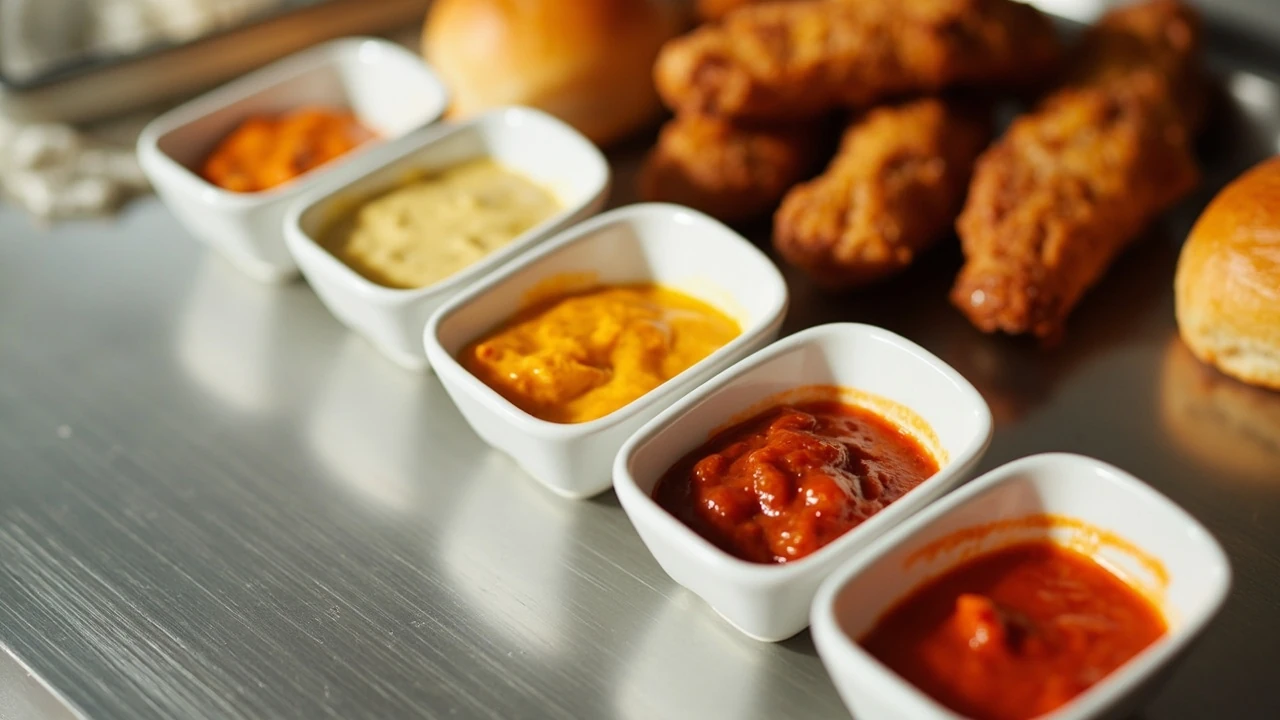
Costco fast food sauces
A food court run at Costco is one of the few remaining places where a hot dog, a slice of pizza, and a churro still feel like a complete meal for under five dollars. Behind that low price sits a quiet workhorse that ties the whole experience together: the sauce. Walk past the condiment counter during a Saturday lunch rush and you will see members squeezing, dipping, and spooning with surprising seriousness. The selection on offer, often the same sauces that travel into the Kirkland bottled line, has become a small obsession for home cooks and restaurant chefs who want big flavor at warehouse prices.
Costco fast food sauces include the familiar squeeze bottles at the food court, the shelf-stable Kirkland products sold in the warehouse, and the rotating limited-time sauces that show up for a season and then quietly disappear. This guide walks through what is actually on the shelves, what each sauce is best at, and how to get real value out of them in a home kitchen or on a small commercial menu.
What counts as a Costco fast food sauce
Most people hear the phrase and picture the red ketchup and yellow mustard pumps at the food court counter. In practice, the category is wider than the condiment bar. It covers three distinct groups, and a smart buyer thinks about all three before loading the cart.
- Food court squeeze bottles: the in-store condiments available at every Costco food court, including the cult-style dipping sauces for chicken tenders and the green jalapeño sauce that long-time members still ask about.
- Shelf-stable Kirkland products: jarred and bottled sauces sold in the main warehouse, often in restaurant or club sizes, that overlap with the food court lineup in flavor and brand ownership.
- Seasonal and limited-time sauces: rotating flavors such as the green goddess or the regional chili crisp that show up for a few months, generate social media buzz, and then exit the rotation when production changes.
Each group has a different role. The food court bottles are designed for one visit and a takeout tray. The Kirkland jars are built for repeat use at home, and they tend to track more closely to what restaurants pay for in food cost terms. The seasonal sauces are the most fun to track, and the easiest to miss, because they ship without much warning and rarely come back in the same form.
The food court lineup at a glance
The exact sauce list varies by region and by year, because Costco adjusts recipes and suppliers quietly. The table below maps the bottles that have been most consistently available across recent years, with their typical use case and a short note on flavor balance. Pricing is omitted on purpose: food court prices change without notice, and the value of a sauce is rarely the number on the receipt.
| Sauce | Form | Best pairing | Flavor profile |
|---|---|---|---|
| Classic yellow mustard | Pump bottle | Hamburger, hot dog, pretzel | Tangy, mild heat, vinegar forward |
| Heinz ketchup | Pump bottle | Hamburger, fries, hot dog | Sweet tomato, balanced acidity |
| Mayonnaise | Pump bottle | Sandwich, salad, fried items | Creamy, neutral, slight tang |
| Hot sauce (varies) | Bottle | Pizza, chicken, breakfast sandwich | Bright vinegar heat |
| Honey mustard | Squeeze bottle | Chicken tenders, salad | Sweet, mild, creamy |
| Buffalo sauce | Squeeze bottle | Chicken tenders, wrap, pizza dip | Buttery, medium heat, tangy |
| Ranch | Squeeze bottle | Chicken, pizza crust, vegetables | Herby, creamy, cool |
| BBQ sauce | Pump or pour | Pulled pork, chicken, pizza | Smoky, sweet, tomato based |
Two facts worth keeping in mind. First, the food court has shifted away from some long-time favorites over the past few years, including the famous green jalapeño sauce, so a sauce that was there last spring may be gone by fall. Second, the squeeze bottles are not the same formula as the shelf-stable Kirkland jars in the warehouse aisle, even when the labels look similar. The in-store bottles are tuned for immediate consumption, while the jars are built to survive weeks in a pantry.
Which sauces are worth bringing home
The real question is not what is on the condiment counter, but what is worth buying in bulk and turning into a working ingredient. A few rules help cut through the noise.
Start with the sauces you already use, not the ones that look interesting on social media. A $9 jar of something exotic has no value if it sits in the back of the fridge for three months. The honest test is whether you would buy a single-serve version of the same sauce at a gas station. If the answer is no, the club-size jar is just a slower way to waste money.
Then look at versatility. A sauce that works on chicken, eggs, rice, and roasted vegetables will get used. A sauce that only works on one dish will be a one-hit purchase. Costco tends to stock several sauces that hit this bar, particularly the ones positioned around the rotisserie chicken, because that single product drives a lot of the warehouse’s regular traffic.
Finally, read the ingredient list, not the front label. Bulk jars are a great place to find honest, simple formulations, but they are also where reformulations show up first. A sauce that used to be sugar and vinegar may now have a stabilizer and a flavor system that changes how it cooks. A two-minute scan of the back panel often tells you whether the sauce is built for real cooking or just for dipping.
A short tour of the strongest Kirkland options
Costco’s shelf-stable Kirkland line is a useful shortcut for cooks who want restaurant-style flavor without paying restaurant supply prices. The list below focuses on products that have been widely available, with a note on where each one earns its space in a real kitchen. Product names shift over time, so think of these as flavor categories rather than fixed items.
- Marinara: thick, lightly sweet, and forgiving on pizza or in a quick weeknight pasta. The mid-size jar often beats grocery store brands on tomato solids and salt balance.
- Alfredo: a heavy cream and cheese sauce that is genuinely useful as a base for a quick weeknight pasta or a chicken bake. It splits more easily than a scratch version, so keep the heat low.
- Teriyaki: a glossy, soy-forward sauce that doubles as a glaze for salmon or a stir-fry shortcut. Watch the sugar, which can scorch at high heat.
- Pesto: bright basil and oil, often priced well below the small grocery store jars. A spoonful thinned with pasta water is a fast way to rescue a dull dinner.
- Buffalo: similar in spirit to the food court squeeze bottle but tuned for repeat use. Works as a wing sauce, a pizza drizzle, or a wrap binder.
- Honey mustard: thick, sweet, and stable enough to use as a sandwich spread or a glaze for pork tenderloin.
- Chili crisp or chili oil: not a classic fast food sauce, but increasingly part of the Costco pantry. A small spoon transforms eggs, rice, and even a plain slice of pizza.
These are the workhorses, not the novelties. The seasonal sauces are worth trying once, but the workhorses are what justify a $75 annual membership for a household that cooks at home.
How chefs actually use these sauces
Restaurant chefs talk about sauces the way plumbers talk about fittings. They are not romantic about them. A good sauce is one that flatters a high-cost protein, stretches across multiple menu items, and holds up at service temperature for at least an hour. Several Costco products clear that bar, which is why you see them in independent kitchens more often than the price tag suggests.
Marinara and alfredo are the most common crossover items. A small pizzeria that buys a case of Kirkland marinara can hit a $0.45 to $0.60 portion cost on a sauce that costs $0.15 a jar in the warehouse, and that gap is the entire margin on a slice. Alfredo is used the same way, often thinned with pasta water to extend a jar across more plates.
Teriyaki and chili crisp do similar work in a different cuisine lane. A spoon of either can turn a piece of plain grilled fish or a bowl of rice into a plate, which matters for fast casual concepts that want complex flavor without hiring a saucier. Even the dipping sauces have a place. Honey mustard and buffalo show up in chef-driven fried chicken shops because they can be dressed up with a fresh herb or a spice blend and still taste like a real kitchen product.
On the marketing side, the food court itself is a useful case study. A $1.50 hot dog with a condiment bar that includes several different sauces feels like a better deal than a $1.50 hot dog with only ketchup and mustard, even though the unit cost of the sauce is tiny. That same logic shows up in the warehouse aisles: a member who fills a cart with a few jars of sauce, a rotisserie chicken, and a bag of rice walks out having solved a week of dinners for under $40. The sauces are the lever that makes the rest of the basket feel like value.
Pairing guide: match the sauce to the protein
Sauce choice is mostly about matching fat, acid, and heat to the protein in front of you. The table below is a starting point, not a rule. Use it to build a default, then adjust for the specific recipe.
| Protein or base | First choice | Second choice | When to skip the sauce |
|---|---|---|---|
| Rotisserie chicken | Chili crisp | Honey mustard | If the bird is heavily spiced or brined |
| Salmon | Teriyaki glaze | Pesto thinned with lemon | If you want a clean sear and no glaze |
| Beef hot dog | Yellow mustard | Chili (from the deli case if available) | If serving a flavored sausage that has its own spice |
| Fried chicken tenders | Honey mustard | Buffalo | If a dry seasoning is the point of the dish |
| Plain pizza slice | Hot sauce | Chili crisp | If the slice already has a strong topping like pepperoni or olives |
| Roasted vegetables | Pesto | Marinara warmed as a dip | If the vegetables are sweet on their own, like carrots or sweet potato |
| Eggs and breakfast | Hot sauce | Chili crisp | If serving a delicate dish like a soft scramble |
| Grain bowl or rice | Teriyaki | Chili crisp | If the bowl already has a creamy dressing |
Two instincts help more than any table. First, lean into acid and heat for rich proteins like beef, sausage, and rotisserie chicken. Second, lean into sweetness and creaminess for lean proteins like chicken breast, turkey, or white fish. Those two rules will cover about 80% of the meals a home cook will face in a week.
Storing and extending shelf life
Bulk sizes only pay off if the product keeps. The two biggest risks with warehouse sauces are oxidation in oil-based products and mold in dairy-based products, and a few habits prevent both.
- Decant into smaller jars. A two-quart jar of marinara with air in the top will discolor and lose flavor faster than the same sauce split between three smaller jars.
- Keep oil-based sauces like pesto and chili crisp in the fridge after opening, with a thin layer of oil on top to seal against oxygen. The Kirkland pesto holds its color well, but only if it is not repeatedly warmed and cooled.
- Use clean utensils. A spoon that has been in a pot of pasta will seed bacteria into a jar that has no preservatives, especially in creamy sauces.
- Write the open date on the lid. Most opened Kirkland jars keep well for two to three weeks in the fridge, longer for vinegar- and oil-based sauces, shorter for dairy-based ones.
- Freeze in ice cube trays. Marinara, alfredo, and curry-style sauces all freeze well in tablespoon-sized portions. Drop the frozen cubes into a bag and grab a few whenever a recipe calls for a small amount.
The frozen cube trick is the single most useful habit for a household that buys in bulk. A tray of pesto cubes in late summer can still be cooking dinner in February, with most of the bright basil flavor intact.
The honest limits of buying sauce in bulk
Bulk buying is not always a win. A few categories are worth skipping, and recognizing them is part of being a sharp shopper.
Anything you have not tasted is a gamble. Costco has a generous return policy on most food items, but bringing back a half-used jar of sauce is a worse experience than skipping the purchase in the first place. Try a small bottle from a regular grocery store first, then commit to the club size once you know the flavor holds up over a few meals.
Sauces with a short ingredient list are usually the best bets, but not always. A simple vinaigrette may not need a club size, because it takes two minutes to whisk at home and tastes better fresh. The savings on a bottled vinaigrette rarely justify the storage cost, especially in a small kitchen.
Specialty sauces that are clearly priced for a gift or a holiday basket often sit in the warehouse for months. A fig jam, a champagne mustard, or a truffle aioli is a fun gift, but the flavor can drift in the jar. If the sauce is a gift, treat it as a gift. If it is an ingredient, buy something fresher.
Costco fast food sauces as a restaurant inspiration
There is a useful pattern hiding in the food court. A retail giant with no fine-dining ambitions has built a small set of sauces that travel across cuisines and proteins, and the lineup is more thoughtful than it looks. The condiment bar is not a leftover from a corporate menu. It is a working example of how a small number of well-chosen sauces can carry a wide range of dishes without complicating the kitchen.
Independent operators and home cooks can borrow the same logic. Pick four or five sauces that hit different points on the flavor map: a creamy, a tangy, a sweet, a hot, and a savory. Stock those, learn to use them, and stop chasing novelty. The food court has been doing exactly that for decades, and the result is the most consistently satisfying cheap meal in American retail.
If you are working on your own menu or brand, the same rules apply. A small, focused sauce set tends to read as more confident than a sprawling one, and it costs less to produce. We have written more about that balance in our piece on menu engineering without killing the soul of the menu, and the food court is one of the cleanest examples of the principle in action.
Frequently asked questions
Does Costco still sell the green jalapeño sauce at the food court?
It comes and goes by region. Some locations carried a green jalapeño sauce for years, then quietly removed it, and similar green sauces have resurfaced in other forms. The honest answer is that availability depends on the warehouse, and the recipe shifts when it returns. Ask a food court manager at your local store if you are hunting a specific version.
Are the food court squeeze bottles the same as the Kirkland jars in the warehouse?
No. The food court bottles are designed to be used immediately and to hold up under a pump. The Kirkland jars are shelf-stable products with different stabilizers, salt levels, and acidity. They share flavors and branding, but they are not interchangeable in a recipe that depends on a specific balance.
Which Costco fast food sauce is the best value per ounce?
It depends on how often you use it. For a household that finishes a jar of marinara in a week, the Kirkland jar is the clear winner. For something more occasional, like a specialty chili oil, the smaller grocery store bottle often wins because the larger jar may lose flavor before it is used up.
Can I buy the food court sauces to take home?
Generally no. The food court condiments are stocked for on-site use, and most locations will not sell a bottle to take out. The closest equivalent is the matching Kirkland product in the warehouse aisle, which is the same brand family in a different format.
Are there gluten-free options among the Costco fast food sauces?
Several are, including most mustards, the hot sauces, and many of the marinara and pesto options. Always read the label, because recipes change and even a familiar jar can pick up a new ingredient between batches.
What is the best sauce for a rotisserie chicken from the deli?
Chili crisp is the most flexible. Honey mustard is a close second for anyone who prefers sweet over spicy. A spoon of either turns the bird into a different meal without much effort, and both keep well on the table for a second sitting.
Do the seasonal sauces come back in future years?
Sometimes. Costco uses limited-time sauces to test flavor directions and to give regular members a reason to stop by the condiment bar. A few, like the green goddess, have come back in slightly different forms, but most are one-shot runs. If you see a seasonal sauce you like, stock up while it is on the shelf.
Is it cheaper to make these sauces from scratch?
For some of them, definitely. A jar of mayo or a simple honey mustard takes about five minutes and costs half of the warehouse price. For others, like chili crisp or a real alfredo, the time and ingredient list make the jar the smarter buy. The decision is more about your time than the dollar amount on the receipt.
How long do opened Kirkland jars last in the fridge?
Most keep for two to three weeks with clean utensils, longer for vinegar- and oil-based sauces, and shorter for anything dairy-based. Freezing in small portions is the safer long-term option for sauces you do not plan to use up within a month.
A short reminder before you head to the warehouse: a few well-chosen Costco fast food sauces will do more for your weeknight cooking than a cart full of novelty jars. Pick the ones you already like, learn to use them across a few different proteins, and let the rest of the shelf stay where it is. For more on how a small set of strong products can carry a whole menu, our guide on why specificity wins food marketing is a useful next read. A broader overview of Costco as a company also helps explain why the food court has stayed so consistent for so long, and a closer look at FDA guidance on food additives and labeling is a good reference if you are starting to read the back panels on those Kirkland jars with more care.