Ethiopian food: what it actually is, and why the table looks the way it does
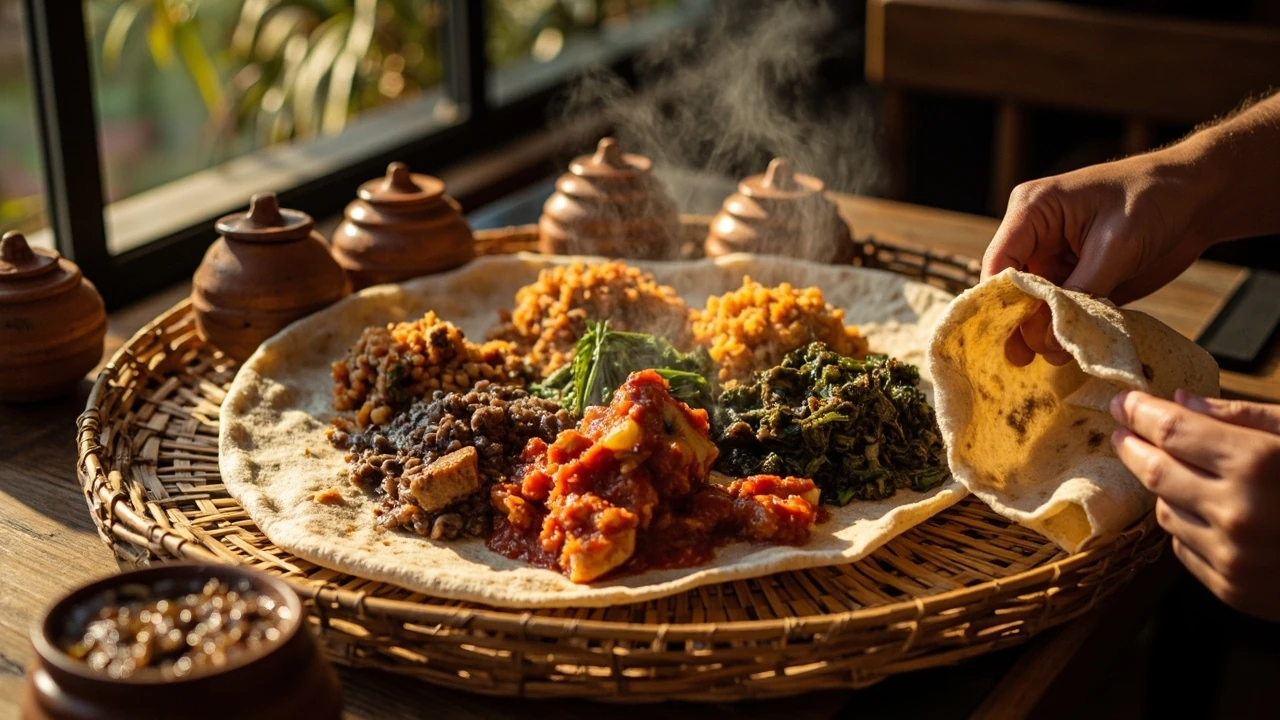
The first time most people sit down at an Ethiopian restaurant, the table looks unfamiliar. There is no plate in the center. A large, soft, crepe-like flatbread covers the basket, and small dishes of stews, vegetables, and occasionally meat are arranged directly on top of it. The wait staff may set down a stack of smaller bread rounds, a small pitcher of water, and a coffee pot that looks like it belongs in a chemistry set. The whole arrangement is the meal.
Ethiopian food is a complete dining system built around a single staple bread called injera, a small library of slowly simmered stews and vegetables, and a strong coffee tradition. Because the bread is both plate and utensil, the meal is also a social act: diners tear, scoop, and eat from the same surface, which shapes what is ordered, how it is shared, and how the food is seasoned. The result is a cuisine that rewards curious eaters and frustrates anyone trying to order the way they would at a typical restaurant.
This guide is written for two readers at once. The first is the curious diner who wants to know what Ethiopian food actually is, what the dishes taste like, and how to order without feeling lost. The second is the restaurant owner, marketer, or operator who wants to understand the cultural framework well enough to talk about the cuisine in a way that does justice to it on a menu, on a website, or at the table. Both readers benefit from the same starting point: the ingredients, the bread, the stews, and the rules of the table.
The building blocks of Ethiopian food
Most of the variety in Ethiopian food comes from a relatively small set of ingredients combined in different ways. Once you understand the building blocks, the menu stops being a wall of unfamiliar names and starts looking like a handful of patterns you can read.
Injera: the bread that is also the plate
Injera is a soft, slightly sour, spongy flatbread made from a grain called teff. Teff is a tiny ancient grain native to the Ethiopian highlands, and it ferments naturally when mixed with water, which gives injera its characteristic tang and the airy bubbles on its surface. Restaurants typically bake a fresh batch daily, although larger operations sometimes bake every two days. The bread arrives at the table in two forms: a large round that covers the serving basket, and a stack of smaller rolls used for scooping.
Three practical points matter when you are eating:
- It is the plate. The stews and vegetables are ladled directly onto the large injera, so tearing the bread means tearing the plate underneath. Use the top layer first.
- It is the utensil. You tear off a small piece with your right hand, lay it on top of a stew so the bread soaks up sauce, and use that piece to scoop. Fork-and-knife diners simply roll pieces of injera around bites.
- It is also eaten. The bread itself is a major part of the meal. If you are very hungry, finish the small rolls before the stews run out.
Teff is naturally gluten-free, which makes injera one of the few traditional flatbreads in the world that works for many diners who avoid wheat. Outside Ethiopia, however, many restaurants blend teff with wheat or barley flour because pure teff is expensive and harder to source. If gluten matters to you or your guests, ask how the restaurant makes their injera before you order.
Berbere: the spice mix that defines the heat
Berbere is the spice blend that gives Ethiopian food most of its color and a good share of its heat. The exact composition varies by household and by region, but the backbone is usually dried red chilies, garlic, ginger, fenugreek, coriander, cumin, cardamom, cloves, cinnamon, and a small amount of salt. Some versions add dried herbs like rue or basil.
Berbere is not the same as a generic chili powder. It is layered, aromatic, and slow-building on the palate, more like a curry powder than a hot sauce. A dish described as “berbere-spiced” will usually have a deeper red color and a warmer, more rounded heat than a dish that simply contains chilies. Mitmita is a separate, fiercer spice blend used in small quantities on raw meat preparations and on certain egg dishes.
Niter kibbeh: the spiced clarified butter
Niter kibbeh is the cooking fat most traditional stews are built on. It is a clarified butter infused with garlic, ginger, fenugreek, turmeric, and other aromatics. The infusion gives it a deep golden color and a savory base note that you can taste even in simple lentil dishes. For diners, the practical takeaway is that many “vegetarian” Ethiopian stews are cooked in butter rather than oil, so strict vegans need to ask. For restaurant operators, niter kibbeh is a flavor signature that is genuinely difficult to replicate with plain oil.
Shiro, lentils, and the legume library
Legumes carry a surprising amount of Ethiopian food. Red lentils split into a soft orange porridge (yemiser key wat), brown or green lentils hold their shape in a milder stew (yemiser alicha), and a roasted, spiced chickpea or broad-bean flour called shiro is cooked into a thick, savory sauce that is one of the most popular vegetarian orders in any Ethiopian restaurant. Shiro can be smooth or slightly textured, and it is often the dish vegetarians gravitate to first.
Meat and the role of raw traditions
Beef, lamb, and chicken all appear in Ethiopian cooking, usually cut into small cubes and slow-simmered. The most famous meat dish is key wat, a beef stew cooked with onions, berbere, and niter kibbeh until the meat is tender and the sauce is brick-red. A milder version, alicha, uses gentler spices and a paler sauce.
One unique preparation worth understanding is kitfo: finely minced lean beef, sometimes served raw or lightly warmed, seasoned with mitmita spice and niter kibbeh. It is a specialty, not a default, and reputable restaurants will tell you how it is prepared when you order. Diners who are not comfortable with raw or rare beef should simply choose one of the long-simmered stews instead. There is no pressure to order kitfo to have a full Ethiopian meal.
How the meal is actually eaten
The mechanics of the table matter as much as the menu. Ethiopian food is designed to be shared, which affects portion sizes, ordering strategy, and pacing.
The shared plate model
In a traditional setup, one or two large platters of food are placed in the middle of the table for everyone. Each diner takes a piece of injera, tears off a section, and uses it to scoop. Eating is a two-handed activity: the right hand tears and scoops, the left hand often rests or supports the platter.
For first-timers, three habits make the experience more comfortable:
- Start with the top layer. Tear gently from the top injera so the platter beneath stays intact for the rest of the table.
- Use your right hand when scooping. Even left-handed diners in Ethiopia typically scoop with the right hand for hygiene reasons in a shared dish.
- Take small amounts. The stews are intense, and a small bite with injera is the proper portion. Going back for more is part of the rhythm.
Ordering for a group
A useful rule of thumb for groups of two to four: order one vegetarian platter or combination plate per two people, plus one meat dish, plus extra injera if anyone is hungry. Larger groups usually order several meat dishes and a vegetarian combination to cover everyone, then add individual items based on what people already know they like.
The table below maps appetite to a reasonable order.
| Group size | Vegetarian combinations | Meat dishes | Extra injera | Drinks to add |
|---|---|---|---|---|
| 2 light eaters | 1 | 1 | 1 small roll | 1 coffee, 1 tea or soft drink |
| 2 hungry eaters | 1 | 2 | 2 small rolls | 1 coffee, 1 beer or tej |
| 4 mixed group | 2 | 2-3 | 3-4 small rolls | Coffee ceremony for the table, plus water |
| 6+ large group | 3 | 4-5 | 1 large injera per 2 people | Tej bottle if the group is curious |
These are starting points, not rules. The wait staff at most Ethiopian restaurants are used to guiding first-time visitors, and many places have house combinations that already bundle a balanced spread.
Eating with your hands vs. with utensils
Both are normal. Tearing injera with the right hand and scooping is the traditional approach, and many regulars will tell you that stews taste different when eaten with the bread rather than a fork. Travelers, business diners, and anyone who feels awkward using their hands can use a fork to lift pieces of injera wrapped around a bite. There is no etiquette penalty for using a fork, and there is no obligation to eat with your hands if you are not comfortable doing so.
Reading the menu: a dish-by-dish field guide
Most Ethiopian restaurant menus follow a similar pattern. A short list of stews and vegetables, a meat section, a few combinations, and a drinks list built around coffee and possibly tej. The names look intimidating at first, but the patterns repeat. The table below maps the dishes you are most likely to encounter to what they actually are and how they taste.
| Dish name | What it is | Main ingredients | Flavor profile | Heat level |
|---|---|---|---|---|
| Injera | Sour, spongy flatbread | Teff (or teff blend), water, starter | Sour, slightly tangy, soft | None |
| Shiro | Thick legume-flour stew | Roasted chickpea/broad-bean flour, onion, garlic, berbere | Savory, nutty, gently spiced | Mild to medium |
| Yemiser key wat | Red lentil stew | Red lentils, berbere, onion, niter kibbeh | Soft, warm, spicy | Medium |
| Yemiser alicha | Mild lentil stew | Lentils, turmeric, ginger, mild spices | Soft, savory, very gentle | Mild |
| Kik alicha | Yellow split pea stew | Split peas, turmeric, garlic, ginger | Soft, savory, slightly earthy | Mild |
| Gomen | Sauteed collard greens | Collards, garlic, ginger, oil or niter kibbeh | Savory, slightly bitter, garlicky | Mild |
| Key wat | Spiced beef stew | Beef cubes, berbere, onion, niter kibbeh | Rich, warming, deeply spiced | Medium to hot |
| Alicha key | Mild beef stew | Beef, turmeric, ginger, mild spices | Rich, savory, gentle | Mild |
| Doro wat | Chicken stew with egg | Chicken, berbere, onion, boiled egg, niter kibbeh | Rich, deep, complex | Medium to hot |
| Kitfo | Minced beef, sometimes raw | Lean beef, mitmita, niter kibbeh, sometimes herb butter | Buttery, peppery, dense | Medium |
| Tibs | Sauteed meat with vegetables | Lamb or beef, onion, peppers, rosemary, sometimes tomato | Savory, slightly smoky, herbaceous | Mild to medium |
| Atakilt | Cabbage, carrots, potatoes | Cabbage, carrot, potato, turmeric, ginger | Soft, sweet-savory, mild | Mild |
| Fosolia | Green beans and carrots | Green beans, carrot, onion, mild spices | Sweet, savory, light | Mild |
| Timatim salata | Tomato salad | Tomato, onion, peppers, lemon, herbs | Bright, acidic, fresh | Mild |
The “alicha” suffix is your best friend on a menu. It marks the milder, more turmeric- and ginger-led version of a dish. The “wat” suffix marks the berbere-spiced, deeper-flavored version. If you are unsure about heat, choose alicha dishes first and add a single berbere-spiced item to share.
Vegetarian and dietary notes
Ethiopian food is one of the most accommodating traditional cuisines for vegetarian diners. Many restaurants have an entire section of the menu marked as “fasting” or “vegetarian” that excludes meat, and in Ethiopia itself, long periods of Orthodox Christian fasting have produced a deep bench of lentil, legume, and vegetable dishes that are genuinely satisfying on their own.
Three practical caveats apply:
- Vegetarian often still means dairy. Most stews are cooked in niter kibbeh (spiced clarified butter). A vegan diner should specifically request a vegan preparation when ordering.
- Gluten-free is possible but not automatic. Pure teff injera is gluten-free, but many restaurants blend teff with wheat. Confirm before ordering if gluten matters.
- Spice can be adjusted. Most restaurants will adjust the heat of a dish if asked. Saying “mild” usually means less berbere in the sauce, not no berbere.
The coffee tradition: more than a drink
If you stay long enough, your server may offer a coffee ceremony, which is one of the most recognizable social rituals attached to Ethiopian food. The ceremony is simple in form and meaningful in practice: green coffee beans are roasted in a pan over coals, ground by hand, and brewed in a small clay pot called a jebena. The coffee is poured in small cups and served in three rounds, often with popcorn or roasted barley on the side.
For diners, two things are worth knowing. First, the ceremony is unhurried, so plan on twenty to thirty minutes from the first roasting smell to the last pour. Second, the coffee is strong, lightly spiced with cardamom in some traditions, and meant to be sipped rather than finished in one go. Saying yes to the ceremony is one of the easiest ways to understand why Ethiopian food is treated as a social event rather than a transaction.
Tej and other drinks at the table
Tej is a traditional honey wine, lightly fermented, sometimes flavored with a herb called gesho. It is served in a distinctive round-bottomed flask called a berele. Sweet, gentle, and slightly herbal, it pairs naturally with berbere-spiced dishes because the sweetness balances the heat. Tej is optional at the table. Most Ethiopian restaurants also serve standard beer, soft drinks, and tea.
Heat, pacing, and a few common mistakes
The most common mistakes first-timers make with Ethiopian food are about pacing rather than food choice. A meal is usually paced as a long, slow social experience, and a few simple habits prevent the common pitfalls.
- Do not order every berbere dish on the menu. Two or three spicy stews per table is plenty, balanced by milder alicha dishes and fresh sides like timatim salata.
- Do not eat injera as a side roll first. Treat the small rolls as a tool. Save some for the last half of the meal when the stews have soaked into the basket injera.
- Do not rush the coffee. A traditional coffee ceremony moves slowly. If you are on a tight schedule, ask your server to bring coffee with dessert or skip the ceremony for that visit.
- Do not assume raw equals unsafe. Kitfo is a real preparation, but reputable restaurants know how to source and serve it. If you are curious, ask how it is prepared that day before deciding.
What a typical meal at an Ethiopian restaurant looks like
A practical walkthrough helps more than any single description. Here is a realistic two-person order at a sit-down Ethiopian restaurant, with pacing notes.
- Start with drinks. Order a coffee or tea, plus water for the table. If you are curious about tej, order a small glass now rather than later.
- Order a combination. One meat-and-vegetarian combination for the table covers a wide range of flavors quickly. Add one extra dish you have not tried, such as shiro or fosolia.
- Order extra injera. One small roll per person is a reasonable starting point; add more if anyone is particularly hungry.
- Begin with mild dishes. Start with the alicha items, the vegetables, and the salads. Save the berbere stews for the middle of the meal so the heat does not hit first.
- Wrap up with coffee. If the restaurant offers a ceremony, this is the right time. If not, a simple coffee with cardamom rounds the meal cleanly.
For operators, the same sequence is useful as a mental model for menu design: a few mild, a few spicy, a few vegetable, a few meat, and a clear path from the first bite to the last.
How Ethiopian food is framed by restaurant operators
If you are writing a menu, a website, or marketing copy for a restaurant that serves Ethiopian food, the same rules that help diners help you. Describe dishes by their actual flavor and texture rather than by origin alone, and respect the structure of the meal.
Two small editorial decisions make a noticeable difference:
- Use the Ethiopian name alongside a clear description. “Key wat: slow-simmered beef stew with berbere spice, served on injera” gives the diner something to act on, where just “key wat” leaves them guessing.
- Explain the table on the menu or website. One short paragraph about how injera works prevents a class of “what do I do now” questions and turns first-timers into confident diners.
This is also where a clear, simple approach to restaurant branding pays off, because the table itself is already doing cultural work. Your menu, photography, and signage need to frame that work honestly. The way a restaurant explains its own story is what guests remember, and the practical lessons of telling that story well are very similar across cuisines. The deeper patterns of writing restaurant copy that respects the food and the guest are worth working through.
Internal reading for restaurant operators
Two pieces on this site are directly useful for anyone writing about or serving Ethiopian food as part of a broader menu strategy. The first walks through how to keep the soul of a menu intact when you are engineering it for margin, which matters when an unfamiliar cuisine lands on a price-conscious menu. The second explores the way specificity in food marketing earns trust, which is exactly the move that helps a new diner commit to ordering something they have never tried.
Frequently asked questions
What is Ethiopian food built around?
Ethiopian food is built around injera, a soft, slightly sour flatbread usually made from teff, which acts as the plate and the utensil for a shared spread of stews, legumes, and vegetables. Most of the variety comes from a small set of stews seasoned with berbere (a warm chili spice blend) or alicha (a milder turmeric-ginger style), cooked in niter kibbeh (spiced clarified butter).
Is Ethiopian food spicy?
It can be, but it does not have to be. The berbere-spiced dishes carry a slow, aromatic heat that is closer to a curry than to a hot sauce. The alicha dishes, the green beans, the cabbage, and the salads are mild. A balanced order mixes a few spicy items with several mild ones, and most restaurants will adjust heat on request.
What does Ethiopian food taste like for a first-timer?
Expect warm spice rather than sharp heat, soft textures rather than crisp, and a noticeable tang from the injera underneath. Lentils and split peas appear as creamy stews, collards appear as a savory green, and meat dishes tend to be rich, slow-simmered, and gently spiced. The bread itself is part of the flavor.
Can you eat Ethiopian food if you are vegetarian or vegan?
Vegetarian diners will find an entire section of the menu dedicated to lentil, legume, and vegetable dishes that are genuinely satisfying. Vegan diners can eat most of those same dishes but should ask whether the kitchen uses niter kibbeh (clarified butter) or oil, because traditional recipes use butter by default.
Is Ethiopian food gluten-free?
Pure teff injera is naturally gluten-free, but many restaurants outside Ethiopia blend teff with wheat or barley flour for cost and handling reasons. If gluten matters, ask how the injera is made before you order, and avoid tibs and doro wat unless you have confirmed the preparation.
How do you eat Ethiopian food without making a mess?
Tear a small piece of injera from the top of the platter with your right hand, lay it on top of a stew so it soaks up sauce, and use that piece to scoop. Take small bites, move around the platter rather than tunneling into one dish, and use the smaller rolls on the side as backup. Fork-and-knife diners can simply roll injera around bites.
What is the best Ethiopian food to order if it is your first time?
For a first visit, order a combination or sampler plate that includes shiro, yemiser alicha (mild lentils), gomen (collards), atakilt (cabbage and carrots), and a single berbere dish such as doro wat or key wat. Add extra injera, finish with coffee, and you will have covered the major flavor groups without overcommitting to heat.
What is kitfo, and is it safe?
Kitfo is finely minced lean beef seasoned with mitmita spice and niter kibbeh. It is sometimes served raw in the style of steak tartare, sometimes lightly warmed, and sometimes fully cooked. Reputable restaurants source carefully and will explain how it is prepared. If you are unsure, simply order a slow-simmered stew instead. You do not need kitfo to have a full Ethiopian meal.
What is the coffee ceremony at an Ethiopian restaurant?
The coffee ceremony is a traditional ritual in which green coffee beans are roasted in a pan, ground by hand, and brewed in a small clay pot. The coffee is served in three small rounds, often with popcorn. It is unhurried, social, and is part of why an Ethiopian meal tends to last longer than a typical restaurant visit.
Is Ethiopian food good for a group?
It is one of the best cuisines for groups because the meal is designed to be shared. Order a few combinations, add a couple of standout dishes, ask for extra injera, and let the table do the work. Most Ethiopian restaurants are set up for groups of two to eight with little advance planning.