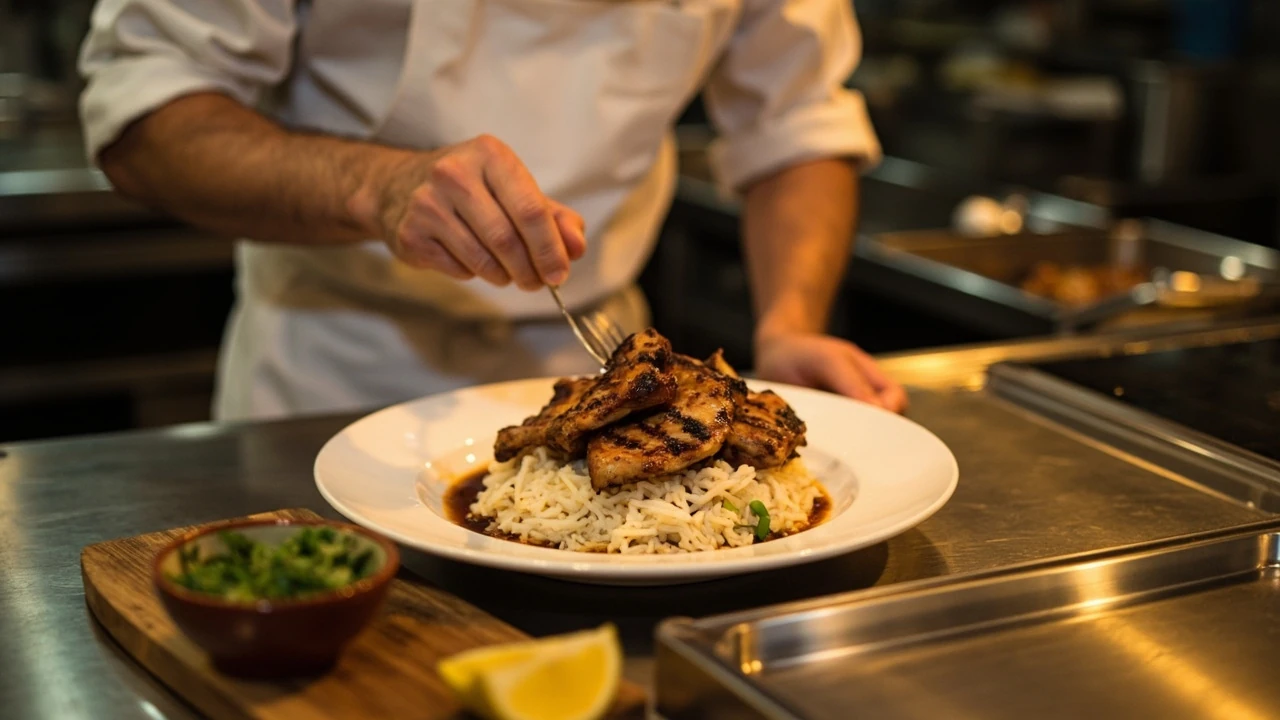
A diner sits down at your counter, glances at the menu, and quietly asks the server whether the kitchen can handle a few restrictions. Chicken is fine, beef is fine, no pork at all, no alcohol in the cooking, and the meat has to come from a supplier the guest can actually trust. This is the everyday moment that halal food stops being a niche label and becomes a normal part of running a restaurant. It is a question about sourcing, a question about training, and a question about how a menu is written.
This guide is written for food business owners, chefs, and brand marketers who need to understand halal food as an operating standard, not as a marketing slogan. It explains what the term covers, what it does not cover, how certification works in practice, how to design a menu that respects Muslim guests, and where the commercial opportunity sits for restaurants that get it right. If you are weighing whether halal belongs in your concept, the section on menu engineering without killing the soul of the menu is a useful companion read.
Halal food: what the term actually covers
Halal food is food that is permitted under Islamic dietary law. The Arabic word halal literally means permissible, and it sits opposite haram, which means forbidden. For most diners, the rule is summarized in three sentences: no pork, no alcohol, and meat from animals slaughtered in a specific way. In practice, the term reaches further than those three points, because the entire chain of how an animal was raised, fed, transported, and processed affects whether observant Muslims will eat the final dish.
The categories below describe the practical territory that halal food covers for a working kitchen.
- Permitted categories. Fruits, vegetables, grains, legumes, fish (with some scholarly variation), dairy from halal animals, and properly slaughtered land animals such as chicken, beef, lamb, and goat.
- Forbidden categories. Pork and pork derivatives, animals that were not slaughtered according to halal method, carnivorous animals, birds of prey, land animals without external ears, blood and blood byproducts, alcohol used as an ingredient, and intoxicants.
- Conditional categories. Ingredients that started out permissible but were processed with non-halal additives, equipment, or flavor systems. The starting point may be halal, but the final product may not be.
The conditional category is where most kitchen mistakes happen. A sauce thickened with wine, a broth simmered with bacon, a vanilla extract made with alcohol, or a knife that just came off a pork cutting board can each take a dish out of halal compliance even if the visible protein is fine. For a deeper background on the term itself, the Wikipedia overview of halal is a useful orientation point before getting into sourcing and certification.
How halal slaughter and sourcing actually work
For a restaurant, the conversation about halal food usually starts with the meat case, not with the theology. The most common questions from chefs and operators are practical. Where does the bird come from, who blessed it, who can vouch for the supply chain, and what paperwork will survive a guest’s follow-up question. The points below cover the operational territory that matters at the pass.
The dhabihah method
Halal slaughter, called dhabihah, requires a swift cut to the throat with a sharp knife by a sane adult Muslim who invokes the name of God. The cut must sever the windpipe, the esophagus, and the major blood vessels so that the animal bleeds out quickly. Stunning before the cut is a debated question: some certifiers accept reversible stunning if the animal is alive at the moment of cut, others reject any stunning. A chef who buys halal meat should know which approach their certifier uses, because Muslim guests often know the difference.
From farm to butcher to kitchen
Halal status is preserved only if the supply chain is clean. An animal that was raised halal, slaughtered halal, and then transported in a truck that also carried pork has a problem. A carcass that was processed on a line that runs pork later the same day has a problem. A butcher who stores halal beef next to pork has a problem. The level of segregation your supplier maintains is more important than the slaughterhouse certificate, because the certificate covers one step and your kitchen is the last step.
What to ask the supplier
The questions below are the minimum a chef or owner should put to a halal meat supplier before signing a purchase order. They are also the same questions a Muslim guest is likely to ask the front-of-house team, so the answers should be simple enough for a server to repeat.
- Which certifying body issues your halal certificate, and is it recognized locally?
- Do you stun before the cut, and if so, what method?
- Is halal meat processed on a dedicated line, or on a shared line with cleaning between runs?
- How is halal meat stored and transported to keep it segregated from non-halal product?
- Can you provide a certificate for each delivery, not just a generic annual certificate?
Certification bodies, paperwork, and trust
p>There is no single global halal authority. Different countries and regions recognize different bodies, and the trust a guest places in a certificate depends on local knowledge. In North America, the better-known certifiers include organizations such as IFANCA, ISWA, and Halal Monitoring Authority, along with several regional bodies. In the United Kingdom, HMC and HFA are common. In Southeast Asia, MUI in Indonesia and JAKIM in Malaysia are widely recognized. A restaurant that wants to be taken seriously should use a certifier that Muslim guests in its market already know, not the cheapest option available.
Certification generally covers three things: the slaughterhouse, the processing facility, and sometimes the restaurant itself. Restaurant-level certification is rarer and is usually pursued by operators who want a sealed halal kitchen rather than a mixed one. The table below compares the three common scopes and what each one actually means for the operator.
| Scope | What is certified | Typical user | Cost range | Operational implication |
|---|---|---|---|---|
| Supplier-level | Slaughterhouse and processing line only | Restaurants that want certified raw materials without committing the whole kitchen | Built into meat price | You still control segregation in your own kitchen |
| Brand-level | All outlets under a brand meet the same sourcing standard | Chains and franchises | Moderate, annual | Requires supplier audits, training, and internal compliance |
| Restaurant-level | The full kitchen, equipment, and recipes | Fully halal restaurants or dedicated halal sections | Higher, plus ongoing audit | No pork, no alcohol, no cross-contact anywhere on site |
For most independent operators, supplier-level certification on the proteins that matter is enough to serve Muslim guests with confidence. Full restaurant-level certification only makes sense when the concept itself is built around halal food and the operator is ready to remove pork and alcohol from the menu altogether.
Designing a menu that respects Muslim guests
A halal menu is not a translation job. It is a design job. The goal is to make it obvious to a Muslim guest which dishes are safe to order, and to make it just as obvious which dishes are not. Ambiguity is the enemy, because it forces the guest to ask, and the question itself is a small signal that the kitchen may not be sure either.
Writing copy that does not confuse
Menu language for halal food is usually a mix of two approaches. The first is to label every dish that contains halal meat with a small symbol or phrase such as halal chicken or halal beef, and to leave other proteins unmarked. The second is to declare the whole menu halal, which is only honest if every single dish is genuinely halal. Mixing the two without a clear rule is the most common copy mistake. A guest who sees a few dishes labeled and assumes the rest are not halal may skip dishes that actually are.
Building a real halal section
If the restaurant is not fully halal, a dedicated section is often clearer than scattered labels. The section can be small, but it should be honest. A useful section has at least one chicken dish, one beef or lamb dish, one seafood or vegetable option, and at least one dessert that is free of alcohol-based flavorings. The table below shows a small section layout that works for a casual concept.
| Course | Halal-friendly option | Ingredient notes |
|---|---|---|
| Starter | Grilled chicken skewers with yogurt and herbs | No wine reduction, no bacon, no gelatin |
| Main | Slow-braised halal beef with roasted vegetables | Stock made without alcohol or pork bones |
| Main | Pan-seared sea bass with lemon and olive oil | Seafood acceptance varies; check with your certifier |
| Side | Turmeric rice with fried onions | Fried in halal-friendly oil, not lard |
| Dessert | Rosewater panna cotta with mango | No gelatin, no alcohol-based vanilla |
Two design points matter more than the dishes themselves. First, the section should sit in a place on the menu that Muslim guests can find without searching. Hiding it on the last page sends the wrong message. Second, the front-of-house team should know the section by heart, because a guest who asks what can I eat here deserves a confident answer, not a glance toward the kitchen.
Training the front-of-house team
Most halal food failures in restaurants are not kitchen failures. They are communication failures. A guest asks, the server hesitates, the manager is called, the manager checks, the answer is unclear, and the guest either orders cautiously or leaves. The fix is to train the team to answer the most common questions in plain language, in under ten seconds. The list below is a starting set, not a complete script, and it should be adapted to each concept.
- Where is the chicken from? State the supplier and the certifier, not just the word halal.
- Is the beef halal? Yes or no, and if no, suggest the halal alternative without making the guest feel like an inconvenience.
- Is the stock made with alcohol? Most kitchens use wine reductions. The answer is usually no for halal dishes, and the team should know which stocks are which.
- Are the desserts halal? Gelatin, vanilla, and alcohol-based flavorings are the usual trouble points. A clear list of safe desserts prevents hesitation.
- Can you accommodate my child who only eats chicken and rice? This is often the most common real-world request, and a confident yes is worth a lot.
If your restaurant runs a regular staff briefing, halal questions should be part of the weekly rotation, the same way allergy questions are. The two topics share a structure: a known set of risks, a known set of safe options, and a known set of phrases to avoid. Treating halal the same way you treat gluten-free or nut-free training is the fastest way to take the awkwardness out of the conversation. For related thinking on how training fits into a wider growth plan, the menu pricing strategies that protect margin without losing guests article is a useful adjacent read.
Common kitchen mistakes that take dishes out of halal
The same handful of ingredients causes most accidental violations. A chef who memorizes this list can audit a menu in about fifteen minutes. The list below is ordered by how often each item shows up in real kitchens, not by how serious the violation is.
- Wine, sherry, or mirin in a sauce or stock. Even after reduction, observant guests consider these haram. Replace with stock, citrus, or verjuice.
- Pork-based stocks or bacon in a base. A green curry paste with shrimp paste, a bean stew with bacon, or a soup with pork bones all disqualify a dish.
- Gelatin in desserts. Often pork-derived. Use agar, pectin, or halal-certified gelatin.
- Vanilla extract and other alcohol-based flavorings. Use alcohol-free versions or natural vanilla bean.
- Shared equipment. A grill that just cooked pork, a fryer that just fried bacon, or a cutting board that was used for both proteins is a cross-contact risk. A clean-down protocol is enough for most kitchens, but the protocol must exist.
Cross-contact is the most common reason a fully halal ingredient becomes a non-halal dish. A kitchen that serves both pork and halal meat on the same line should keep a dedicated section, dedicated tools, and a written cleaning routine. The cleaning routine is not optional: it is the only way to defend the menu if a guest asks for proof.
Halal food as a commercial opportunity
The commercial case for halal food is no longer speculative. The global Muslim population is large, young, and increasingly urban, and a meaningful share of food spending in cities like London, Toronto, Paris, Jakarta, Dubai, and Kuala Lumpur already goes through halal supply chains. A restaurant that ignores halal is choosing to ignore a real segment of the market. The question for an operator is not whether halal matters, but how much of the menu to commit to it.
Three operating models
The table below compares the three common ways a restaurant can engage with halal food. Each model has a different cost, a different guest expectation, and a different upside.
| Model | What it looks like | Best for | Risk |
|---|---|---|---|
| Halal-friendly | A small halal section on a broader menu | Concepts that want to welcome Muslim guests without changing the concept | Guests may doubt the kitchen’s commitment if the section is small or unclear |
| Halal-led | Halal proteins across the menu, pork and alcohol still on the menu | Concepts in mixed neighborhoods that want Muslim guests as a core audience | Higher supplier cost, more training, and a clear copy job on the menu |
| Fully halal | No pork, no alcohol, certified kitchen | Concepts in Muslim-majority neighborhoods or in cities with strong halal demand | Loses guests who specifically want pork or a bar program |
The right model depends on neighborhood, concept, and the segment a restaurant already serves. A fully halal restaurant in the wrong neighborhood loses more than it gains. A halal-friendly restaurant in the right neighborhood can serve Muslim guests without alienating anyone else. The middle model, halal-led, often makes the most sense for a city like London or Toronto, where Muslim guests are a large share of the market and other guests still want a normal range of options.
Margin and cost reality
Halal meat usually costs more than conventional meat, often by 10 to 30 percent depending on the protein and the certifier. The premium reflects smaller production runs, dedicated lines, and the cost of the certifier’s audit. Restaurants that want to keep margin should treat halal proteins as premium items rather than as substitutes. A halal chicken dish priced the same as a standard chicken dish will quietly lose money. A halal chicken dish priced as a premium option, with a story behind the sourcing, will hold its margin and pull in a segment of guests who actively look for it. The pricing logic is the same as any other premium ingredient, and the same menu pricing principles apply.
Marketing halal food without overpromising
Halal marketing fails in two opposite directions. The first is silence, where a restaurant serves halal proteins but does not say so, and Muslim guests only find out by word of mouth. The second is overreach, where a restaurant uses the word halal on packaging, signage, and delivery listings without the supply chain to back it up. The second mistake is worse, because it loses trust faster than the first. The points below are the minimum a careful operator should put in place.
- State the certifier by name. Saying halal is a claim. Saying halal-certified by X is a fact. Muslim guests know the difference.
- Keep the claim narrow. If only the chicken is halal, say halal chicken. Do not say halal kitchen if the kitchen also handles pork.
- Update listings honestly. A delivery platform listing that says halal should match the actual menu. Platforms change their rules often, and a stale listing is a complaint waiting to happen.
- Avoid visual clichés. The halal market is not a single demographic, and stock photography of mosques, crescents, or Middle Eastern settings can read as inauthentic in a casual concept. Use real food photography and real kitchen scenes instead.
For a restaurant working on its brand voice alongside menu work, the restaurant branding guide covers how to keep identity consistent without leaning on borrowed visual cues.
Halal and other dietary systems side by side
Halal is one of several religious or ethical dietary systems that restaurants handle at the same time. The table below compares halal to kosher, vegetarian, and vegan, and highlights where the rules overlap and where they diverge. The point of the table is not to merge the systems, but to make it easier to design a single menu that respects each one.
| System | Meat rule | Alcohol rule | Cross-contact rule | Overlap with halal |
|---|---|---|---|---|
| Halal | Permitted animals slaughtered in a specific way; no pork | No alcohol as an ingredient | Avoids pork, blood, and unpermitted additives | Reference |
| Kosher | Permitted animals slaughtered by a shochet; no pork; meat and dairy separated | Wine must be kosher; grape products handled carefully | Strict separation of meat and dairy, plus separation from non-kosher items | High overlap on the no-pork rule; meat is not interchangeable |
| Vegetarian | No meat or fish | Usually no concern | No meat cross-contact required | Many vegetarian dishes are halal-friendly by default |
| Vegan | No animal products | No concern | No animal-product cross-contact required | Most vegan dishes are halal-compatible |
The takeaway from the table is simple. A dish that is vegan is usually halal-compatible, but a halal dish is not automatically vegan. A dish that is kosher may or may not be halal, because the slaughter methods and the processing rules are not the same. Designing with overlap in mind keeps the menu simpler and the kitchen more efficient, especially for restaurants that handle multiple dietary systems in a single service.
What to do this week if halal is new to your kitchen
Bringing halal food into a kitchen that has not done it before is a one-week project, not a one-month project, if the operator keeps the scope honest. The list below is a realistic opening sequence for a casual concept that wants to add a halal section without committing to a full conversion.
- Pick one protein to start. Halal chicken is the simplest entry point because the supply chain is mature in most cities and the cost premium is manageable.
- Pick one supplier and audit them. Ask the questions from the supplier section above, and visit the facility if at all possible.
- Pick two or three dishes. A starter, a main, and a dessert that share ingredients with the existing menu keep waste low and training short.
- Train the front-of-house team on the answers. A two-briefing rollout is usually enough for a small team.
- Update the menu and the listings. Honest, narrow copy that names the certifier will outperform vague marketing language.
After a month, the operator can decide whether to expand the section, switch to a halal-led model, or keep the current scope. The data to watch is simple: how often halal dishes are ordered, what guests ask about them, and whether the supplier is reliable. Those three signals are enough to make the next call without guessing.
Frequently asked questions
What is halal food in simple terms?
Halal food is food that is permitted under Islamic dietary law. The most common rules are no pork, no alcohol used as an ingredient, and meat that comes from an animal slaughtered in a specific way with a blessing spoken at the time of slaughter.
Is all chicken automatically halal?
No. Regular chicken is not halal unless it was raised, slaughtered, and processed according to halal rules. The word halal describes a supply chain, not a species.
Can halal food include alcohol that has been cooked off?
Most observant Muslims consider any alcohol used as an ingredient to be haram, even after cooking. Restaurants that want to serve halal guests replace wine and sherry with stock, citrus juice, or verjuice.
Is seafood halal?
There is scholarly variation. Many Muslims eat all seafood, while others limit seafood to fish with scales. A restaurant should ask its certifier and its guests rather than assume.
Do I need a halal certificate to serve halal food?
You do not need a certificate to buy halal meat from a certified supplier and serve it, but a certificate gives guests confidence and protects the restaurant if there is ever a question about the supply chain.
How is halal different from kosher?
Both forbid pork and require a specific slaughter method, but the slaughter rules, the certifiers, and the processing rules are different. A kosher dish is not automatically halal, and a halal dish is not automatically kosher.
Can a restaurant serve both halal and non-halal meat?
Yes, many restaurants do, as long as the segregation is real. The kitchen needs a clear protocol for storage, tools, and cleaning, and the menu needs copy that makes the difference obvious to the guest.
What ingredients should I check first when auditing a recipe?
Start with wine, sherry, and mirin, then pork-based stocks and bacon, then gelatin and vanilla extract. These five items cause most accidental violations.
Does halal food cost more to produce?
Halal meat usually costs more than conventional meat, often by 10 to 30 percent. The premium is best handled as a pricing decision, with halal proteins sold as premium menu items rather than as direct substitutes.
How should halal food be described on a menu?
Name the certifier and the protein, keep the claim narrow, and put halal dishes in a place where Muslim guests can find them without searching. Avoid vague labels and avoid leaning on visual cues that read as borrowed.