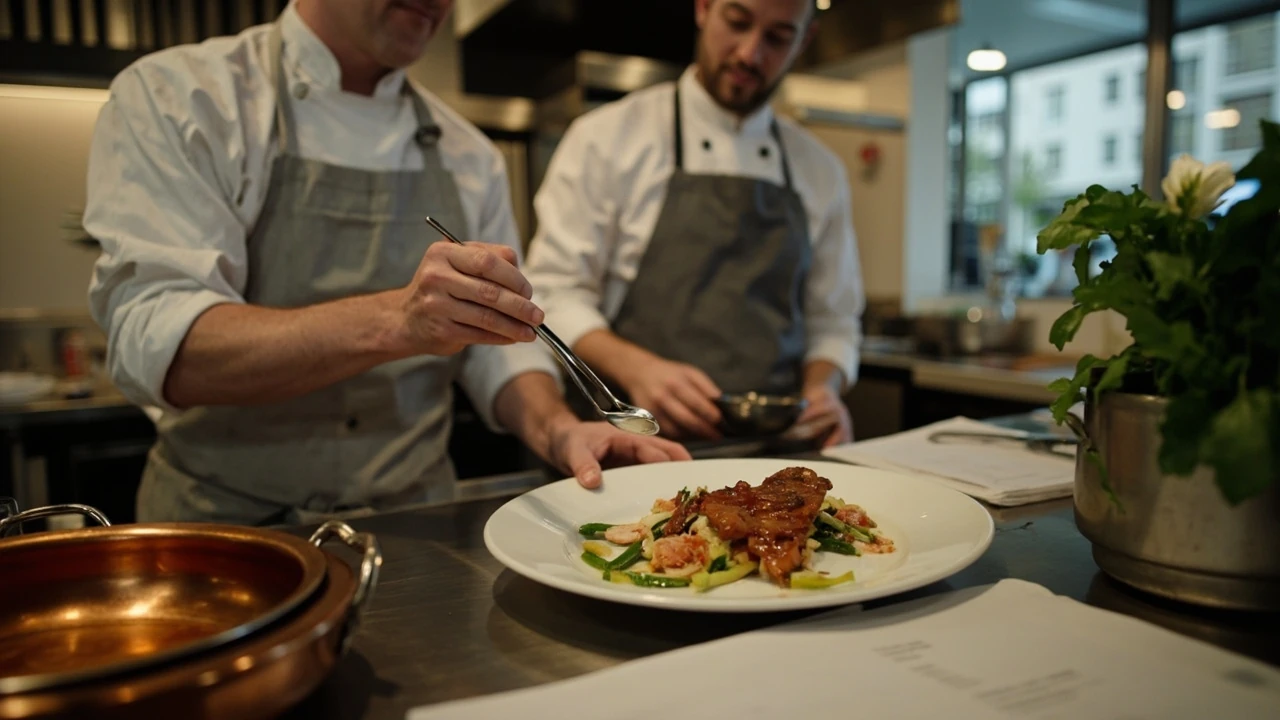
True food kitchen: what the term actually points to
A cook in Portland slices golden beets over a sheet tray while a server writes the day’s prep on a clipboard. A small bistro in Lisbon lists two farms on the back of its menu and changes both every Thursday. A neighborhood taquería in Austin stamps a number on a bag of tortillas because the owner can name the mill that ground the corn. None of these places use the phrase true food kitchen as a slogan, but each one behaves the way the phrase suggests. A true food kitchen is a working kitchen whose choices — sourcing, menu design, labor, equipment, waste — are aligned with what the restaurant actually claims to be, and can be verified by anyone who walks in the door.
The phrase has drifted through a few meanings over the last decade. In some marketing copy it is used as a feel-good label for any place that uses the word “fresh.” In other contexts it describes a deliberate restaurant concept built around ingredient integrity, kitchen transparency, and a menu that changes with what is actually available. This article treats it in the second sense: as a working philosophy with concrete operational consequences for owners, chefs, and the guests who keep an eye on what is real.
For a restaurant, a true food kitchen is not a moral badge. It is a set of decisions that touch every part of the operation. The remainder of this article walks through what those decisions look like in practice, what they cost, what they protect against, and how to tell whether a kitchen that calls itself one is doing the work or borrowing the language.
Why the phrase matters for restaurant positioning
Guests increasingly ask the same question in different ways: where did this come from, who cooked it, and is the menu honest about both? That pressure has pushed restaurant language toward words like “real,” “honest,” “scratch,” “farm,” and “true.” Each of those words is cheap to print and expensive to back up. A true food kitchen is the operational answer that has to live behind those words.
For independent restaurants, the positioning question is not whether to use such language, but whether the kitchen can sustain the claims that language makes. A menu that prints a farm name has to keep buying from that farm, or it has to change the print run. A kitchen that claims scratch cooking has to actually cook from raw ingredients during service, not open bags of finished components. A claim of zero waste has to survive an audit by a curious line cook, not just a food writer.
This is also where the marketing and the kitchen meet. Most of the public content a restaurant produces — menu, website, social posts, signage — flows from what the kitchen can actually do. A true food kitchen frames that direction correctly: the kitchen is the source, and the rest of the restaurant is the translation. When the order is reversed, restaurants end up with menus and websites that drift away from what the line is actually producing, and guests feel the gap even when they cannot name it.
What a true food kitchen looks like behind the pass
Looking at working kitchens that take the idea seriously, a few patterns repeat. They are not rules, but they are signals that the kitchen is built around the concept rather than the marketing.
- Visible prep and storage. The walk-in is organized by supplier or by farm, and a guest on a tour can see the labels.
- Short, specific menus. The menu changes when supply changes, not on a fixed calendar the kitchen ignores.
- Cooks who know the producers. Line cooks can name at least the region, and often the farm, for the main proteins and produce on the menu.
- Knife work and from-scratch components. Stocks, sauces, and pickles are made in-house, and finished products are not the backbone of the menu.
- Waste tracked and acted on. Trim, overproduction, and spoilage are weighed, recorded, and reflected in the next menu revision.
These signals are useful for owners because they are concrete and inspectable. A restaurant that ticks most of them is doing the work. A restaurant that prints the language and misses most of them is borrowing the idea without carrying its weight.
The sourcing layer: how a true food kitchen buys
Sourcing is where a true food kitchen either earns its name or quietly loses it. Two things matter: who the suppliers are, and how the kitchen documents the relationship. Both have to survive a slow Tuesday night when a regular asks, “Where is the halibut from?”
The most common sourcing models in this kind of kitchen fall into three rough groups. Each has trade-offs in cost, consistency, and storytelling power.
| Sourcing model | What it looks like in practice | Strengths | Trade-offs |
|---|---|---|---|
| Direct farm relationships | Owner or chef buys weekly from named farms; deliveries are documented with farm name and date | Strong story, transparent supply, supports small producers | Higher cost, supply swings, more time spent ordering and receiving |
| Specialty distributor with named growers | Orders through a distributor that lists farm of origin on the invoice and lets the kitchen choose | Reasonable consistency, easier paperwork, partial transparency | Less direct contact with the farm, marketing story is one step removed |
| Hybrid model | Anchor proteins and produce from direct farms, commodity items from broadline distribution | Balances cost and integrity, lets the kitchen focus storytelling on signature items | Requires discipline to keep the “anchor” list from shrinking under cost pressure |
The hybrid model is the most common in independent restaurants that call themselves a true food kitchen, because it lets the kitchen protect the menu’s most visible items without going broke on every commodity line. The key is to keep the “anchor” list honest. Once the named-producer list shrinks to one or two items, the kitchen is no longer behaving like a sourcing-led operation; it is behaving like a normal restaurant with a couple of good stories.
Documentation that actually holds up
Documentation is where many kitchens lose the thread. A real binder with delivery dates, farm names, and quantities is worth more than a polished website. The simplest workable system is a daily receiving log: date, supplier, item, quantity, and the invoice number. From that log the kitchen can answer almost any guest question and can rebuild a sourcing story if a key employee leaves.
Menu design as a mirror of the kitchen
In a true food kitchen, the menu is downstream of what the kitchen can actually do, not upstream of it. That order sounds obvious, but it is reversed in many restaurants. The chef or owner writes a menu first, then the kitchen is asked to deliver it. Over time, the kitchen either bends to fit the menu or quietly substitutes, and the restaurant ends up serving something other than what it says.
Working in the correct order looks different. It usually means a short list of components the kitchen is confident in on any given week, then a menu built from those components. That is the discipline behind “what’s in” and “what’s out” decisions, and it is the reason a true food kitchen’s menu often changes more often than a chain’s. For broader context, the True overview provides a concise reference for this section.
There are practical ways to design a menu that reflects the kitchen without becoming chaotic for service.
- Build the menu around a small number of “anchors” — proteins and produce the kitchen is willing to write the farm name next to.
- Keep the number of menu items low enough that prep can be done in-house, not just assembled.
- Cross-utilize components so that one farm delivery can show up in two or three dishes without waste.
- Print a menu that can be revised quickly. A daily or weekly insert is more honest than a laminated page that stays for a year.
- Match the menu to the equipment and labor you have, not the equipment and labor you wish you had.
This is also where the menu becomes a planning tool rather than a finished artifact. When a kitchen can read its own menu as a forecast, the menu is doing its job.
Labor and skills inside a true food kitchen
Ingredient integrity does not survive a weak line. A true food kitchen has to be staffed by cooks who can do the work the menu assumes. That has consequences for hiring, training, scheduling, and pay. The kitchens that hold this position longest tend to invest in a small core crew and pay them enough to stay, rather than cycling through line cooks who are learning the craft on the job.
Skills that matter specifically for this kind of kitchen include knife work, sauce and stock work, fermentation and pickling, portion control without scales on every plate, and the ability to adjust on the fly when a delivery is short or a product is not at its best. These are teachable, but they are not free, and they take longer to build than the typical two-week training window in many restaurants.
For owners, the labor question is also a financial question. A true food kitchen often runs with slightly higher labor cost per cover than a comparable restaurant that leans on convenience products. The trade is usually visible in food cost, waste, and guest perception. The kitchen that does its own butchery and stocks will spend more on labor and less on food. The kitchen that opens bags will spend less on labor and more on food. Neither is automatically right, but the choice has to be deliberate, and it has to match the menu.
Equipment and layout choices
A kitchen that cooks from raw ingredients needs different equipment than a kitchen that heats and plates. It is not a question of prestige; it is a question of throughput. A true food kitchen is usually organized around prep, not just finishing. That tends to mean more counter space, a real prep area, refrigeration sized for whole-product receiving, and equipment that can handle volume prep rather than just plating.
Two layouts are common. The first is the “prep-heavy” line, where most of the equipment sits in a back prep kitchen and the hot line is mostly for finishing. The second is an open line where prep happens in view of guests, which doubles as theater. Both can support a true food kitchen. The first protects speed and consistency. The second protects storytelling and guest trust. Many restaurants that take this approach run a hybrid: an active prep kitchen behind the wall, and a smaller finishing line that the guest can see.
| Layout choice | What it supports | What it costs |
|---|---|---|
| Closed prep kitchen, finishing line | Throughput, cleanliness, controlled temperatures | Less guest visibility, weaker story |
| Open line in guest view | Theater, trust, real-time feedback | Slower prep, harder noise and heat management, higher design cost |
| Hybrid: prep in back, finishing in front | Balance of throughput and visibility | More square footage, more coordination between stations |
The right choice depends on the concept and the room. A 30-seat restaurant with a small footprint will not run the same layout as a 120-seat dining room with a separate prep kitchen, and pretending otherwise is one of the more common ways restaurants burn capital early.
Waste, trim, and the honest kitchen
Waste is the part of the true food kitchen idea that restaurants tend to under-document. If a kitchen is cooking from whole ingredients, it will produce trim, bones, and offal that have to go somewhere. What happens to them is part of the story. A kitchen that sends carrot tops to the bin every night is not a zero-waste kitchen, no matter what the press release says.
The honest version of this work is simple to describe and difficult to run. Trim is collected by type, weighed, and either reused, donated, composted, or sent to a specific waste stream. The data is logged. The menu is adjusted when trim volumes suggest a dish is overproducing. Over a quarter, the data tells the kitchen where the real waste is, and it almost always reveals something the team assumed was already under control.
This is also the area where a true food kitchen has a real financial lever. Reducing trim waste by even a few percent of food cost is often the same dollar value as a year of marketing campaigns, and it shows up in the books immediately. The kitchens that do it well treat trim as an ingredient with a destination, not as a by-product with a bin.
How the idea shows up in branding and content
Once the kitchen is behaving like a true food kitchen, the brand and the content can be built honestly. This is the order most restaurants get wrong. The mistake is to build the brand first and then ask the kitchen to live up to it. The kitchens that hold their position over years tend to do the opposite: they build the kitchen, then let the brand describe what is already there. Readers can also consult the kitchen's new ceo for an independent source related to this section.
Two content choices follow from that.
- Write the menu and the website from the kitchen outward, using the suppliers, the prep rhythms, and the trim work as primary material.
- Use the kitchen’s real constraints as a feature, not as something to hide. “We change the menu on Thursdays because the farm delivery is Wednesdays” is a stronger story than a generic freshness claim.
Restaurants that already work this way often find that their content almost writes itself, because the kitchen is producing specific, dated, sourced material every week. The hardest part is usually choosing what to leave out, not finding something to say.
Common failure modes
It is easier to describe a true food kitchen in theory than to run one for a year. A few failure modes repeat across the restaurants that drift away from the idea.
- Menu drift. The menu grows to match the dining room’s expectations instead of the kitchen’s capacity, and shortcuts enter the prep quietly.
- Supplier substitution without disclosure. The named farm is replaced under cost pressure, and the menu and website are not updated.
- Labor erosion. The trained cook who knew the producers leaves, and the new team is not given the time to build the same relationships.
- Waste blindness. The kitchen stops tracking trim, and the volume of by-product grows without anyone noticing until the trash bill changes.
- Story inflation. The language on the website outruns what the kitchen can defend, and a thoughtful guest notices.
None of these are dramatic. They are slow, and they are the reason a true food kitchen has to be actively managed, not just declared.
What to look for as a guest or reviewer
For guests, the question is how to tell whether a restaurant is living this idea. A short list of checks works better than a slogan.
- Ask the server where a specific dish’s main ingredient came from. A working answer with a region or a name is a good sign.
- Read the menu for specifics. “Local greens” is weaker than “greens from [named farm], 12 miles west.”
- Notice how often the menu changes. A truly source-led menu will move with the seasons and the suppliers.
- Watch the trash and the prep area if the kitchen is open. Trim bins, scales, and labels are honest signals.
- Track your own experience. If a menu item that relied on a specific producer disappears quietly, the kitchen is not communicating honestly.
These are the same checks an experienced food writer tends to run. They are not hostile; they are just specific. Kitchens that take the idea seriously welcome them.
A short checklist for owners building one
Owners who want a true food kitchen to be more than a phrase can use a short working checklist to keep the concept honest. The list is not a standard; it is a way to take a snapshot of the operation and see where the gaps are.
- Can the kitchen name the source of every main protein and produce item on the menu?
- Is the receiving log up to date and readable by someone who was not there that day?
- Is the menu being revised because supply changed, or only on a fixed schedule?
- Is trim being weighed, logged, and directed to a real destination other than the bin?
- Do the cooks on the line know the producers, not just the receiving lead?
- Does the website language match what the kitchen is actually doing this week?
- Is the labor model set up to retain the cooks who know the suppliers?
If most of those answers are yes, the kitchen is doing the work. If three or more are no, the kitchen is borrowing the idea, and it is worth deciding whether to either invest in the work or stop using the language.
Where the idea connects to the rest of the operation
Once a restaurant commits to this kind of kitchen, the choices ripple outward. Marketing copy, social content, photography, menu design, pricing, and even the restaurant’s hiring pitch all start to read from the same source. That is the practical benefit of the idea: it gives the restaurant a center of gravity, and that center is the kitchen rather than the brand book.
For a small restaurant, that is a useful place to center an operation. It is also a useful filter. Decisions about partnerships, catering, second locations, and retail products get easier when the test is simple: does this match what the kitchen can actually do, and can we keep doing it next month.
For readers thinking about their own restaurants, the practical move is to start where the work actually is. A receiving log, a trim log, a supplier list, and a one-page menu description written from the kitchen outward will produce more honest positioning in a month than another round of brand words will produce in a year.
For guests, the practical move is to use the kitchen’s own signals as the test. The kitchens that take this seriously make it easy to verify, and the ones that do not will eventually show it in the menu, the trim bin, and the answers you get when you ask.
A true food kitchen is, in the end, a kitchen whose claims a guest can check on a slow Tuesday. That is the whole idea, and it does not need a slogan to be true.
Frequently asked questions
What does “true food kitchen” actually mean?
In restaurant practice, a true food kitchen is a working kitchen whose sourcing, prep, menu, and waste practices match what the restaurant says it is doing. The phrase is used as marketing language in some places, but the operational meaning points to kitchens that buy from named suppliers, cook from raw ingredients, design menus around what is actually available, and document the work so it can be verified.
Is a true food kitchen the same as a farm-to-table restaurant?
It overlaps with farm-to-table, but the two are not identical. Farm-to-table describes a sourcing model built around direct farm relationships. A true food kitchen is a broader operational idea that includes sourcing but also covers prep, labor, waste, and how the menu is written. A restaurant can be farm-to-table without running a true food kitchen if the rest of the operation does not hold up, and a true food kitchen can work with a hybrid sourcing model that includes broadline distribution for commodity items.
How is a true food kitchen different from a normal scratch kitchen?
Most independent restaurants cook from raw ingredients to some degree. The difference with a true food kitchen is that the sourcing, the prep, and the menu are designed as one system, and the kitchen is set up to defend that system. That usually means a receiving log, a trim log, a short menu built around a small number of named anchors, and labor that is paid to stay long enough to learn the producers.
Does a true food kitchen have to be expensive for the guest?
It often is, because the labor and the sourcing cost more. It does not have to be. A small menu built around seasonal produce, careful trim use, and direct farm relationships can keep menu prices in a range similar to comparable restaurants in the same neighborhood. The key is that the cost structure is real and reflected in the menu, not hidden in a lower-quality version of the same dish.
How do I know if a restaurant’s “true food kitchen” claim is real?
Ask specific questions and look for specific signals. Where did a dish’s main ingredient come from? How often does the menu change? Is the kitchen open enough to see how trim is handled? Is the receiving log documented? Restaurants that take the idea seriously will answer without hesitation and will often offer more detail than asked for. Restaurants that borrow the language will hedge or generalize.
What is the most common reason a true food kitchen drifts off course?
Labor and cost pressure together. The trained cook who knew the producers leaves, the new team does not have the time to rebuild the relationships, and the menu quietly substitutes to keep food cost flat. Over a year, the kitchen stops being source-led without anyone formally deciding to change direction.
Can a small restaurant with one chef run a true food kitchen?
Yes, but the model has to be honest about scale. A small kitchen can buy from a few named farms, cook from raw ingredients, and run a short menu. It will not be able to do the volume of a larger kitchen, and it should not try to. Trying to scale the same concept without scaling the labor and the equipment is one of the more common ways this kind of restaurant fails when it expands.
How does a true food kitchen handle waste?
The kitchens that do this work well treat trim as an ingredient with a destination. Trim is collected by type, weighed, and either reused in stocks and ferments, donated, composted, or sent to a specific waste stream. The data is logged, and the menu is adjusted when the data shows consistent overproduction. A kitchen that says it is zero-waste but does not track trim is not actually running a waste program.
What kind of content should a true food kitchen publish?
Content that comes from the kitchen itself: the suppliers, the prep rhythms, the menu changes, and the trim work. A weekly note about what came in from which farm, what is on the menu because of it, and what is being done with the trim is more useful and more honest than generic brand copy. Restaurants that already do this work rarely have a hard time producing content because the kitchen is generating specific, dated material every week.
How is a true food kitchen different from a “farm-to-fork” concept?
“Farm-to-fork” usually describes the supply path from the producer to the guest. A true food kitchen is a broader operating standard that includes the supply path but also the prep, the labor, the menu design, and the waste handling. A farm-to-fork restaurant can run a true food kitchen if the rest of the operation supports the claim. A farm-to-fork label alone, without the kitchen work behind it, is not enough to call the kitchen a true food kitchen.