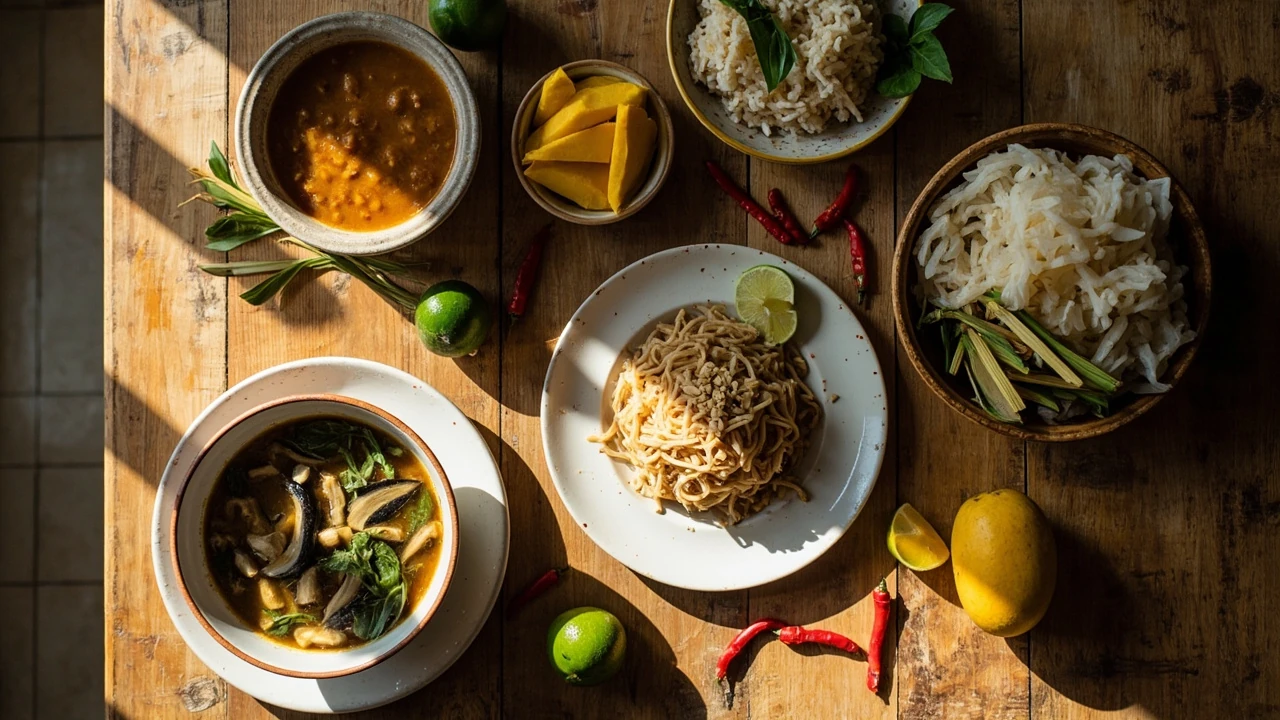
Thai food
A traveler walks into a small room in Chiang Mai, points at a menu written only in Thai script, and within ten minutes receives a bowl of khao soi, a plate of som tam, and a small dish of sticky rice. The flavors are sharp, smoky, sour, sweet, and hot in the same bite, yet nothing on the table tastes random. Thai food is built on a logic that is older than the modern restaurant, and once you understand that logic, menus stop being intimidating and kitchens start becoming predictable.
This guide is a working walkthrough of that logic. It covers how Thai food is actually built, how the four regional kitchens differ, which dishes every menu tends to share, how the flavor balance works, and how to read a Thai menu whether you are a diner, a cook, or a restaurant operator thinking about adding a dish or two to your own line-up.
What “Thai food” actually refers to on a menu
The phrase “Thai food” gets used loosely. In strict terms it describes the cooking of Thailand, a country whose borders were drawn in the twentieth century and whose kitchens absorbed influences from China, India, Myanmar, Laos, Cambodia, Malaysia, and Portugal over several centuries. In practical terms, when someone types “Thai food” into a search bar, they usually mean one of three things: the everyday dishes found in Thai restaurants abroad, the regional cooking inside Thailand, or the home-cooked meals that Thai families eat during the week.
Most English-language menus outside Thailand flatten those layers into a few reliable categories: noodle dishes, curries, stir-fries, soups, salads, and rice plates. The categories are useful, but they hide the deeper structure. Inside Thailand, the kitchen is usually described by region, by the dominant flavor, or by the role a dish plays in a meal rather than by its cooking method.
That is the lens this guide uses. Instead of listing every Thai dish in alphabetical order, it explains the kitchen the way a cook would plan it: the building blocks, the regional logic, the dishes that appear everywhere, and the choices you face when you decide what to order, cook, or sell.
The five-flavor framework that holds the kitchen together
Thai food is usually described through a balance of five flavor notes: salty, sour, sweet, spicy, and sometimes bitter. That framework is not a marketing line. It is a working tool Thai cooks use to taste as they cook, and it is the single most reliable way to understand why a dish tastes the way it does.
The classic application of the framework is the balance table used in professional kitchens and home kitchens across Thailand.
| Flavor | Typical Thai source | What it does in a dish |
|---|---|---|
| Salty | Fish sauce, soy sauce, salted crab, shrimp paste | Sets the savory base and deepens other flavors |
| Sour | Lime juice, tamarind, vinegar, green mango | Lifts heaviness, balances richness, sharpens aromatics |
| Sweet | Palm sugar, white sugar, coconut milk, ripe fruit | Rounds sharpness, softens chili heat, carries aromatics |
| Spicy | Fresh bird’s eye chilies, dried chilies, chili paste | Adds heat, stimulates appetite, lengthens the finish |
| Bitter | Chinese bitter melon, bitter herbs, some green vegetables | Cuts fat, cleanses the palate, adds complexity in smaller doses |
Not every dish hits all five. A bowl of tom yum is usually strong on sour, salty, and spicy, with a little sweetness and a green herbal note that sits somewhere between bitter and aromatic. A plate of pad thai leans sweet, sour, and salty, with chili as a variable. Massaman curry, which reflects Indian influence, tilts toward sweet and savory with a softer heat. When a Thai cook tastes a dish during cooking, they are usually checking the position of those notes, not following a printed recipe line by line.
Four regional kitchens, four different logics
One of the biggest mistakes Western diners and new cooks make is treating Thai food as a single style. The country is large and its climate varies sharply, and the four main regional kitchens reflect that variation. Ordering, cooking, or menu-planning without the regional context usually leads to underwhelming results.
| Region | Key ingredients and influences | Signature flavor tendency | Representative dishes |
|---|---|---|---|
| Central (Bangkok and the Chao Phraya basin) | Coconut milk, palm sugar, fresh herbs, Chinese-influenced techniques | Balanced sweet-sour-salty, aromatic, often richer | Pad thai, green curry, tom yum goong, boat noodles, massaman curry |
| Northern (Chiang Mai, Chiang Rai, the mountains) | Heavier use of pork, fermented sausage, local herbs, Burmese influence | Milder heat, deeper savory notes, smoky and bitter accents | Khao soi, sai ua, nam prik, gaeng hang lay |
| Isan (northeastern Thailand) | Sticky rice, freshwater fish, grilled meats, strong Laotian roots | Hot, sour, salty, very herb-driven | Som tam, larb, jaew bong, grilled chicken with sticky rice |
| Southern (peninsular Thailand) | Coconut milk, seafood, turmeric, Indian and Malay influence | Spicy, rich, often with a sour edge from tamarind or lime | Massaman curry, gaeng som, khanom jeen, fish curries with turmeric |
For diners, the practical takeaway is simple. If a dish you have only ever eaten in a Western Thai restaurant tastes different in Thailand, you are usually tasting a different regional version of the same name, not a different recipe. If you operate a kitchen and want to add Thai food to your menu, the regional choice is the first real decision you make, because it sets your spice tolerance, your protein logic, and your equipment needs before you write a single recipe.
The pantry: the eight ingredients that quietly run the kitchen
Most of the visual drama of Thai food comes from the plate, but the real decision-making happens in the pantry. A small set of ingredients shows up in a huge percentage of the dishes, and a new cook can get surprisingly far by building a focused pantry rather than chasing every specialty item. The list below is a working minimum, not a complete shopping list for a Thai restaurant.
- Fish sauce: the main source of salt in most savory dishes. Thai brands such as Tiparos and Megachef are widely used outside Thailand.
- Palm sugar: a soft, caramel-like sugar sold in blocks or jars. It sweetens curries, dressings, and dipping sauces more gently than white sugar.
- Thai chilies: small, hot, and used fresh or dried. The common variety is the bird’s eye chili (prik kee noo), which is significantly hotter than a jalapeño.
- Limes: usually used as fresh juice, sometimes with the zest. Bottled juice loses the bright top note that the dishes depend on.
- Coconut milk: used in curries, soups, and some desserts. The canned, full-fat version is the most reliable for restaurant use.
- Galangal, lemongrass, and kaffir lime leaves: the core aromatics for soups and curries. They are not interchangeable with ginger, regular lime leaves, or other citrus leaves.
- Shrimp paste (kapi): a fermented paste that adds a deep, salty umami to dips, chili pastes, and some curries. Used in small amounts.
- Jasmine rice and sticky rice: jasmine rice covers central and southern meals; sticky rice is the staple in the north and northeast.
Other ingredients that appear in a working pantry as you grow: tamarind paste for sourness, Chinese broccoli and Thai basil for stir-fries, holy basil for pad krapow, long beans for some curries, and bitter melon for specific regional dishes. The deeper you go into one region, the more specialized the list becomes.
The dishes that appear on almost every Thai menu
If you walk into a Thai restaurant in Bangkok, London, or Los Angeles, the menu tends to share a recognizable set of dishes, even though the execution varies. The list below explains what each one is, how it is built, and what to expect from a good version. It is the practical core of what most readers mean when they search for Thai food.
- Pad thai: stir-fried rice noodles with egg, tofu or shrimp, bean sprouts, garlic chives, tamarind, fish sauce, and palm sugar. Served with crushed peanuts, lime, and sometimes a small portion of chili powder. A good version should taste balanced: sweet, sour, and salty in the same bite, with a clean char from a hot wok.
- Green curry (gaeng keow wan): a coconut-based curry with green curry paste, Thai basil, eggplant, and usually chicken, beef, or tofu. The “green” refers to the paste, which is made from green chilies, lemongrass, galangal, and herbs. It is hot and aromatic, not mild.
- Red curry (gaeng phed): a similar coconut-based curry with red curry paste, which includes dried red chilies. The flavor profile is deeper and slightly less sharp than green curry.
- Massaman curry: a rich, mild, slightly sweet curry with Muslim Indian roots. Usually made with beef or chicken, potato, onion, peanuts, and warm spices like cardamom and cinnamon. It is one of the gentlest curries in the canon.
- Tom yum goong: a hot and sour soup with shrimp, lemongrass, galangal, kaffir lime leaves, lime juice, and chili. The clear version is more herb-forward; the creamy version (tom yum nam sai) adds evaporated milk or coconut milk.
- Som tam: a green papaya salad from the Isan region, pounded in a mortar with garlic, chilies, lime juice, fish sauce, palm sugar, and sometimes dried shrimp or peanuts. The balance of sweet, sour, salty, and spicy is the entire point.
- Pad krapow (moo, gai, or nuea): a stir-fry of minced meat with garlic, chilies, holy basil, and oyster sauce, served over rice with a fried egg. It is the everyday lunch of much of Thailand.
- Khao soi: a northern Thai curry noodle soup with egg noodles in a coconut curry broth, topped with crispy noodles and served with lime, shallots, and pickled mustard greens. Found throughout Thailand but rooted in Chiang Mai.
- Mango sticky rice (khao niao mamuang): sticky rice cooked with coconut milk and sugar, served with ripe mango slices. A dessert that appears on almost every Thai menu abroad, even where other regional dishes are missing.
The mix of dishes tells a small story. The international Thai menu is a negotiation: the dishes that travel are the ones with the most universal flavors and the simplest supply chain. That is why noodle dishes and curries are everywhere, and why Isan grilled meats and certain northern herb dishes are less common outside Thailand, even when they are everyday food at home.
How to read a Thai menu when you do not speak the language
Most Thai menus abroad use English, but a few useful cues help when you are looking at a Thai-language menu, a picture menu, or a short line of transliterated Thai. A short list of patterns covers the majority of decisions. A useful background reference is the Thai President, which places this part of the discussion in context.
- Pad: stir-fried. Pad thai, pad see ew, pad krapow. The base is a hot wok and a quick toss.
- Gaeng: curry, usually wet. Gaeng keow wan (green), gaeng phed (red), gaeng massaman.
- Tom: soup, usually a hot and sour one. Tom yum and tom kha are the two most common.
- Yum or nam tok: a salad, often tossed with lime juice, fish sauce, chili, and herbs.
- Khao: rice. Khao pad means fried rice; khao niao is sticky rice; khao soi is a specific noodle dish.
- Protein order: in Thai-language menus, the protein often comes first, then the dish. Gai krapow means chicken with holy basil; moo pad krapow means the same with pork.
- Spice level: if a menu does not ask, it is acceptable to ask whether the dish is medium or strong. Outside Thailand, “mild” is usually a Western compromise and not how the dish is made in its home kitchen.
If a menu lists a protein and a method together, the order is usually the reverse of English. Reading the menu as “protein first, technique second” prevents a lot of small mistakes, especially when you are choosing between a curry and a stir-fry with the same main ingredient.
Flavor balance in practice: a worked example with som tam
Som tam is the clearest example of the five-flavor framework in action, which is why Thai cooking teachers use it as a teaching dish. A typical green papaya salad starts with a base of fish sauce, lime juice, and palm sugar, then adds garlic and chilies pounded in a mortar, then papaya, long beans, and tomato. The dish tastes balanced when the base is slightly sweet at first, with a sour edge that follows, and a delayed heat that lingers.
For a new cook, a useful mental table looks like this:
| Adjustment | What to add or change | What it fixes |
|---|---|---|
| Too salty | Add a small amount of palm sugar and a touch of lime | Sharpens the sweet and sour notes to balance salt |
| Too sour | Add palm sugar gradually | Lifts the sweetness without flattening the acid |
| Too sweet | Add lime juice and a little more fish sauce | Restores sourness and a savory anchor |
| Too mild | Add more fresh chilies or a spoonful of the soaking liquid from the chilies | Raises heat without changing the other notes |
| Flat overall | Check the fish sauce first, then the lime | Most “flat” som tam is under-salted, not under-soured |
The same logic applies to pad thai, tom yum, and most curry pastes. The flavors are not a list of ingredients; they are positions in a balance, and a cook moves between them by adjusting the smallest set of sauces that appear in almost every dish.
Common misconceptions about Thai food
Several ideas repeat in casual conversation and online lists, and a quick working through them helps when you are choosing what to order, what to cook, or what to put on a menu.
- “All Thai food is spicy.” Heat is a variable, not a constant. Massaman curry, khao soi, and certain stir-fries are mild by Thai standards. Even som tam is balanced with sugar and lime, not designed to burn.
- “Thai food is just about heat and lime.” Heat and sourness are part of the framework, but the framework is five notes. The dishes that use bitter, sweet, or umami prominently are also part of Thai food.
- “Peanut sauce is the national sauce.” It is not. Peanut sauce is more of a Chinese-influenced dipping sauce served with satay. Most Thai dishes do not contain peanuts at all.
- “Thai food is unhealthy.” Restaurant Thai food can be calorie-dense, but the underlying structure is built on rice, fresh vegetables, herbs, fish, and small amounts of meat. The heavy dishes are a subset, not the whole kitchen.
- “The menu in Bangkok looks like the menu in New York.” International Thai restaurants tend to share the same ten to twenty dishes. Local Thai restaurants, especially outside Bangkok, often rotate through regional and seasonal dishes that never appear abroad.
None of these points are absolute, and they are not meant to be. They are starting positions, and a careful reader will adjust them as they encounter more of the kitchen.
Cooking Thai food at home: a realistic starting order
A common mistake is to start with the most photogenic dish. A more reliable path is to start with a few dishes that share techniques, so the time spent in the kitchen compounds. A small, focused progression tends to produce better results than a wide, shallow one.
- First week: build the base pantry. Fish sauce, palm sugar, jasmine rice, limes, and one or two pastes. A pre-made green curry paste is fine for the first round.
- Second week: cook a single stir-fry and a single curry. Pad krapow and a green curry with chicken cover the wok, the curry, and the rice plate in one go.
- Third week: cook a soup and a salad. Tom yum with shrimp and som tam with green papaya add the hot-sour and the pounded-salad techniques.
- Fourth week: cook noodles and a dessert. Pad thai and mango sticky rice round out the basics and use the pantry you already have.
- After that: pick a region. Once the central kitchen is comfortable, branch into northern (khao soi), Isan (larb, grilled chicken), or southern (turmeric fish curry) recipes.
This sequence is not the only way to learn the kitchen. It is just one path that tends to keep frustration low and progress visible, because each week adds a technique the next week relies on.
Adding Thai food to a restaurant menu: what to consider
For an operator outside Thailand, adding Thai dishes to a non-Thai menu is a real business decision, not just a creative one. The list below covers the practical questions to answer before writing the recipe. It is the same set of questions an experienced consultant would ask in a menu review, the kind of work that shows up in a piece on menu engineering.
- Source the pastes, or make them from scratch. Pre-made curry pastes are consistent and save hours. Scratch pastes are more authentic and let you control the heat. Most operators start with pre-made and move toward scratch for one or two signature dishes.
- Decide which region you are representing. A pad thai and a khao soi on the same menu is fine. A pad thai and a southern fish curry on the same menu is fine. A pad thai and a massaman curry with the same mild profile can flatten the category and confuse diners.
- Plan the spice dial. Many Western diners cannot handle the heat level of a true tom yum. Decide upfront whether you will dial the heat down for the room, or whether you will offer a clear heat scale. Either choice is workable; inconsistency is not.
- Control the proteins. The most reliable Thai proteins for non-Thai kitchens are chicken, pork, beef, tofu, and shrimp. Lamb, duck, and specialty fish work, but they need a tighter supply chain and clearer training.
- Train on the wok. A flat-top griddle will produce pad thai, but it will not produce the smoky breath of a hot wok. A well-seasoned carbon steel wok is the single most useful piece of equipment for this category.
- Set the price honestly. Pastes, fish sauce, and palm sugar are inexpensive, but the labor on a curry, a salad, or a noodle dish is real. Underpricing Thai food because the ingredients look cheap is a common reason the category fails to grow.
These points are operational, not creative. The creative choices happen on top of them: which two or three dishes to lead with, how to photograph them, and how to describe them on the menu so the diner understands the flavor profile before they order. That last step is part of the broader work of menu pricing and food brand strategy, and it is usually where the menu either wins or stalls.
Pairing Thai food with drinks and sides
Drinks and sides are part of the meal, and the choices are more structured than they look. A short working list helps both diners and operators. Readers can also consult the our organization for an independent source related to this section.
- Beer: lagers, especially lighter Thai brands like Singha and Chang, work with most spicy and sour dishes because the cold temperature and carbonation reset the palate.
- Tea: jasmine tea or oolong cleanses the palate between bites, especially with curries and stir-fries.
- Still water: the simplest pairing and the most useful one in a very spicy meal.
- Sweet drinks: Thai iced tea and iced coffee are popular but can over-sweeten an already sweet-leaning dish. Pair them with spicy or sour dishes, not with sweet curries.
- Rice as a side: jasmine rice is the default. Sticky rice is the right choice for northern and Isan dishes. Fried rice works as a base for saucy stir-fries, but it competes with the seasoning of the main dish.
None of these pairings are rigid. They are the kind of starting positions a server can use, and they help a diner avoid the most common pairing mistakes, which usually involve doubling the sugar or the heat in the same bite.
Vegetarian, vegan, and allergen notes
Thai food is more accommodating to plant-based eaters than it is often given credit for, but the adjustments are not free. A few working notes help avoid the most common mistakes.
- Fish sauce is the main animal-derived ingredient in many savory dishes. A vegan version requires either a vegan fish sauce, a soy-based alternative, or a clear shift to soy sauce with extra salt.
- Shrimp paste is hidden in many curry pastes and chili pastes. Pre-made pastes are the most common source. Vegan kitchens either make their own pastes or check the label carefully.
- Coconut milk and tofu are widely used and well-tolerated. Many curries and noodle dishes already have a vegetarian or vegan version in the canon, especially pad thai and green curry with tofu.
- Peanut allergies. Peanuts appear in pad thai, som tam, and satay. A kitchen serving guests with peanut allergies should know which dishes are safe and which are not, and it should not rely on “we can leave the peanuts out” as a complete answer, because some dishes use peanut-derived sauces.
These notes are starting points, not a complete allergen plan. A serious kitchen treats allergens as a separate operational system, the same way it handles the broader questions of how the menu is communicated to guests before they order.
Frequently asked questions
What defines Thai food compared to other Southeast Asian cuisines?
Thai food is defined by its balance of salty, sour, sweet, spicy, and sometimes bitter notes, its heavy use of fresh herbs and aromatics like lemongrass, galangal, and kaffir lime leaves, and the absence of a single dominant sauce. Vietnamese food leans toward fresh herbs and fish sauce with a lighter sourness. Malaysian food uses more coconut and rempah-style spice pastes. Indonesian food tends toward richer, sweeter, more peanut-forward profiles. The Thai balance is the most explicit of the three.
Is Thai food always spicy?
No. Heat is a variable, and many Thai dishes are mild or moderate. Massaman curry, khao soi, and many noodle stir-fries are gentle by Thai standards. Within a meal, diners can control the heat by asking for fewer chilies in pounded salads and curries, and by choosing milder dishes alongside hotter ones.
What are the most popular Thai dishes outside Thailand?
Pad thai, green curry, red curry, massaman curry, tom yum soup, pad krapow, som tam, and mango sticky rice are the dishes that appear most often on Thai menus abroad. The exact list varies by city, but those eight are the most consistent across the United States, the United Kingdom, and most of Europe.
What is the difference between Thai curry pastes?
Green, red, and yellow pastes share a base of lemongrass, galangal, garlic, shallots, and shrimp paste, but they use different chilies and aromatics. Green is made with fresh green chilies and is the sharpest and most herbaceous. Red uses dried red chilies and is deeper. Yellow includes turmeric and is closer in profile to a mild massaman paste. Massaman itself adds Indian-influenced warm spices like cardamom, cinnamon, and cloves.
Can Thai food be made vegetarian or vegan?
Yes, with a few substitutions. Fish sauce can be replaced with vegan fish sauce or light soy sauce with extra salt. Shrimp paste in curry pastes needs to be avoided or made from scratch. Tofu, vegetables, and coconut milk work in almost every curry and noodle dish. Many Thai restaurants outside Thailand already label a vegetarian section on the menu for this reason.
What rice should I serve with Thai food?
Jasmine rice is the default for central, southern, and most international Thai meals. Sticky rice is the right choice for northern and Isan dishes, including som tam, larb, and grilled meats. Basmati is not a traditional pairing and tends to sit awkwardly next to Thai curries because of its different aroma and grain length.
Why does pad thai taste different at different restaurants?
The flavor of pad thai is set by the balance of tamarind, fish sauce, and palm sugar, and that balance is rarely identical from one kitchen to the next. A sweeter pad thai usually has more palm sugar and less tamarind. A more sour version has more tamarind and lime. The heat comes from chili powder served on the side, and the texture comes from the wok temperature. A version that tastes flat usually means the wok was not hot enough or the sauce was added too early.
How do I know which region a Thai dish comes from?
Curries and stir-fries with coconut milk and palm sugar are usually central or southern. Noodle soups with mild, herbaceous broths are usually northern. Salads and grilled meats with sticky rice are usually Isan. A dish that uses turmeric and fish prominently is usually southern. Asking the restaurant or checking a regional cookbook is the most reliable way to confirm.
Is Thai food healthy?
It can be. The everyday Thai diet is built on rice, fresh vegetables, herbs, fish, and small portions of meat, with sweets and fried foods reserved for specific occasions. Restaurant Thai food can be higher in sodium, sugar, and fat because of portion size and added sauces. Ordering vegetable-forward dishes, asking for less sugar in dipping sauces, and choosing steamed over fried sides keeps the meal close to the everyday Thai pattern.
What is the best way to start cooking Thai food at home?
Build a small pantry first: fish sauce, palm sugar, jasmine rice, limes, and one or two pre-made curry pastes. Then cook a stir-fry and a curry in the same week so the pantry and the techniques share. Add a soup and a salad the next week, and add noodles and a dessert the week after. After a month, branch into one regional kitchen and learn one or two of its specific dishes well.
What are the most common mistakes when cooking Thai food?
The most common mistakes are overcooking the aromatics, under-salting with fish sauce, skipping the palm sugar, using a wok that is not hot enough, and trying to cook every dish at once instead of building the kitchen one technique at a time. A close second is treating the dish as a recipe to follow rather than a balance to taste, which is the part that makes Thai food feel alive rather than formulaic.