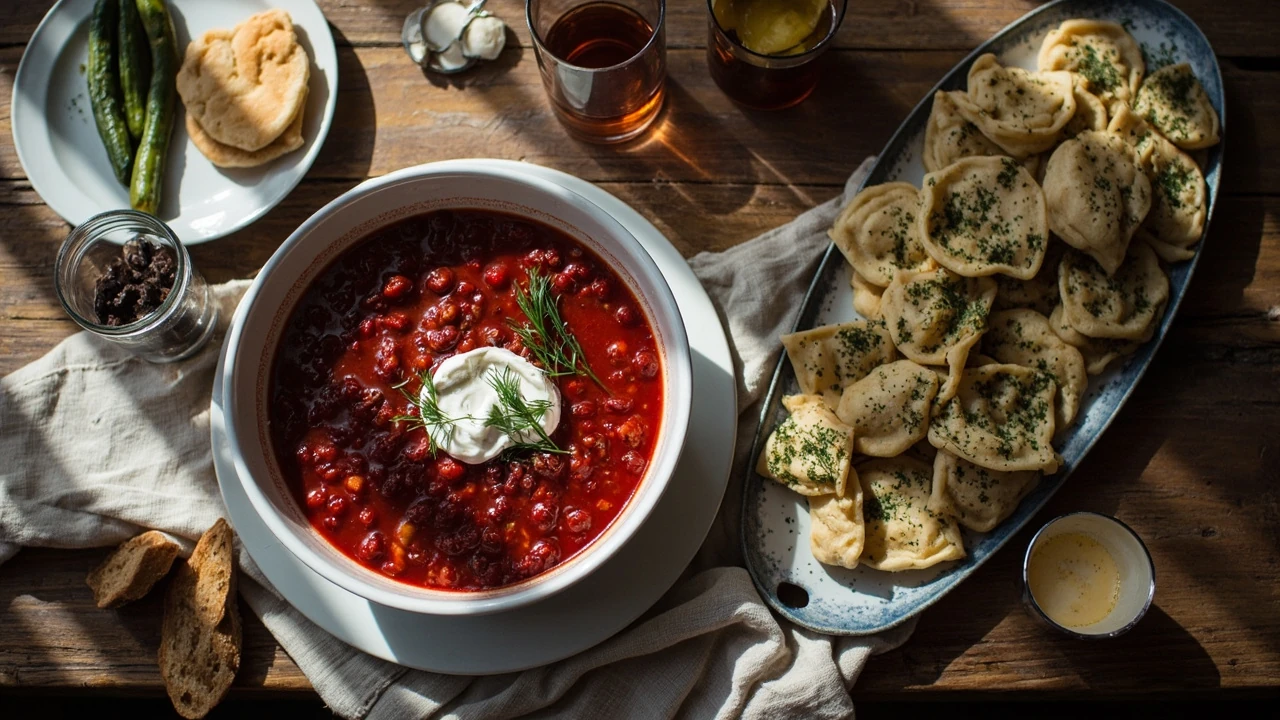
Walk into a grandmother’s kitchen in Yaroslavl on a cold February morning and you will find the logic of russian food before you find the recipes. A pot of soup stretches across lunch and dinner. A jar of fermenting cucumbers sits on the windowsill next to a second jar of sauerkraut. Bread is dark, dense, and slightly sour. Meat is treated as a small accent, not the center of the plate. The meal is built to warm, to last, and to feed a household through a long winter, not to impress a guest with a single signature protein.
That domestic logic is what most English-language writing about russian food gets wrong. The cuisine is usually described as a list of famous dishes: borscht, beef stroganoff, pelmeni, blini, caviar. The dishes are real. They are also the wrong place to start, because each one of them only makes sense once you understand the climate, the storage problem, the Orthodox calendar, the long relationship with neighboring cuisines, and the pantry of preserved, soured, and roasted ingredients that anchors every meal. This guide is built around that practical logic. By the end, you will know what russian food actually contains, why it tastes the way it does, how the regional kitchens differ, and which dishes are worth cooking at home if you want to understand the cuisine rather than just photograph it.
What russian food actually is
Russians, Ukrainians, Belarusians, and several smaller Slavic and Turkic communities in the region share a large common plate. Because the borders have shifted, the kitchen is best understood as a tradition centered on the East Slavic, Volga, and Siberian foodways of the Russian Federation, with strong overlap into Ukrainian, Belarusian, Tatar, Georgian, Armenian, and Central Asian cooking. When English speakers say russian food they usually mean this wider Slavic and post-Soviet cluster, even though only some of it originated inside modern Russia’s borders. A practical working definition is helpful:
- It is the home cuisine of the Russian Federation and its close Slavic neighbors, shaped by long winters, the Orthodox liturgical calendar, peasant preservation methods, and later imperial urban refinement.
- It is defined less by technique and more by storage, seasonality, and the conversion of cheap, hardy ingredients into something filling and warming.
- It is a cuisine of soups, porridges, preserved vegetables, dark bread, small portions of meat, and clear sweet-savory contrasts, especially in the use of honey, jam, and sour cream.
Once you hold that working definition, famous dishes stop looking like random exports. Borscht is one expression of the broader Slavic beet-and-sour soup family. Pelmeni belong to the same dumplings as Ukrainian varenyky, Siberian Tatar-influenced pelmeni, and Central Asian manti. Beef stroganoff is a late-imperial refinement of an older French-influenced sauce tradition applied to cheap cuts of beef. The patterns are old, and the famous plates are just the most photographed tip of them.
The climate problem that shaped the kitchen
Most of European Russia sits at roughly the latitude of southern Canada. Moscow averages about five months a year with daytime highs below 10°C, and large parts of Siberia see seven or eight. That single fact explains more about russian food than any single recipe. A cuisine built under those conditions has to solve a few specific problems:
- How to keep food through a winter without reliable fresh produce. The answer was fermentation in brine, lactic acid preservation in cabbage and cucumbers, smoking and salt-curing of fish and meat, drying of mushrooms, and the long boiling of root vegetables and grains into dense porridges and soups.
- How to feed a large family cheaply when meat is expensive. The answer was to use meat as a flavoring for grain or vegetable dishes, not as a standalone steak. A pot of buckwheat with a few pieces of stewed beef, a cabbage soup with a single smoked ham hock, or a mushroom-and-kasha filling in a pastry carried the protein across many meals.
- How to warm the body without alcohol. Soups, porridges, hot sweet tea, and very hot drinks like sbiten filled the role. Cold appetizers and cold soups like okroshka are an exception that proves the rule, made for the brief heat of summer when the kitchen needs a break from the stove.
If a dish on a russian menu looks heavy, sour, or both, it is usually a solution to one of these three problems. The sourness is not a style choice. It is the taste of lactic fermentation, the dominant preservation method, and it shows up in the rye bread, the pickled cucumbers, the schi cabbage soup, and the fermented drink kvass.
The Orthodox calendar and the rhythm of the year
Russians were Christianized in 988, and the Orthodox liturgical calendar still structures the eating year, even for households that are no longer practicing. Two rhythms matter. The first is the maslenitsa butter week before Lent, when dairy, eggs, and rich baked goods are eaten in preparation for fasting. The second is the long Great Lent itself, plus four shorter fasts through the year, which together remove meat, dairy, and eggs for roughly 200 days a year in observant households.
This is why the cuisine is unusually good at feeding people without meat, and unusually reliant on a small set of substitute ingredients. Lenten cooking developed a whole pantry of mushroom dishes, fish dishes, grain porridges, and vegetable pies. The result is that a modern russian table alternates between rich and lean weeks, and the same household will eat both blini with butter and blini with mushroom filling in the same month.
The pantry: ten ingredients you will meet again and again
You can read every russian recipe you like, but you will keep finding the same small set of ingredients. These are the ones worth stocking if you want to cook the cuisine at home without buying twenty specialty items.
| Ingredient | What it is | Why it matters in russian food |
|---|---|---|
| Smetana | Fermented sour cream, higher fat than most western sour cream | Default finishing dairy, dolloped on borscht, pelmeni, blini, and salads |
| Tvorog | Soft, fresh curd cheese, similar to farmer cheese or quark | Base for sweet and savory dishes: sirniki pancakes, vareniki fillings, casseroles |
| Kefir | Thin fermented milk drink | Drinking culture, salad dressings, base for cold okroshka in summer |
| Rye flour | Dark, slightly sour flour milled from rye berries | Source of borodinsky and other dense dark breads that anchor every meal |
| Buckwheat (grechka) | Toasted triangular groats, cooked into kasha | The default savory porridge and side dish, used as a filling and a base |
| Beets, cabbage, cucumbers, dill, horseradish | Core vegetables | Pickled, fermented, or fresh, they supply the acid backbone of the cuisine |
| Dill and parsley | Fresh herbs | Heavy use of dill in particular, far more than in most Western European cuisines |
| Smoked and cured fish | Includes seld herring, smoked salmon (syomga), and shproty sprats | Holiday zakuski spreads, Lenten meals, simple family suppers |
| Honey | Traditional sweetener before refined sugar was cheap | Used in blini, pryaniki spice cakes, tea, and sauces for poultry |
| Kvass | Fermented drink made from dark bread, rye flour, or beets | Cooking liquid for okroshka and botvinya, also a low-alcohol summer drink |
Once these ten are familiar, about 70 percent of the russian food canon becomes legible. The remaining 30 percent is mostly variations on how they are combined.
The structure of a russian meal
Russians do not usually build a meal around a single main protein the way a French or American meal does. A normal family lunch or dinner is closer to a small buffet of three or four dishes set on the table at the same time, and people compose their own plate. The components are predictable:
- A hot first course, almost always a soup. Borscht, schi, ukha (clear fish soup), soljanka, rassolnik with cucumbers, or a simple chicken noodle soup with thin vereshchaka noodles.
- A hot main, usually a protein with a grain or potato side. Buckwheat, mashed potatoes, rice, or boiled potatoes are the standard vehicles, with the protein in a sauce or small portion on top.
- A cold spread of zakuski appetizers, brought out at the start of the meal and left on the table. Pickled cucumbers, sauerkraut, khleb rye bread, smoked fish, selyodka pod shuboy herring under a fur coat, mushroom zhulien, and a small salad.
- A sweet ending, often a simple pastry, varenye (whole fruit in heavy syrup), tea, or a fruit drink. Restaurant tasting menus sometimes end with syrniki or honey cake (medovik).
The zakuski table is the part most tourists never see, because it is the most domestic. It is also where the cuisine’s personality really lives: a slab of cold boiled tongue, a dish of studen meat aspic, a jar of pickled gherkins, a small bowl of grated horseradish with beet, a few slices of dark bread, and butter. To a Western guest that looks austere. To a Russian host it is the normal opening of every celebration.
Iconic dishes, and what each one is actually for
Borscht
Borscht is the most mis-translated dish in russian food. It is not a single recipe. It is a family of beet-and-cabbage soups that exists in Russian, Ukrainian, Polish, Lithuanian, and Romanian kitchens, with each country claiming the canonical version. The Russian variant usually includes beef or pork broth, beets, cabbage, potatoes, carrots, onions, tomato, and a final spoonful of smetana and a generous pour of fresh dill. The red color comes from beets cooked with a little acid. The deep savory flavor comes from long, gentle simmering and a final addition of sautéed vegetables stirred in at the end.
It is a kitchen-clearing soup. Whatever root vegetables are in the cellar go in. Whatever leftover meat is around goes in. It improves on the second day, which made it ideal for the Orthodox fasting rhythm and for a household without refrigeration.
Schi
Schi is the older, more specifically russian soup. It is built on sauerkraut, not fresh cabbage, and often includes a smoked ham hock or sausage. The flavor is sharper and more sour than borscht. Schi is sometimes called the national soup, and a saying goes that schi da kasha (cabbage soup and porridge) is the food of the people. It is also the soup most often associated with the Lenten fast, because the meat is optional and the flavor still works with just mushrooms or fish.
Pelmeni
Pelmeni are small, thin-walled meat dumplings, usually filled with a mix of beef, pork, and sometimes mutton or game. They are boiled and served with butter, vinegar, sour cream, or a simple broth, often with a heavy hand of black pepper and dill. The shape is the point: small, frozen quickly, and stored in sacks in the yard through winter. The dumplings are a Siberian adaptation of the broader dumpling family that runs from Chinese jiaozi through Central Asian manti and into the Slavic vareniki.
Blini
Blini are thin yeasted pancakes made from buckwheat, wheat, or a blend. They are eaten year-round, but the most important week is maslenitsa, when they mark the end of winter and the last days before Lent. The classic pairings are butter and caviar, smoked salmon and sour cream, mushrooms, jam, honey, or tvorog with sugar. The thin, slightly sour buckwheat blini is a different dish from a French crepe and from an American pancake, and the difference is structural: blini batter ferments for hours, which gives it lift and a slight tang that the others do not have.
Beef stroganoff
Beef stroganoff is a late-imperial dish, developed in the 19th century by a French-trained chef working for the Stroganov family, a merchant dynasty in Siberia. The original is a sautéed lean beef served in a mustard-and-sour-cream sauce. The 20th-century Soviet version thickened the sauce with flour, added tomato paste, and started serving it over rice or egg noodles, which is the form most Western readers recognize. Both are valid. The imperial version is sharper, cleaner, and closer to a French stroganoff; the Soviet version is softer, sweeter, and built for cafeteria service.
Olivier salad
The Olivier salad, sometimes called stolichny salad after the capital, is the New Year and celebration centerpiece of russian food. The 19th-century original by the French chef Lucien Olivier at the Hermitage restaurant in Moscow included grouse, capers, crayfish tails, and Provençal truffles. The Soviet and post-Soviet version is boiled potatoes, carrots, peas, dill pickles, eggs, bologna or boiled chicken, and a thick mayonnaise dressing. It is not a sophisticated dish, and that is the point. It is the dish that says: the table is set, the year is turning, everyone is fed.
Regional kitchens inside russian food
Treating russian food as a single national kitchen hides how much variation exists across the Federation. A few of the most important regional differences:
| Region | Climate and farm profile | Distinctive dishes and habits |
|---|---|---|
| Central Russia (Moscow, Tver, Vladimir) | Cold continental, mixed farming, orchards, dairy | Whole-mushroom and grain cooking, kasha with butter, kalya fish soups, mushroom zhulien |
| North (Arkhangelsk, Vologda, Karelia) | Subarctic, fishing, dairy, forest | Heavy fish cookery including ukha and pyatiminutka, berry preserves, rye porridge, rzhanoy dark bread |
| South (Rostov, Krasnodar, lower Volga) | Steppe, grain, sunflower oil, more fresh produce | Don and Kuban shchi, fish roe, sunflower-oil fried fish, vegetable pies with more greens |
| Volga and Tatar influence (Kazan, Tatarstan) | Mixed Tatar-Russian population, halal-friendly protein traditions | Chak-chak honey dessert, echpochmak triangular meat pies, tukmach noodle soup, horse-meat and lamb dishes |
| Urals and Siberia (Yekaterinburg, Novosibirsk, Tyumen) | Cold, fishing rivers, forest game, later Soviet industrial | Pelmeni as a daily staple, stroganina raw frozen fish, ragu and manty from the south, forest mushrooms |
| Far East (Vladivostok, Kamchatka) | Pacific fisheries, Chinese, Korean, and Ainu influence | Red caviar, kapusta with sea greens, Korean-influenced salads in the south, salmon roe on blini |
| Caucasus spillover (North Caucasus) | High-altitude, lamb, herbs, flatbreads | Khachapuri-style cheese breads, shashlik kebabs, herb-heavy sauces, chakhokhbili chicken |
What this table is really showing is that russian food in the strict national sense is a Northern and Central Slavic kitchen, while the country as a whole eats the cuisines of more than 190 ethnic groups, including the cuisines of Tatar, Bashkir, Chechen, Ossetian, Buryat, Yakut, and many others. Travelers who only eat in Moscow hotels often miss most of this variety.
How russian food was reshaped in the 20th century
The cuisine most tourists encounter in 2026 is, in practice, a Soviet kitchen with some imperial flourishes. That matters because the Soviet period actively reorganized how Russians ate, and the reorganization is still visible in restaurants, cafeterias, and home tables.
- Standardization of dishes: Classic dishes were simplified for cafeteria, factory kitchen, and stolovaya service. Olivier lost its grouse, borscht became a one-pot beet soup, stroganoff became a roux-thickened sauce over noodles. The simplified versions are what most Russians grew up with and what most cookbooks still teach.
- Book of Tasty and Healthy Food: The 1939 state cookbook, repeatedly revised, became the standard reference for an entire generation and codified the Soviet version of russian food, including a heavy emphasis on soups, salads, compotes, and hot mains in the sequence most kitchens still follow.
- Queue and shortage culture: Long Soviet decades of partial shortages made cuisine stretch further. A single chicken might feed a family as a soup, a pie, and a salad across three days. That pattern still shapes portioning and the habit of always serving a spread rather than a single plate.
- Industrial baking and dairy: State bakeries made dense rye loaves and baton white bread cheap and universal. Industrial smetana, tvorog, and kefir normalized the fermented-dairy trio for almost every household. The pantry today still looks like that Soviet standard, with a few imported or boutique additions.
Post-Soviet russian food has, in turn, moved in two directions at once. A high-end restaurant scene in Moscow and Saint Petersburg has rediscovered imperial French-Russian cooking, regional foraging, and contemporary plating. At the same time, an aggressive fast-casual layer built around shashlik, shawarma, blini, and pelmeni has made those dishes into everyday street and station food. Both layers are still recognizably the same cuisine.
Tea, drinks, and the role of the table
No overview of russian food is complete without the drink culture, because the table is built around it. Russians drink a lot of tea, traditionally served in a glass holder (podstakannik) with a slice of lemon and a small spoonful of jam on the side. Black tea, often Indian or Sri Lankan in the 20th century and increasingly Chinese and Kenyan today, is the default. Coffee exists, but is treated as a smaller, after-meal drink rather than the anchor of a social meeting.
Other drinks you will meet at the table:
- Kvass: A low-alcohol fermented drink made from rye bread, rye malt, or beets. It is sour, slightly sweet, and very common in summer. It is also used as the liquid in cold okroshka soup, which is essentially a salad in kvass.
- Kompot: A cold fruit drink made by boiling dried or fresh fruit in water with sugar and letting it cool. It is what most Russian children grow up drinking at lunch instead of soda.
- Mors: A cold drink made from raw crushed berries, usually lingonberry, cranberry, or sea buckthorn, sweetened and left to infuse. It is sharper and more acidic than kompot.
- Medovukha: A traditional low-alcohol honey drink, often homemade, with a flavor somewhere between mead and cider.
- Vodka: Served ice-cold, almost always with food, usually as a small shot alongside pickled cucumbers, smoked fish, khleb, or seld herring. The classic food pairings are sour, salty, and fatty because they slow the alcohol’s effect.
A Russian meal is not a quick sit-down. It is a slow rotation of soup, hot main, and small cold bites with a constant flow of tea, and it is meant to last. The structure is one of the reasons visitors sometimes describe russian hospitality as overwhelming. From the host’s side, the abundance is the point.
How to cook russian food at home without buying a whole new kitchen
Most home cooks can cover a serious amount of the cuisine with equipment they already own: a heavy pot, a cast-iron skillet, a griddle for blini, and a few sheet pans. The ingredients that require a little planning are the dairy and the rye. Smetana is widely available in Eastern European and international grocery stores. A good substitute is full-fat European-style sour cream with a small spoon of buttermilk stirred in. Tvorog is harder to find; a workable substitute is a well-drained whole-milk cottage cheese or a 4:1 blend of ricotta and plain yogurt, strained through cheesecloth for an hour.
For the rest, the practical approach is to start with five dishes that teach the patterns of the cuisine, then expand:
- Borscht with beef: A weekend project that teaches beet cookery, the vegetable sauté, the smetana finish, and the second-day improvement.
- Schi with sauerkraut: Teaches fermented-cabbage cookery and the smoked-ham-hock flavor base.
- Pelmeni from scratch: A dough and filling exercise that produces a freezer staple, exactly as a Russian household would.
- Blini with buckwheat flour: Teaches the overnight yeast ferment and the thin-pour technique. The same batter works for sweet and savory toppings.
- Olivier salad: Surprisingly instructive. It teaches the boil-and-dice rhythm of the cold table and how a Russian meal is built from small, repeatable components.
Once those five are in your rotation, the next tier is vareniki with potato or cherry fillings, syrniki cottage cheese pancakes, kasha with butter and fried onions, beef stroganoff in the imperial style, and a simple ukha fish soup. The learning curve is gentle. The ingredients are forgiving. The leftovers are usually better than the first meal.
Common mistakes when cooking russian food abroad
A few patterns repeat in Western kitchens and are worth avoiding:
- Skipping the smetana or the butter finish. Russian soups and porridges are often described as bland by people who leave out the dairy. The fat and the lactic acid are not garnish; they are part of the dish.
- Over-sweetening blini. Western pancake batter is sweeter. Blini batter should be only lightly sweet or fully savory. The toppings carry the sweetness.
- Using fresh cabbage where sauerkraut is required. Schi specifically depends on fermented cabbage. Substituting fresh cabbage produces a different soup, and not the one the recipe is asking for.
- Serving stroganoff over rice in the imperial style. The imperial stroganoff is served with the sauce and the meat on their own, with bread or simple boiled potatoes on the side. The rice-and-stroganoff pairing is a Soviet cafeteria invention and is fine, but it is worth knowing which one you are cooking.
- Treating dill as optional. In russian food, dill is structural. It is used in greater quantity and at more stages of cooking than in most Western kitchens. Cut the stems and add them to stocks; chop the fronds and add them at the end.
Where russian food is going
The current moment in russian food is unusually interesting. Three pressures are pushing the cuisine in different directions at once. The first is the high-end revival in Moscow and Saint Petersburg, where chefs are working with regional foraging, ancient grain varieties, and old recipe archives to reframe the cuisine for a fine-dining audience. The second is the localization of post-Soviet street food, in which shashlik, khachapuri, manti, and plov are increasingly treated as the everyday russian plate, especially in the regions. The third is the export of the cuisine through supermarket shelves in Eastern Europe, the Caucasus, and Central Asia, where Russian-branded pelmeni, tvorog, and kvass are now routine pantry items.
For an English-speaking reader, the practical result is that more russian food is now reachable from outside the Federation than at any point in the last thirty years. Diaspora restaurants in London, New York, Berlin, and Tel Aviv are doing serious work on borscht, shchi, and the cold zakuski table. Specialty importers are bringing real smetana, tvorog, dark rye, and grechka buckwheat into ordinary supermarkets. A home cook who wants to learn the cuisine in 2026 has a much shorter path than a home cook in 2006 did.
That said, the cuisine is still widely misrepresented in English. The biggest persistent error is treating russian food as a list of dishes. It is a kitchen logic, a pantry, a calendar, and a set of preservation habits. Once you learn the logic, the dishes teach themselves.
A practical checklist before you cook or order
Use this short list as a way to test whether a restaurant, recipe, or dinner party actually understands the cuisine. If most of these boxes are checked, the food is in the right family.
- Is there a hot first-course soup, not a small appetizer portion of the main protein?
- Is there dark rye bread or a reasonable substitute, served with butter?
- Is smetana offered as a finish, not a garnish?
- Is dill used at multiple stages of the meal, not just as a plate decoration?
- Is there a cold zakuski component on the table, even if it is just pickled cucumbers and herring?
- Is tea offered throughout, not only at the end?
Six small details. They are the difference between a russian meal and a generic Eastern European menu.
Frequently asked questions
Is borscht a russian or a ukrainian dish?
Both, and the honest answer is that beet-and-cabbage soup predates either modern nation. The Russian, Ukrainian, Polish, Lithuanian, and Romanian versions are all real, and the dish is shared across the region. Each tradition has its own canonical version, and debates about whose is the original are part of the cultural conversation, not a settled fact.
What is the difference between pelmeni and vareniki?
Pelmeni are small, thin-walled dumplings, usually filled with raw minced meat and boiled, and are strongly associated with Siberia and the Urals. Vareniki are larger, half-moon dumplings, usually filled with cooked or sweet fillings like potato, mushroom, cabbage, or cherries, and are more central to Ukrainian and southern Russian cooking. Both use a similar unleavened dough and are often served with smetana.
Is russian food always heavy and sour?
The cuisine leans that way because the climate and the pantry push it there, but it also includes bright summer cooking. Cold soups like okroshka and botvinya, fresh berry mors, and lighter Lenten dishes with mushrooms, greens, and fish all exist in the same tradition. A well-balanced russian table changes with the seasons, with a sour-and-heavy winter and a fresh-and-cold summer.
Are russian and soviet food the same thing?
No. Soviet food is a 20th-century simplification and standardization of the older imperial and peasant cooking. The Soviet version is the one most Russians grew up with, and it is the version that dominates most cookbooks and restaurant menus, but the older imperial and regional traditions are richer and more varied, and they are being actively revived by contemporary chefs.
Do russians actually drink vodka with every meal?
No. Vodka is reserved for celebrations, guests, and zakuski-heavy tables. Daily meals are built around soup, hot main, and tea, often without any alcohol. When vodka is served, it is almost always with cold pickled or smoked food, not with a hot main course, and the standard serving is a single small shot rather than a long pour.
What should a beginner cook first if they want to learn russian food?
Start with borscht and blini. Borscht teaches the vegetable sauté, the beet, the smetana finish, and the second-day improvement. Blini teach the overnight batter, the thin pour, and the sweet-savory topping logic. After those two, pelmeni, schi, and Olivier are the natural next steps.
Is russian food vegetarian friendly?
More than the stereotypes suggest, because of the Orthodox fasting tradition. Lenten russian cooking has a long history of mushroom, grain, fish, and vegetable dishes that work for vegetarian and vegan tables. Schi with mushrooms, mushroom zhulien, mushroom and cabbage vareniki, vegetable borscht, and buckwheat kasha with mushrooms are all in the canon.
What is the role of tea in russian food?
Tea is the central drink of the table and is served throughout the meal, not only at the end. It is usually strong black tea, often served in a glass holder with a slice of lemon, and accompanied by small sweets, jam, pryaniki spice cakes, or dried fruit. A russian meal without tea feels incomplete to most Russian guests.
How is russian food different from other eastern european cuisines?
It shares a lot with Ukrainian, Belarusian, and Polish cooking, but it is set apart by the depth of fermented-dairy and fermented-vegetable use, the prominence of buckwheat and rye, the Lenten table, and the strong Tatar and Siberian influence on its dumpling and meat traditions. The colder, longer-storage-driven core of the cuisine distinguishes it from the more vegetable-forward Mediterranean or Caucasian kitchens to the south.
Where can I learn more about russian food beyond this article?
Two good starting points are the English Wikipedia article on Russian cuisine for a general map of the kitchen and its history, and the late Soviet and post-Soviet editions of the Book of Tasty and Healthy Food for a snapshot of how the canon is actually taught. A site that covers how to market and present a food business well is a good guide to restaurant branding for menus like these, and if you are building content around a cuisine like this, the turn one signature dish into a month of content approach is a useful place to start.