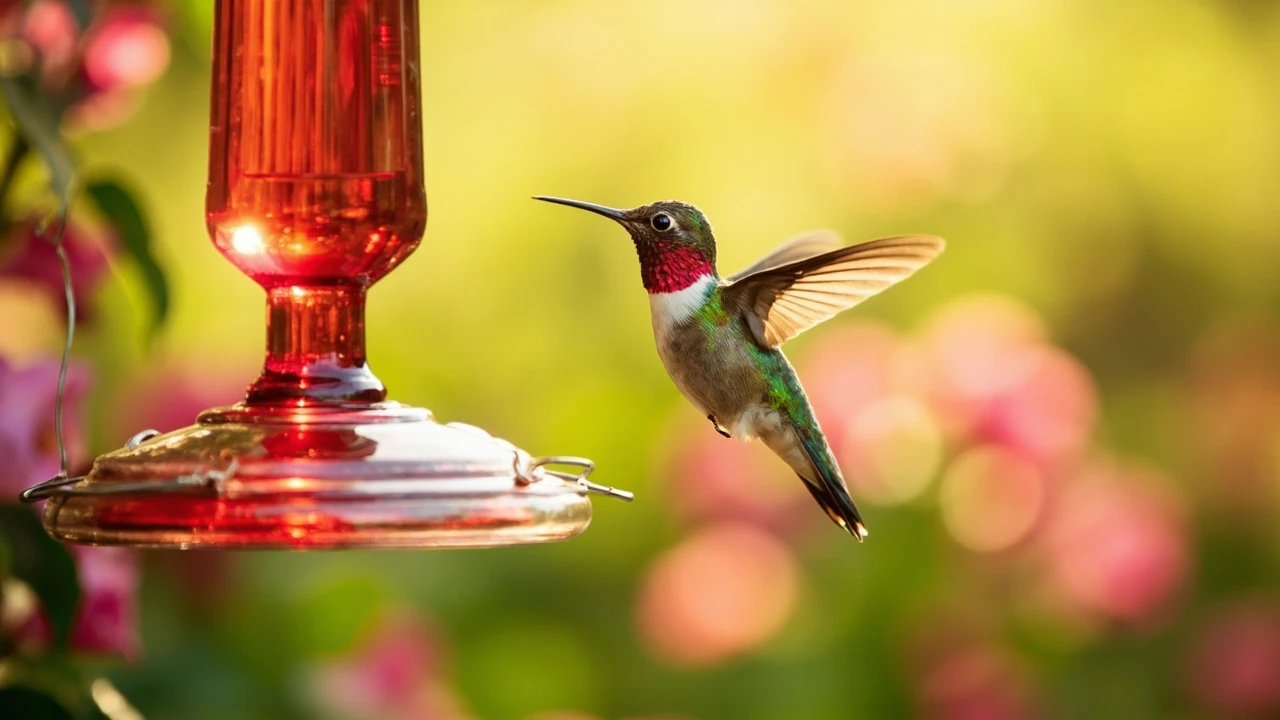
Hummingbird food: what to put in the feeder and what to skip
A half cup of white table sugar dissolved in two cups of warm water is the safest homemade hummingbird food you can offer, and the recipe has not changed in decades because the science has not changed. Ornithologists, rehabilitation centers, and long-running citizen-science projects all converge on the same simple formula, and the reason is straightforward: hummingbirds need a liquid that resembles the sucrose-dominant nectar of the flowers they coevolved with. Anything richer, sweeter, dyed, or fermented throws off that balance and can sicken the birds you are trying to help.
The practical job of this guide is to walk you through hummingbird food from the moment you mix it to the moment you pull the feeder down for the season. You will see exactly how to mix it, how often to change it, how to clean the feeder, which feeders hold up best, and which widely repeated tips are actually myths. The goal is fewer wasted batches, fewer spoiled birds, and a yard that hums from spring through migration.
The safe hummingbird food recipe and why the ratio matters
The standard ratio for homemade hummingbird food is one part plain white granulated sugar to four parts water by volume, which works out to about a quarter cup of sugar per cup of water, or roughly a 20 percent sucrose solution. This concentration falls within the range of natural flower nectars, which typically sit between 18 and 25 percent sugar. That match is not a coincidence; researchers at organizations like the Cornell Lab of Ornithology have long pointed out that stronger solutions do not give hummingbirds more energy, they just dehydrate them faster because the birds have to process excess sugar with extra water they do not have.
Use only plain white cane or beet sugar. Brown sugar, raw sugar, turbinado, honey, molasses, agave, artificial sweeteners, and fruit juices all cause problems. Honey promotes a fungal bloom in the feeder that can cause a fatal tongue infection in hummingbirds, and brown or raw sugars carry iron and trace minerals that accumulate in a tiny bird’s body faster than its kidneys can clear them. Artificial sweeteners provide no calories at all, and a hummingbird that fills up on a sweet, empty liquid is in worse shape than a bird that did not stop at all.
| Ingredient | Safe for hummingbird food | Why |
|---|---|---|
| Plain white granulated sugar | Yes | Closest match to flower nectar sucrose |
| Boiled or filtered tap water | Yes | Reduces mineral buildup and bacteria |
| Brown sugar, raw sugar, turbinado | No | Excess iron and minerals accumulate in the bird |
| Honey | No | Encourages fatal fungal growth in the feeder |
| Artificial sweeteners | No | Zero energy, can deter feeding |
| Red dye, food coloring, Jell-O mix | No | Unnecessary and potentially harmful; the feeder can be red |
| Fruit juice, soda, flavored drinks | No | Wrong sugar profile, ferments quickly |
Mixing hummingbird food is simple. Boil the water if you want to slow spoilage during hot weather, or use room-temperature tap water and dissolve the sugar with a quick stir. Allow the mixture to cool fully before filling the feeder. Do not add red dye, do not add essential oils, and do not add anything advertised as a ” hummingbird vitamin.” A clean sugar-water mix is the entire diet they need from a feeder; the rest of their nutrition comes from real insects and spiders they catch on the wing for protein and minerals.
How often to change hummingbird food
The single biggest cause of feeder-related illness is not the recipe. It is stale nectar. In warm weather above 80 degrees Fahrenheit, hummingbird food begins to ferment within a day or two, and the cloudy film you see in the bottom of a neglected bottle is a bacterial bloom, not harmless dust. In cooler weather between 60 and 80 degrees, you can stretch changes to three or four days, and below 50 degrees, every five to seven days is usually fine. The rule that always applies is that if the nectar looks cloudy, smells off, or shows black flecks of mold, dump it, wash the feeder, and refill.
Heat, direct sun, and rain dilute the nectar and accelerate spoilage, so the placement of the feeder changes how often you will be changing it. A shaded hanging spot on the east side of a porch, sheltered from afternoon sun and afternoon rain, will keep nectar fresh longer than a hook on a south-facing fence post. During a heat wave, switch to a smaller feeder so the contents get used up before they have a chance to spoil. Many long-time hummingbird hosts keep two small feeders and rotate them in the dishwasher every few days.
- Above 80 degrees Fahrenheit: change every 1 to 2 days, or daily in direct sun.
- Between 60 and 80 degrees: change every 2 to 4 days.
- Between 40 and 60 degrees: change every 4 to 5 days.
- Below 40 degrees: change every 5 to 7 days; consider bringing the feeder in overnight to prevent freezing.
Cleaning the feeder the right way
Every time you change the nectar, you should clean the feeder, not just rinse it. A quick rinse removes sugar water but leaves behind the thin bacterial film that the next batch will feed on. A small bottle brush, warm water, and a squirt of plain white vinegar are usually enough. For stubborn buildup or any sign of black mold inside the ports, soak the feeder in a solution of one part white vinegar to four parts water for an hour, then scrub the feeding ports with a pipe cleaner. Avoid bleach for routine cleaning, and if you do use it, dilute one tablespoon of unscented bleach per quart of water, soak briefly, then rinse three times. Any soap residue, bleach residue, or vinegar residue can put hummingbirds off the feeder and, in concentrated form, irritate their crops.
| Feeder issue | Best response | Frequency |
|---|---|---|
| Clear nectar, light film | Bottle brush and warm water rinse | Every refill |
| Cloudy nectar, mild film | Soak in white vinegar solution, scrub, rinse well | Weekly or as needed |
| Black spots inside ports | Soak in diluted bleach, scrub ports with pipe cleaner, triple rinse | As soon as noticed |
| Ant invasion | Install an ant moat above the feeder; do not grease the hanger | At first sighting |
| Bee or wasp swarming | Move feeder briefly, switch to one with bee guards | When persistent |
| Feeder with cracks or scratches | Replace; bacteria hide in scratches | Once a year or as needed |
If you are storing a feeder for the winter, wash it thoroughly, let it dry completely, and store it in a sealed bag so the rubber gasket does not pick up dust and odors. A clean, dry feeder that comes out of storage in spring is a much better starting point than one that sat in a shed with last season’s sticky residue.
Where to hang the feeder for safety and traffic
Feeder placement matters as much as feeder cleanliness, and the goal is to give hummingbirds a quick getaway from any predator while keeping them visible enough for you to enjoy. Hang feeders at least four feet off the ground, ideally closer to ten feet, near a branch or shrub the birds can dive into if a sharp-shinned hawk cruises by. Keep them roughly ten to fifteen feet away from a window, or attach decals to the glass, because hummingbirds that treat a feeder like a territorial outpost can collide with the window at full speed.
Most hummingbird hosts discover that two or more feeders placed out of sight of each other reduces squabbles. A dominant male will defend one feeder as his personal reserve, and any subordinate birds, females, and juveniles will quietly visit the second. In a small yard, you can sometimes just place the second feeder on the far side of the house or around a corner of a fence. The reduced sight line is enough to break the territorial patrol.
- Height: roughly 4 to 10 feet, with clear flight paths in and out.
- Distance from windows: at least 10 feet, or use bird-safe decals.
- Distance from hiding cover: 10 to 15 feet so cats cannot ambush from a bush.
- Sun exposure: morning sun and afternoon shade, or full shade in hot climates.
- Shelter from rain: under an eave or porch overhang if possible.
- Spacing between multiple feeders: out of direct sight of each other to reduce fighting.
Common hummingbird food myths worth retiring
Some advice for hummingbird food has been recycled so many times that it has started to feel like folk wisdom, even when it is wrong. Red dye is the most persistent myth. The idea is that a red feeder full of red nectar will attract hummingbirds faster. In practice, the red plastic on the feeder is enough of a signal on its own, and many studies and rehab organizations have noted that dye has no benefit and a small but real risk of accumulation. Skip the dye, buy a red feeder, and move on.
Another common myth is that boiling the sugar water is required to make it safe. Boiling does help sugar dissolve faster, and it can slow fermentation in hot weather because it kills the bacteria present in tap water. But it is not a safety requirement. Plenty of successful hummingbird hosts simply stir sugar into room-temperature water, fill the feeder, and have healthy birds all season. Boil only if you find it easier, or if your tap water has a strong mineral taste that you would rather drive off.
There is also a long-running argument about whether hummingbird food should be stronger in fall to help migrants build fat reserves. The current best evidence is that the standard 1-to-4 ratio is fine throughout the season. Migrating hummingbirds fatten up on a combination of nectar and protein-rich insects, and a stronger sugar solution does not give them an edge; it just dehydrates them and spoils faster. Keep the ratio the same from your first spring arrival to your last fall departure.
What hummingbirds actually eat in the wild
Feeders are a supplement, not a substitute. Wild hummingbirds get most of their calories from tubular flowers like trumpet vine, bee balm, cardinal flower, salvia, and native columbines, and the rest from tiny insects and spiders they pluck from spider silk, leaves, and bark. The insects matter because nectar is essentially sugary water with no protein, no calcium, no iron, and no B vitamins. Without insects, a hummingbird cannot build feathers, lay eggs, or grow through a molt. So a yard that is full of nectar-rich flowers and lightly buggy will always attract more hummingbirds than a yard that is spotless and stocked with a single feeder.
If you plant even a few of the right species around your feeder, you will notice the difference. Salvia, cuphea, penstemon, and agastache are reliable hummingbird magnets in most of North America, and the orange tubular flowers of trumpet vine will pull in migrating ruby-throats in late summer. Layer the bloom times so something is flowering from early spring through the first frost, and the feeder becomes a backup bar rather than the main course.
| Plant | Bloom period | Region | Notes for hummingbird food pairings |
|---|---|---|---|
| Bee balm (Monarda) | Early to mid summer | Most of U.S. and southern Canada | Pair with a shaded feeder in morning sun |
| Cardinal flower (Lobelia cardinalis) | Mid to late summer | Eastern and central U.S. | Thrives in moist soil, great near a porch |
| Salvia (Salvia greggii, S. splendens) | Spring through fall | Most regions; tender in cold zones | Long bloom season complements a single feeder |
| Trumpet vine (Campsis radicans) | Mid to late summer | Eastern and central U.S. | Vigorous; plant well away from the house |
| Penstemon | Late spring into summer | Western U.S. especially | Native species outperform cultivars for birds |
| Cuphea (firecracker plant) | Summer to first frost | Warm zones as annual elsewhere | Excellent patio plant next to a small feeder |
| Native columbine (Aquilegia canadensis) | Spring | Eastern North America | Early-season nectar when feeders are busiest |
Choosing a feeder that stays clean and keeps coming back
The best hummingbird feeder is the one you will actually take apart and clean every few days. Fancy molded glass bottles look beautiful on a porch, but if the base has too many curves and crevices, it will not get scrubbed and the nectar will spoil. Look for a feeder that comes apart into two or three simple pieces, has wide-mouth openings you can reach a bottle brush into, and uses clear plastic or glass so you can see the level and the cleanliness at a glance. The feeding ports should unscrew for thorough cleaning, because that is where mold loves to hide.
Capacity is a tradeoff. A larger bottle means fewer refills, but a larger bottle also means more wasted nectar if the birds drink slowly and the heat sours it before they finish. In hot climates, a small 8 to 12 ounce feeder is usually better than a 32 ounce one, and you can always hang two. In cool spring or fall weather, a larger feeder keeps you from topping it up every morning during migration when traffic spikes.
Seasonal rhythm: spring, summer, fall, and winter
Hummingbird food schedules follow the calendar, but they also follow your local species. In much of the eastern and central U.S., the first male ruby-throats show up in early to mid spring and head south in late summer through early fall. On the Pacific coast, Anna’s hummingbirds are present year-round. In the desert Southwest, you can have migrating and resident species overlapping. The general idea is to put your clean feeder out roughly a week before the expected first arrival in your area, leave it up through the last week of migration, and resist the urge to bring it in too early. Late migrants and confused juveniles regularly show up after the main wave has passed, and a clean feeder in October can be the difference between life and death for a straggler.
For year-round hummingbird hosts, the winter task is the same as the summer task, only slower. Cold nectar spoils less quickly, but the small volume of winter feeding means you should use a small feeder to keep the contents fresh. Keep an eye out for freezing; if a feeder turns to slush overnight, thaw it in the morning with warm water, rinse, and refill. A frozen feeder is not just useless, it can crack and leak, and a leaking feeder in freezing weather is bad for the birds and the porch.
- Spring: hang a clean feeder one week before typical first arrival; expect a slow start.
- Summer: refresh nectar every 1 to 3 days; clean the feeder at every refill.
- Fall: keep the feeder up two weeks after your last sighting; traffic can spike unexpectedly.
- Winter (year-round zones): switch to a small feeder; check for freezing each morning.
What to do when a hummingbird looks sick or weak
Sometimes a hummingbird will perch on a feeder or a nearby branch and look fluffed, listless, or unable to fly. The most common causes are spoiled nectar, a contaminated feeder, or in late summer, an exhausted juvenile. The first move is to take the feeder down, dump the contents, and wash the feeder thoroughly, because the bird is most likely picking up fermented liquid and getting drunk on it. Replace with fresh nectar and offer it in a shaded, quiet spot. In warm weather, you can offer a small, shallow dish of plain sugar water on a flat surface for an hour to give the bird an easy drink while it recovers.
If a bird is clearly injured, grounded, or has been in a cat’s mouth, it needs a licensed wildlife rehabilitator as soon as possible. Cat saliva is fatal to small birds within hours, even from a tiny puncture, and the clock starts the moment the bird is caught. Most states have a wildlife hotline staffed by the Department of Natural Resources, and most rehab centers will talk you through transport. A homemade hummingbird food station is a privilege, and part of the privilege is knowing when a bird is beyond the help a backyard can give.
A simple weekly hummingbird food routine
Once your feeder is in place, hummingbird care becomes a quick weekly rhythm rather than a chore. The easiest schedule is to set a phone reminder for a specific day and time, and treat the task like watering the plants. On refresh day, you dump the old nectar, rinse the feeder, scrub the ports, and refill with a fresh batch from a jar of concentrate you keep in the fridge. A standard concentrate is one cup of sugar dissolved in four cups of warm water, stored in a clean glass jar with a lid. Each refill takes about a minute of active time and keeps the feeder safe for the week.
| Step | Time required | Frequency |
|---|---|---|
| Mix a 1:4 sugar-to-water concentrate | 5 minutes | Once a week |
| Dump old nectar from the feeder | 30 seconds | Every 1 to 7 days, weather dependent |
| Rinse the feeder with warm water | 1 minute | Every refill |
| Scrub ports and base with a bottle brush | 2 minutes | Weekly, or when nectar looks cloudy |
| Refill and rehang | 1 minute | Every refill |
| Inspect ant moat, hangers, and perches | 1 minute | Weekly |
That routine, repeated faithfully, is the entire backbone of safe hummingbird food. Everything else, the choice of feeder, the placement, the plants around it, the timing through the seasons, sits on top of that simple foundation.
Connecting hummingbird food to a healthier food business mindset
The reason hummingbird food is a good case study for anyone in the food world is that it strips hospitality down to its core. A clean, simple ingredient, served fresh, in the right vessel, at the right temperature, with attention to the people showing up to enjoy it. There is no secret recipe, no fancy branding, no clever marketing trick that replaces the basics. The recipe on the back of the sugar bag, repeated with discipline, outperforms every “ultimate nectar formula” the internet has to offer.
That same logic shows up in how the best small food businesses build menus, brands, and customer habits. Specificity and consistency win the long game. If you run a kitchen, a café, or a packaged food brand, the same principle applies: protect a small set of core items with rigorous quality, and your regulars will tell their friends. The details we have walked through here, ratios, refresh cadence, clean equipment, the right vessel, the right setting, are the same details a thoughtful operator handles without fanfare every day.
For a closer look at how specificity and clean storytelling help food brands stand out, the article From Scratch: Why Specificity Wins Food Marketing makes the same point from a marketing angle, and Food photography that actually sells the dish is a useful companion if you are photographing the plate, the feeder, or anything else you want people to notice.
Frequently asked questions
What is the safest homemade hummingbird food?
The safest homemade hummingbird food is one part plain white granulated sugar dissolved in four parts water by volume, with no dye, no honey, and no additives. Bring the water to a boil if you want to extend freshness, allow the mixture to cool, and fill a clean feeder. Replace the nectar every one to three days in warm weather and every five to seven days in cool weather.
Can I use brown sugar or honey in hummingbird food?
No. Brown sugar, raw sugar, turbinado sugar, and honey are all unsafe in hummingbird food. Brown and raw sugars carry extra iron and minerals that accumulate in a small bird’s body, and honey supports a fungal bloom in the feeder that can cause a fatal tongue infection. Plain white sugar is the only safe sweetener.
How long can hummingbird food sit in a feeder?
It depends on temperature. In weather above 80 degrees Fahrenheit, change it every one to two days, and sooner in direct sun. Between 60 and 80 degrees, three or four days is usually safe. Below 50 degrees, you can stretch to five to seven days. If the nectar looks cloudy, smells fermented, or shows black spots, change it immediately.
Do I need to add red dye to hummingbird food?
No. Red dye is unnecessary and is not recommended. Hummingbirds are attracted to the color of the feeder itself, not the nectar, and several bird organizations have moved away from recommending dye because there is no benefit and a small potential for harm. Use a feeder with red parts, and keep the nectar clear.
Is it okay to boil the sugar water for hummingbird food?
Yes, and many long-time hosts do. Boiling helps the sugar dissolve faster, drives off chlorine, and can slow fermentation in hot weather. It is not required, though. Room-temperature mixing works fine as long as you stir until the sugar is fully dissolved and you keep the feeder clean. Let the mixture cool to room temperature before filling the feeder.
When should I put my hummingbird feeder out in spring?
Hang a clean feeder roughly a week before the typical first arrival date in your area. For ruby-throats in the eastern and central U.S., that is usually early to mid spring depending on latitude. For Anna’s hummingbirds along the Pacific coast, the feeder can stay up year-round. Local birding groups and Audubon chapters are good sources for first-arrival dates in your specific county.
Should I leave my hummingbird feeder up in fall?
Yes. Leave the feeder up for at least two weeks after your last sighting, and longer if weather stays warm. Late migrants and juvenile birds can show up well after the main wave has passed, and a clean feeder with fresh nectar is a real lifeline during that window. Once you stop seeing hummingbirds for a full week and the nights are reliably cold, it is safe to bring the feeder in.
How do I keep ants and bees off the hummingbird feeder?
Ants are best managed with an ant moat, a small water-filled cup that hangs between the hanger and the feeder, and bees and wasps respond well to feeders with built-in bee guards around the ports. Do not grease the hanger, since grease can smear onto feathers. If wasps are persistent, move the feeder briefly to a new spot, and the swarm will usually disperse.
Is a bigger hummingbird feeder always better?
Not necessarily. A larger feeder means fewer refills, but in warm weather the nectar can spoil before the birds drink it all. Many experienced hosts use small 8 to 12 ounce feeders in summer and switch to larger ones in cooler weather. If you have a busy yard, two small feeders placed out of sight of each other reduce territorial fights and ensure that more birds get a turn.
What should I do if a hummingbird looks weak at my feeder?
Take the feeder down, dump the nectar, and wash the feeder thoroughly, then refill with a fresh batch. The most common cause of a sluggish hummingbird is fermented nectar, and a clean refill often helps within hours. If the bird is clearly injured, grounded, or has been caught by a cat, contact a licensed wildlife rehabilitator in your area as soon as possible, because cat saliva is fatal to small birds within hours.