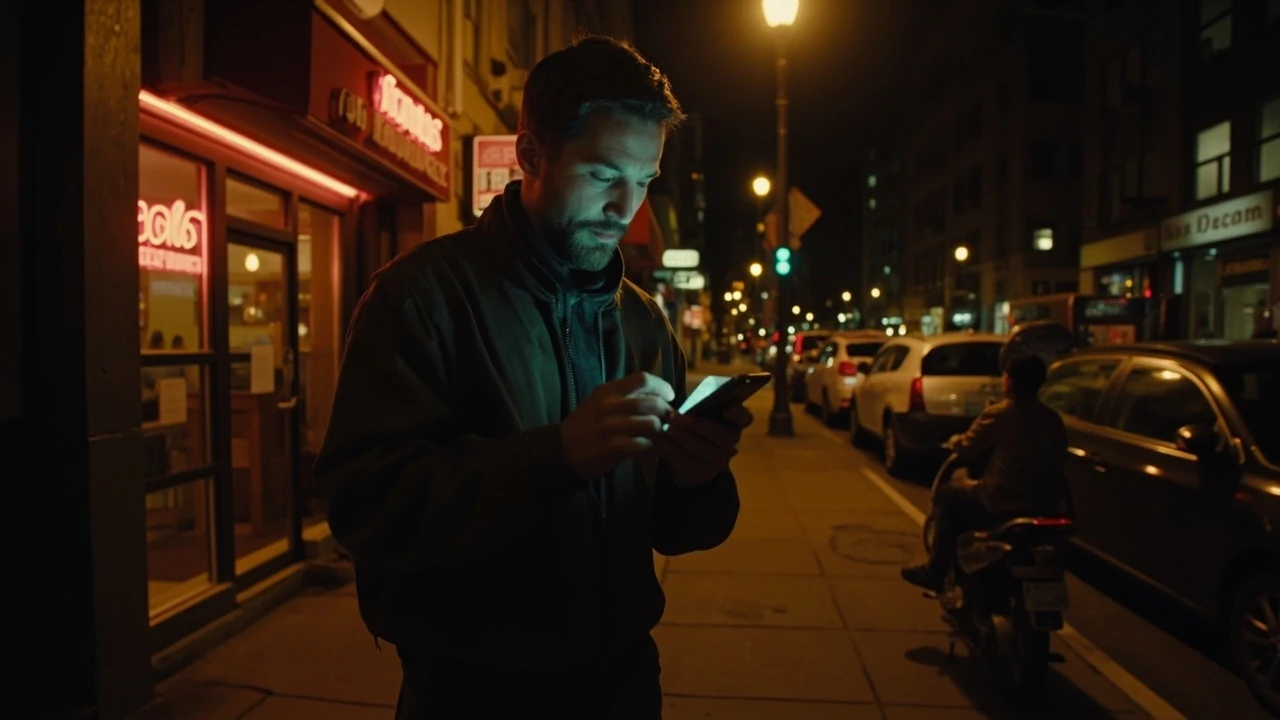
Food open now: a practical way to find a real meal at the last minute
It is 10:47 p.m. on a Tuesday. The kitchen at home is closed, the kids have already eaten, and someone in the house wants something real, not a packet of crackers. You open your phone and type food open now. The first three results are chains you have already tried this month, the next two are listing sites that show photos of plates that no longer exist on the menu, and the map is dotted with red pins that you know from experience mean “closed in spirit, open in name.” This guide is for that moment. It is a working method for finding a place to eat right now, whether the clock says 11 p.m., 3 a.m., or the awkward 4 p.m. stretch in a small town where everything shuts between lunch and dinner.
The page below is built around the kinds of decisions real eaters make in real time: how to read a listing, how to tell whether a place will actually serve you in the next twenty minutes, what to ask before you drive across town, and what to do when your usual search returns nothing useful. It also looks at the operator side of the same problem, because the phrase “food open now” only works when a kitchen is actually open, and most late-night and off-hour food failures start on the restaurant side of the door.
What “food open now” actually means when you search
The phrase is short, so search engines have to guess what you want. In practice, “food open now” usually carries one of three different intents, and the right tool depends on which one you actually mean.
- Nearest open kitchen. You want a place within driving or walking distance that is serving food at this exact minute, including dine-in, takeout, and drive-through.
- Specific cuisine or meal type, open now. You want a particular kind of food (pizza, sushi, vegan, halal) that is open right now, and you are willing to travel a bit further if the match is right.
- Delivery or pickup, open now. You want a delivery platform or restaurant that is currently accepting orders, not just a place whose lights are on.
Each of those intents changes the best source. A map search is strong for the first. A directory or filter tool is stronger for the second. A delivery app is usually the fastest path to the third, but it has its own blind spots, which we will get to. The mistake most people make is treating all three as the same question and then blaming the search results when the answer is thin.
The five-step method to find food open now
The method below is the one to keep in your head. It works in cities, small towns, and roadside stops, and it does not depend on a single app staying in business.
1. Anchor the search to a map, not a directory
Map products such as Google Maps, Apple Maps, and Waze are the only mainstream search tools that reliably show live “open” or “closed” status based on a business’s own posted hours. A directory like Yelp or Tripadvisor lists hours but rarely updates them in real time, and a restaurant’s own website is the least reliable of all because it is often cached from the last redesign. Start with a map, type the area you are in, and let it filter by “open now.”
2. Cross-check the hours on the restaurant’s own channels
Map data is usually right, but not always. A small place may have changed its winter hours and forgotten to update the map listing. Before you drive, glance at the restaurant’s Instagram, Google Business profile posts, or a recent review. If three of the last four reviews mention that the place now closes at 9 p.m. instead of midnight, trust the reviews over the hours tag.
3. Call if the kitchen is closing soon
If the map says the place closes in 25 minutes and you are 15 minutes away, a short call is worth more than any filter. Ask two questions: are you still seating, and is the kitchen still taking orders. A host who says “we are open” can still mean the kitchen is already closed for the night, because front-of-house hours and kitchen hours are not the same thing. The “Menu & Margins” approach to scheduling helps operators keep those two clocks aligned, and guests who ask the question help them keep honest.
4. Plan a backup two tiers down
Late-night food rarely survives a single plan. The place you wanted may have a private event, the line may be longer than the menu, or the only dish you wanted just sold out. Pick a primary, a five-minute-away backup, and a chain or 24-hour fallback you do not love but can rely on. The chain is not a failure. It is a safety net that lets you enjoy the interesting place without gambling your evening on it.
5. Eat the meal, then update the map
The loop closes when you mark the place as open or closed on the map, drop a short review that mentions the real closing time, or correct the hours if they were wrong. The next person searching for food open now at 11 p.m. is relying on what you leave behind. This is one of the cheapest ways to be useful to a local food scene, and most regular late-night eaters are surprised how often the listing is off by an hour or more.
How late-night and off-hour kitchens really operate
From the guest side, a kitchen is either open or closed. From the operator side, the answer is more layered. Most late-night spots run one of three models, and the model changes what you should expect.
| Model | Typical hours | What you can count on | Where it usually falls short |
|---|---|---|---|
| Dedicated late-night kitchen | Open 10 p.m. to 4 a.m. or later, seven days | Consistent menu, kitchen staff used to last-call rushes, often full bar | Smaller menu, higher prices, often louder and busier than a regular restaurant |
| Daytime place with extended hours | Open 7 a.m. to 1 a.m. or 2 a.m. | Wider menu, often family-friendly, sometimes better value | Late hours may be takeout or limited menu only, kitchen may stop an hour before close |
| 24-hour diner or drive-through | Open 24/7, year-round | Predictable, fast, good for groups with mixed tastes | Quality varies, menu fatigue sets in by 3 a.m., limited healthy options |
| Ghost kitchen or delivery-only | Varies, often evenings only | Specialist menus, no dine-in wait, designed for delivery apps | No physical address to walk into, hours can change without notice, harder to verify on a map |
Knowing which model a place runs is the difference between a smooth meal and a wasted trip. A 24-hour diner does not care if you walk in at 2 a.m. with six people and no reservation. A dedicated late-night kitchen often does. A delivery-only ghost kitchen cannot help you at all if you want to sit down. The label on the map is rarely precise enough on its own.
Reading the signs: how to tell if a place will actually serve you
Even after a place shows as open, there is a second layer of checks. The lights can be on, the door can be unlocked, and a place can still turn you away. The cues below are the ones that regulars pick up over time and that newcomers can learn in a single late shift.
- The host stand is dark, but the bar is busy. Many restaurants keep the bar open after the dining room is closed. You can often order food from the full kitchen at the bar, but not always. Ask before you sit.
- The menu is shorter than the online version. A bar menu or a “late-night” menu is normal after 10 p.m. If the printed menu is much shorter than what is on the website, that is the real list, not a glitch.
- The kitchen display screen is mostly empty. A quiet kitchen is a good sign for fast service. A packed screen with tickets backed up is a sign to order something simple, or to expect a wait.
- Staff are eating at the bar. When the team is comfortable enough to order a meal themselves at 11:30 p.m., the kitchen is usually in a steady rhythm, not winding down.
- The dessert case is empty before 10 p.m. Either the place is much busier than the map says, or the kitchen has stopped baking. Either way, adjust your expectations.
These signs are not guarantees, but they are the kind of pattern recognition that turns a 30-minute hunt into a 5-minute decision. Operators who read their own floor see the same signals from the other side, which is why front-of-house training tends to focus on this kind of cue as much as on the menu itself.
Why “food open now” is harder than it looks on the operator side
From a restaurant’s point of view, staying open late is one of the most expensive decisions on the schedule. Rent, utilities, and a core team keep running whether there are six covers or sixty. Most kitchens that try a 1 a.m. close do not keep it for long, because the unit economics rarely work unless the room is full, the bar is busy, or the menu is designed for speed. A few practical operator realities shape what you actually find when you search at night.
| Factor | Why it matters for late hours | What it means for the guest |
|---|---|---|
| Labor cost as a share of revenue | Rises sharply after 10 p.m. because tips and covers both fall | Smaller teams, slightly longer ticket times, fewer specials |
| Menu engineering at night | Kitchens simplify to dishes that travel and reheat well | Expect a focused late-night menu, not the full daytime list |
| Inventory risk | Perishable product left at 1 a.m. is a direct hit to margin | The freshest items may run out first, so order early in the late shift if you can |
| Marketing of hours | Many operators do not push late hours hard because they do not want to over-promise | The best late spot in town may be almost invisible online; ask locals |
| Staff safety and transit | Late shifts are harder to staff, and closing teams often leave together | Be patient with the front door at closing time; the team is finishing a long day |
When a kitchen disappears from late-night search results, it is rarely because the operator is lazy. It is usually because the cost of being wrong about hours is higher than the cost of being quiet. The places that do stay open late and visible have usually built their whole model around it, or they have the kind of neighborhood loyalty that lets a slow night still break even.
Field-tested sources for finding food open now
There is no single source that wins in every situation. The list below is ordered by what to try first in a typical case, with a note on where each one fails.
- Google Maps with the “open now” filter. Best for the first pass. Filter by walking or driving distance, then sort by rating. Failure mode: hours can be wrong, especially for small or recently changed businesses.
- Apple Maps. Strong for iPhone users, especially in cities. Tends to update hours faster when a business updates its own profile. Failure mode: less coverage in smaller towns.
- Yelp’s “Open Now” filter. Good when you want a specific cuisine, because Yelp’s category filters are more granular. Failure mode: hours are not always live.
- Delivery apps (DoorDash, Uber Eats, Grubhub). The fastest path to “a hot meal at home in 30 minutes.” Failure mode: shows ghost kitchens and virtual brands that have no dining room, and the listed hours are for delivery, not the underlying restaurant.
- Local subreddits and Facebook groups. Surprising depth for the 11 p.m. to 3 a.m. window, because locals often know which corner store or taco truck is open when nothing else is. Failure mode: inconsistent, slow to update, and sometimes the answer is “nothing, this town shuts at 9.”
- Hotel front desks and 24-hour pharmacies. For travelers in an unfamiliar city, the front desk at a mid-range hotel usually has a mental list of two or three reliable late-night places within a short drive. Failure mode: bias toward chains the staff know.
The instinct is to start with delivery and work outward. For most people, it is faster to start with a map, narrow to one or two candidates, and only open a delivery app if no nearby dine-in option looks solid. Delivery platforms charge a premium for convenience, and that premium is largest exactly when demand is highest, which is usually when you are searching at 11 p.m. on a weekend.
Special cases: airports, highways, hospitals, and small towns
General advice breaks down fast in the four situations below. Each one has its own logic.
Airports
Most airport food is open whenever the terminal is open, which is often earlier and later than people expect. A 5 a.m. flight usually means the terminal is alive by 4 a.m., and a red-eye landing at 1 a.m. will still find a few options in the main concourse. The catch is that airside options are usually limited to chains, and prices are 20 to 40 percent higher than the same brand outside the airport. If you have a long layover, the airport’s own app or website is more reliable than a general map search, because it knows which gates are currently past security.
Highways and road trips
Highway food is a search problem of its own. The best move is to plan the meal one stop ahead, not at the moment of hunger. State-specific rest area guides and the major truck stop chains (Pilot Flying J, Love’s, TA, Buc-ee’s) are the most reliable 24-hour food sources on most U.S. routes. A small-town diner is often better food, but hours are unpredictable. The phrase “food open now” on a highway usually means “is the next exit going to have anything,” and the answer depends more on the day of the week than the time of day.
Hospitals
Hospital cafeterias are an underrated source. Many large hospitals run a 24-hour cafeteria that is open to visitors, not just staff. The hours are not always obvious from outside, and the entrance may be through a specific wing. If you are with someone at a hospital and you need food at 2 a.m., ask at the information desk or the security booth. They will often point you to a place that does not show up on any public map.
Small towns and rural areas
Small towns are the hardest case. A town of 3,000 people may have one diner that closes at 8 p.m. and one gas station with a roller grill that is technically open until 10. The right move is to ask at the gas station or the local pharmacy. They know exactly who is serving food tonight and who closed for the season. Online listings for small-town food are often months out of date, and the local word-of-mouth network is faster and more accurate than any app.
What to ask when you call ahead
A two-minute call can save a twenty-minute drive. The questions below are the ones front-of-house teams are trained to answer quickly, and the order matters.
- Is the kitchen still taking orders? Not “are you open” but specifically the kitchen. This is the single most useful question.
- How long is the current wait? Honest answer, and it tells you whether to order now or wait until you arrive.
- Is the full menu available, or a late-night menu? Sets expectations so you are not surprised when half the items are off.
- Do you have any 86’d items tonight? Industry shorthand for “sold out.” Saves you from picking the wrong dish at the table.
- Do you need a credit card to hold a table? Some late-night places will not seat a party of five without a card. Better to know now.
Keep the call short. Late-night teams are often short-staffed, and the host is doing three jobs at once. The more specific you are about your party size, your time of arrival, and any allergies, the faster they can help you.
Common mistakes that ruin a late-night food search
Most bad late-night food experiences are not about the food. They are about the search. The mistakes below are the ones that come up over and over.
- Trusting a single source. Hours on a map, on a website, and on a delivery app are three different claims. Cross-check at least two.
- Ignoring the day of the week. A place that is open until midnight Friday through Sunday may close at 9 p.m. on a Tuesday. The “open now” filter usually shows hours for the current day, but only if the platform has updated them.
- Driving to a chain when a better local spot is open. Chains dominate late-night search because they have marketing budgets. Independent spots that are open late often need the call-ahead to confirm.
- Forgetting about your own timing. Showing up at 9:55 p.m. to a place that closes the kitchen at 10 means you may get a takeout box, not a real meal. Aim to arrive at least 45 minutes before the kitchen closes.
- Skipping the menu check. A 24-hour diner with a sad menu is a worse experience than a 10 p.m. place with a great one. The closing time is not the only quality signal.
If you fix only one of these, fix the cross-check habit. Most failed late-night searches come down to a single wrong hours entry, and a 30-second second look would have caught it.
How restaurant marketing makes “food open now” work better
Operators who are serious about late-night service do three things that show up in search. First, they keep their hours accurate on every platform where they have a listing, including the small ones. Second, they post on social media when hours change, so the next searcher sees a recent post that says “open until 2 a.m. tonight.” Third, they encourage reviews that mention real closing times, so the algorithm and the humans both have good data. The “From Scratch: Why Specificity Wins Food Marketing” approach applies directly here: a clear, specific claim like “open until 1 a.m., Wednesday through Saturday” outperforms a vague “late-night hours” every time.
On the guest side, the parallel move is to leave better data behind. A two-line review that says “place was open at 11:30 p.m. on a Wednesday, kitchen closed at 12:15” is more useful than a star rating. That is the kind of detail the next person searching for food open now is actually looking for, and it takes 20 seconds to write.
What to do when nothing is open
Sometimes the search returns nothing useful. The town is small, the hour is late, the few pins on the map are all closed, and the delivery apps are showing 60-minute waits from places 40 minutes away. The list below is the order in which to fall back.
- Check the 24-hour options one more time. A pharmacy, a gas station, a hospital cafeteria, a hotel bar. Something within a short drive is almost always open.
- Hit a convenience store for a real snack, not a sad one. A hard-boiled egg, a good cheese stick, a microwave rice bowl, a piece of fruit, and a bottle of water is a more useful meal than a bag of chips and regret.
- Cook the smallest possible thing. Two eggs, toast, butter, salt. Ten minutes from fridge to plate. This is not a failure; it is the original “food open now.”
- Plan tomorrow’s meal now. If you cannot eat well tonight, decide what you will eat first thing tomorrow. The hunger is worse when it has no plan attached to it.
The point of the list is not to romanticize the gas station egg. The point is that a short plan beats an open-ended search, and “nothing is open” is almost never literally true. It usually means “the kind of place I want is not open right now,” which is a different problem with a different solution.
Frequently asked questions
How do I find food open now near me at midnight?
Open your phone’s map app, turn on the “open now” filter, and zoom to your current location. Sort by distance first, then by rating. Cross-check the top two results on the restaurant’s own Google Business profile or Instagram to confirm the hours, because map hours are not always live. If nothing within a 10-minute drive looks promising, widen the search radius to 20 minutes and check a delivery app at the same time. Most cities have at least one reliable option within that radius, even at midnight, and the call-ahead step takes the guesswork out of the last two miles.
Why does Google say a restaurant is open when it is closed?
Hours on Google are entered by the business owner or scraped from the website. Both go stale. A small place that changed its hours for the season and forgot to update the Business Profile is the most common cause. A second common cause is the difference between dining-room hours and kitchen hours: the listing says “open until 11” but the kitchen stopped taking orders at 9:45. When in doubt, a quick call confirms the real status in under a minute.
Are 24-hour diners still common?
Fewer than they used to be, but yes. Most U.S. cities of any size still have at least one 24-hour diner, and truck stop chains fill in along highways. The classic diner is a smaller share of the late-night market than it was in the 1990s, replaced by a mix of dedicated late-night kitchens, fast-food drive-throughs with extended hours, and delivery-only ghost kitchens. The diner survives partly because it is the most reliable single answer to “food open now” in any town, even when it is not the best meal in town.
Is it cheaper to eat late at night?
Sometimes. Some places run a discounted late-night menu to fill seats after 10 p.m., especially in cities with a bar crowd. Other places charge more because the menu is shorter and the staff is smaller. Drive-throughs often run a late-night deal between 10 p.m. and midnight. The honest answer is that the price depends on the model, and you can usually tell which one you are in by looking at the menu and the room. A late-night spot with a bar full of regulars is more likely to be running deals than a hotel restaurant trying to cover a slow evening.
What is the best way to find a 24-hour restaurant in a small town?
Ask at the gas station, the local pharmacy, or the front desk of the only hotel in town. Online listings for small-town hours are often months out of date, and the people who work the late shift at a gas station know exactly which diner, truck stop, or family kitchen is open and which closed for the season. The local word-of-mouth answer is usually faster and more accurate than any app, and it comes with the added benefit of a short story about the place.
How accurate are delivery app hours?
The hours shown on a delivery app reflect when that platform is accepting orders from the restaurant, which is not always the same as the restaurant’s own hours. A delivery-only ghost kitchen may show as open on a delivery app while having no physical storefront at all. A traditional restaurant may stop accepting delivery orders 30 minutes before the dining room closes, because the kitchen needs to wind down. Treat the delivery app hours as a useful but narrow source, and check the restaurant’s own channels for the full picture.
Can I trust a restaurant’s own website for hours?
Less than you would hope. Restaurant websites are often built once and updated rarely, and the hours page is a common casualty. The Google Business profile, Instagram, and recent reviews are usually more current, because they are updated more often. If the website and the social profile disagree, the more recently updated one is usually right.
What should I do if I am traveling and need food open now in an unfamiliar city?
Ask the front desk at your hotel, use the map app with the open-now filter, and check whether the airport, a 24-hour pharmacy, or a hospital cafeteria is nearby. In most U.S. cities of any size, a 15-minute ride will get you to at least one reliable option at any hour. If nothing within 15 minutes looks good, the hotel bar or a 24-hour diner chain is a safe fallback even if it is not exciting. Avoid ordering delivery from a platform you have not used in that city before, because the delivery times are often longer than the map suggests.
Are there healthy options for food open now?
More than there used to be, but it still depends on the city. Salad chains and poke bowl spots with extended hours have filled in part of the gap in larger cities. 24-hour pharmacies often have a small but decent cooler section with yogurt, fruit, and protein snacks. Hospital cafeterias are an underrated source of genuinely healthy food at odd hours, especially in cities with large hospital systems. The honest answer is that “healthy” and “open now” still do not overlap as much as most people would like, and a short plan is usually better than a long search.
How can I help the next person searching for food open now?
Leave a short review that mentions the real closing time, mark the place as open or closed on the map when the listing is wrong, and post a quick story on a local subreddit or neighborhood group if a place has changed its hours. The phrase “food open now” works as well as it does because a few thousand people each night take 20 seconds to leave better data behind. The search is only as good as the most recent answer to it.