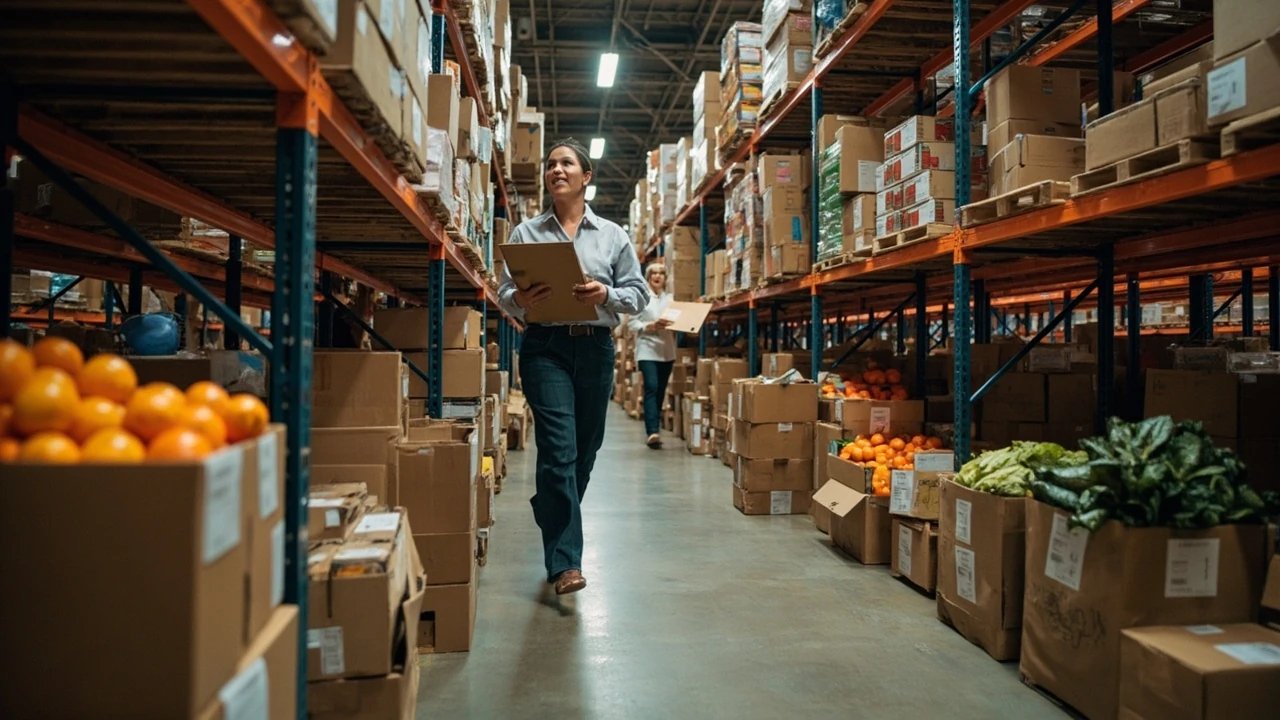
A line of refrigerated trucks backs into a loading dock at 5:30 a.m., and a warehouse crew begins sorting pallets of yogurt, bread, and frozen chicken. By noon, smaller vans will leave the same dock carrying those boxes to pantries, shelters, and school programs across the region. That is the daily rhythm of most food banks: large, centralized hubs that collect donated or rescued food, sort it by category and shelf life, and redistribute it to smaller frontline programs that hand groceries directly to people facing hunger.
Food banks sit between surplus and need. They are not the same as a food pantry, even though the two terms get used interchangeably at the register. A food bank usually operates at a regional or city scale, runs a warehouse, and works with partner agencies. A food pantry is usually a smaller site, often run by a church, school, or community center, where households actually pick up a bag of groceries. Knowing the difference matters if you are donating, volunteering, or trying to decide where a restaurant’s surplus should go.
Food banks: what they are and how the system works
A food bank is a nonprofit organization that acts as a clearinghouse for donated food. It receives products from growers, manufacturers, wholesalers, retailers, and individual donors, then sorts, stores, and redistributes that food to partner programs that serve meals or hand out groceries. In the United States, the network is coordinated nationally by Feeding America, a federation of roughly 200 regional food banks. Other countries use different models: the UK works through the Trussell Trust network, Canada through Food Banks Canada, and much of Europe through a mix of public, charity, and EU-funded programs.
The basic flow is straightforward in shape, even if the logistics are complex:
- Donations arrive: surplus from farms, manufacturers, distributors, grocery chains, restaurants, and individual households.
- Food is sorted: by category, temperature requirement, allergen risk, and remaining shelf life.
- Food is stored: ambient, refrigerated, and frozen zones inside a warehouse.
- Food is distributed: trucks carry pallets to partner pantries, shelters, schools, and meal programs.
- People receive food: at no cost, usually based on household size and need.
Behind that flow sits a stack of decisions: what to accept, how to keep cold chain intact, how to handle allergen labeling, how to move perishable food fast enough to avoid waste, and how to record every pound for compliance and reporting. The reason a regional food bank is a hub rather than a pantry is that those tasks need warehouse space, refrigerated trucks, food-safety systems, and a finance and grants team. Most individual pantries cannot run that themselves.
Food bank vs. food pantry vs. soup kitchen
These three terms show up together so often that even donors mix them up. The roles are different, and so are the ways a restaurant or a household can help each one.
| Organization type | Scale | Main job | Who it serves | How a restaurant can help |
|---|---|---|---|---|
| Food bank | Regional or city, often a warehouse | Collect, sort, store, and redistribute donated food | Partner agencies, not the public directly | Donate surplus ingredients or prepared food, sponsor logistics, fund cold-chain equipment |
| Food pantry | Local, often a single room in a church or community center | Hand grocery bags directly to households | Individuals and families in a neighborhood | Run a food drive, supply reusable bags, donate shelf-stable items, volunteer at distribution days |
| Soup kitchen | Local, often a commercial or community kitchen | Prepare and serve hot meals on site | People who need a meal that day | Cook a shift, donate prepared food, lend equipment, host a guest-chef night |
The practical takeaway is that a regional food bank is the right contact for large-scale donations, including pallets of product, while a pantry or soup kitchen is the right contact for smaller, restaurant-sized donations or volunteer shifts. Most food banks will happily direct you to the partner agency closest to your kitchen.
Where the food actually comes from
The supply side of a food bank is more varied than most people realize. Retail donations and food drives are the most visible source, but they are usually a minority of total volume.
- Retail rescue: grocery chains pull near-date or damaged-pack items from shelves and donate them rather than discard them.
- Farm and grower surplus: produce that does not meet retail specifications is harvested, packed, and donated through gleaning networks.
- Manufacturer donations: mislabeled cans, overrun production, and reformulated products that supermarkets will not take.
- Wholesale and distributor overstock: pallets that lose a buyer and would otherwise be written off.
- Federal programs: in the US, the USDA’s Emergency Food Assistance Program (TEFAP) supplies commodity food to states, which allocate it to food banks.
- Restaurant and catering surplus: prepared food, surplus ingredients, and end-of-service stock that meet local food donation rules.
The mix varies by region. Some food banks are dominated by retail rescue, others by federal commodity shipments, others by grower surplus in agricultural areas. Understanding the mix matters for any restaurant thinking about donating: a food bank that already has a strong produce pipeline is going to be more excited about proteins and prepared meals than another truckload of lettuce.
How food banks decide who gets food
Distribution is not a free-for-all. Most food banks allocate food to partner agencies using a combination of factors:
- Service area and population density, so urban and rural gaps are both covered.
- Households served per month, so larger pantries do not run out before smaller ones.
- Capacity to handle specific categories, including cold storage and allergen separation.
- Equity targets, which may prioritize agencies serving low-income neighborhoods, indigenous communities, or new arrivals.
- Funding and grant requirements, which sometimes dictate how a specific donation must be allocated.
For donors and partner agencies, this means the food bank is making a constant set of trade-offs. A refrigerated truck of yogurt is wonderful, but it has to be allocated somewhere with cold storage and a fast enough turnaround to use it before the date code. A pallet of rice is easier to place, but takes up more shelf space per meal served than a pallet of peanut butter.
How food banks are funded
Food looks free at the point of distribution, but the logistics are not. Warehouses, refrigerated trucks, forklifts, food-safety staff, and rent are expensive, and most of the cost is not the food itself.
| Funding source | Typical share for a regional food bank | Notes |
|---|---|---|
| Government grants and commodity programs | Around 30 to 50 percent | Includes federal and state programs such as TEFAP in the US. |
| Individual donations | Around 25 to 40 percent | Monthly givers, one-time donors, workplace giving, and bequests. |
| Corporate and foundation grants | Around 10 to 20 percent | Often tied to capacity projects such as cold storage or trucks. |
| Earned income | Around 5 to 15 percent | Shared maintenance fees from partner agencies, paid warehouse services, catering, or co-packing work. |
The exact split varies widely. Some food banks are heavily dependent on government commodity shipments, which makes them sensitive to policy changes. Others are heavily supported by a small number of corporate donors, which makes them sensitive to corporate priorities. A useful first step for any business that wants to support a food bank is to ask the development team what share of their budget is unrestricted, because unrestricted dollars fund the trucks, the staff, and the rent that the food itself depends on.
How restaurants fit into the food bank system
Restaurants interact with food banks in several ways, and the right one depends on the size of the business, the type of food being donated, and the local food-safety rules.
Donating surplus prepared food
Most regions now have a Good Samaritan food donation law that protects donors who give food in good faith, as long as basic safety steps are followed. In the US, the federal Emerson Act covers this. In practice, a restaurant can usually donate cooked food that has been held at safe temperatures, labeled with the date and ingredients, and transported in clean, food-grade containers. Many food banks run a direct pickup program for prepared food, or partner with apps that route surplus meals to pantries or shelters.
Donating surplus ingredients
Unopened dry goods, sealed dairy, and whole produce are the easiest donations to absorb. Most regional food banks will arrange pickup for a meaningful volume, and some pantries will accept smaller drop-offs. The practical limit is usually the donor’s own logistics, not the food bank’s appetite.
Hosting a food drive
Even a small restaurant can run a customer-facing food drive by placing a barrel near the door or offering a menu item whose proceeds go to a local food bank. This is a low-effort way to engage staff and guests, and it is one of the few marketing tactics that nearly always pays off in trust.
Volunteering and lending expertise
Restaurants have skills food banks need: food-safety systems, recipe development, and high-volume kitchen operations. A chef who volunteers to write standardized recipes for pantry clients, or who helps a food bank test new shelf-stable products, can deliver more value per hour than another box of cans.
Buying in to support the system
Some food banks run social enterprises, such as catering lines, co-packing services, or branded grocery programs. Buying from those programs keeps revenue inside the food bank. It is not a donation, but it is a way for a restaurant group to support the infrastructure.
If you are not sure which route makes sense for your operation, it is worth starting with a short conversation with the food bank’s development team. They will usually tell you within a few minutes whether they need trucks, cold storage, prepared food, shelf-stable food, or volunteers, and which of those they already have in surplus. That kind of conversation also tends to surface partnership ideas the standard donation page does not mention, from shared purchasing to staff training exchanges. Many operators find that the deeper partnerships last longer and have more impact than one-off donations, and they tend to feed back into the rest of the business, including brand positioning and community trust.
That said, none of this matters if the food is not safe. The same rules that protect paying guests protect recipients. Cooked food must be cooled quickly, held at safe temperatures, and labeled. Containers must be clean. Allergens must be declared. A good rule of thumb is to donate food you would still be comfortable serving at your own pass, because once it leaves the kitchen, your name is on it.
Common mistakes when donating or partnering
Most of the friction between restaurants and food banks is the same friction that shows up between any two operations with different incentives. A few patterns come up often enough to be worth naming.
- Donating food the food bank cannot store. Prepared meals with no cold chain, or large quantities of fresh produce with no plan to distribute it within 48 hours, end up creating waste rather than preventing it.
- Donating opened or homemade food. Most food banks can only accept sealed, commercially prepared, or otherwise traceable items because of liability and food-safety rules.
- Treating the food bank like a dumpster. The Bill Emerson Act protects good-faith donors, but it does not protect donors who knowingly pass on unsafe food.
- Promising recurring donations you cannot sustain. Food banks plan around recurring supply, so a one-time hero donation followed by silence can be harder to absorb than a smaller, reliable monthly contribution.
- Skipping the contract conversation. Larger or recurring donations should always sit behind a simple written agreement covering pickup, labeling, temperature, and liability.
The fix in each case is the same: ask the food bank what its current constraints are, then build the partnership around those constraints. That usually means a short onboarding call, a written agreement for anything more than a one-off, and a clear point of contact on both sides.
How to evaluate a food bank before donating
Not every organization that calls itself a food bank is structured the same way. If you are making a significant donation, either of money or of food, it is reasonable to ask a few questions before you commit.
| Question to ask | Why it matters |
|---|---|
| How many pounds of food did you distribute last year? | A baseline scale figure. Very small numbers can be a sign of capacity limits or of an early-stage operation. |
| What share of your food is donated versus purchased? | Purchased food often means rescued surplus that the bank paid a low price for, which can stretch donor dollars further. |
| What is your overhead ratio? | Independent ratings from Charity Navigator, GuideStar, or the local regulator will publish this. |
| Who are your top three funders? | Concentration risk matters. A food bank that is 80 percent funded by one source is fragile. |
| Which partner agencies do you serve? | The agencies are the part of the system the public actually sees. A food bank whose agencies are active and well-run is usually a good sign. |
| What is your biggest current capacity gap? | The answer tells you exactly where a donation, a piece of equipment, or a volunteer hour would land. |
None of these checks are about trust. They are about matching the right donation to the right gap. A food bank that already has strong cold-chain capacity does not need another freezer; a food bank that is bursting at the seams on logistics might need exactly that.
What a food bank does not do well
It is worth being honest about the limits of the food bank model, because those limits shape the right way to use them.
- Food banks are not designed to end hunger. They reduce the harm of hunger, but the underlying drivers are housing, wages, healthcare, and policy.
- Food banks are not always efficient. A pound of food distributed through a regional network is far more expensive than the same pound bought at retail, even before considering logistics.
- Food banks can vary widely in food quality. A pantry that gets mostly shelf-stable canned goods is a different experience from one that gets fresh produce and proteins every week.
- Food banks depend on volunteers and grant cycles. Their capacity can shrink quickly during economic downturns when need rises and donations fall.
Those limits do not make food banks less valuable. They make it clearer where they sit in the broader response to food insecurity. Restaurants and food businesses are part of that response, but so are policy choices, employer wages, and local housing. Donating surplus is a real contribution, but it is one part of a much larger picture.
Practical next steps if you want to help
For most readers, the question is not whether to engage with food banks, but how to do it well. A short checklist tends to help more than a long essay.
- Identify the regional food bank that covers your service area, then ask for a 20-minute call with their development lead.
- Ask which type of donation has the highest marginal value right now: cash, prepared food, shelf-stable food, equipment, or volunteer hours.
- Start with a small, structured pilot, such as one monthly pickup of prepared food, before committing to a larger partnership.
- Document the process inside your own kitchen so the partnership survives staff turnover.
- Reassess every six months, because the food bank’s constraints will change as the economy and the seasons shift.
That is the shape of almost every durable partnership between a food business and a food bank. It is rarely dramatic, and it is almost always worth doing. A regional food bank that knows your kitchen’s rhythm, and that you can call when you have surplus, will move more food into the community than a dozen one-off drop-offs. For a deeper look at how food businesses can build a public identity around real operations, the article on restaurant branding and identity walks through how to make that kind of work legible to guests without sliding into marketing speak.
If you want to see how a single, well-known dish can carry that kind of community story over time, the piece on turning one signature product into a month of content is a useful counterweight: it shows how a restaurant can build a real narrative around what it actually does, including the parts that happen off the pass.
Frequently asked questions
What is the difference between a food bank and a food pantry?
A food bank is a regional warehouse operation that collects, sorts, and redistributes donated food. A food pantry is a local site, often run by a church or community center, where households actually pick up groceries. Most food banks do not serve the public directly; they serve partner pantries and meal programs.
Are food banks free to use?
Yes. The food distributed through food banks is free to the people who receive it. Partner pantries and meal programs do not charge guests, although some ask for identification, proof of address, or a self-declared income statement to track who they serve.
How do food banks get their food?
From a mix of retail rescue, farm and grower surplus, manufacturer overstock, federal commodity programs, and individual or business donations. The exact mix depends on the region and the season.
Can restaurants donate prepared food to food banks?
Usually yes, as long as the food is held at safe temperatures, properly labeled with ingredients and dates, and transported in clean, food-grade containers. Most regional food banks will arrange a pickup or refer a restaurant to a partner agency that handles prepared meals.
Is donating food to a food bank tax-deductible?
In many countries, including the United States, businesses can deduct the fair market value of donated food. The rules around appraisals, documentation, and qualifying organizations are specific, so it is worth checking with a tax professional before claiming a large deduction.
What kinds of food do food banks need most?
Protein, dairy, fresh produce, and shelf-stable items with long dates are usually the highest-value categories. Prepared meals are valuable but require a partner agency with the right cold chain and a fast turnaround.
How do food banks keep food safe?
They follow the same food-safety frameworks as commercial kitchens, including temperature control, allergen separation, FIFO rotation, pest control, and staff training. Many also carry third-party audits such as AIB or SQF.
How can a small business help a food bank if it cannot donate food?
Cash is often more useful than food, because it lets the food bank buy what it is short of at wholesale prices. Volunteering, lending equipment, and helping with marketing or fundraising are also real contributions.
Do food banks only operate in the United States?
No. Almost every country has some version of a food bank network, although the funding model, scale, and coordination differ. The Trussell Trust in the UK, Food Banks Canada, and the European Food Banks Federation are well-known examples outside the US.
What is the biggest misconception about food banks?
That they have ended or could end hunger on their own. Food banks reduce the harm of food insecurity, but the underlying drivers, including wages, housing, healthcare, and policy, sit outside the food bank system. Treating food banks as the whole solution underestimates both the system and the problem.