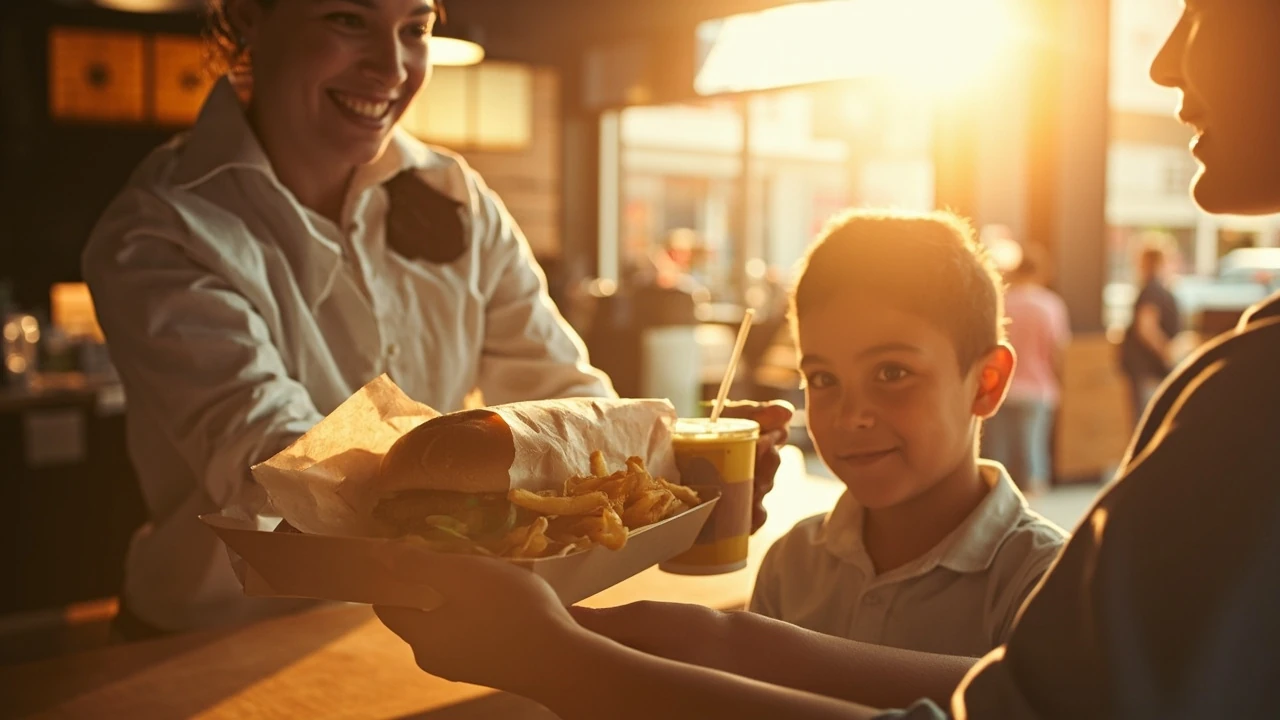
Walk into any train station concourse at noon and you will see the same pattern: a short queue, a counter, a board with photos of burgers, fries, drinks, and a set meal under ten dollars. That is fast food in its most recognizable form, but the category now stretches well beyond the original American drive-thru model. It includes regional chains, ghost kitchens, and grocery-aisle meals built to be heated in a microwave, all of which are competing for the same limited minutes in a customer’s day.
This article is a working definition of fast food for restaurant operators, marketers, and curious readers. It is not a directory of chains, a recipe list, or a nutrition lecture. The goal is to explain what makes a meal fast food in 2026, how it differs from adjacent categories like quick-service and fast casual, and what those differences mean for menu design, pricing, and brand strategy. The framing matters because the term is now used so loosely that it can describe both a two-dollar gas-station burrito and a globally recognized brand with thousands of locations.
Fast food: a working definition for operators and diners
The simplest way to define fast food is by three operational traits: a limited menu, a service model built for speed, and food that is either ready immediately or finished quickly after ordering. The United States Department of Agriculture and most academic food-system studies use that same combination, although they phrase it differently. The Wikipedia overview of fast food traces the modern model to the United States in the early twentieth century, with the drive-through, the standardized menu, and the franchise system all emerging between the 1920s and the 1960s. That history still shapes what diners expect today, even when the food is vegan, halal, or entirely digital.
Two refinements keep the definition honest in a contemporary market. First, fast food is a category of restaurant, not a category of food. A slice of pizza eaten on a park bench is still fast food if it came from a counter that served it in under a minute. A long-simmered stew that a diner reheated at home is not fast food, even if it was cheap. Second, the category is defined by the operator’s promise, not the customer’s behavior. A bistro that happens to serve lunch quickly has not turned itself into a fast food brand; it has simply had a fast lunch service.
For most working purposes, the operational definition in the table below is the one that survives contact with a real P&L. It is the same definition used by industry analysts and food-service consultants when they segment the market.
| Trait | What it looks like in practice | Why it matters for operators |
|---|---|---|
| Limited menu | Core menu of roughly 10 to 30 items, often fewer if the concept is single-product | Reduces ingredient complexity, simplifies training, and supports consistent quality |
| Service for speed | Counter, drive-thru, or app-based ordering designed to deliver food in minutes | Defines the entire kitchen layout, equipment, and labor model |
| Standardized preparation | Centralized or published recipes, portioned ingredients, timed cooking steps | Makes the experience repeatable across locations and shifts |
| Affordable price points | Average check low enough to compete with home cooking and grocery meals | Keeps the category accessible and protects volume during downturns |
| Off-premise friendly packaging | Wraps, clamshells, and drink cups engineered for travel | Supports delivery, drive-thru, and takeaway as core revenue, not add-ons |
That five-part test is more useful than any marketing slogan. A restaurant does not need to call itself fast food to be part of the category, and a restaurant that calls itself fast food but has a 40-item menu, table service, and a 30-minute average ticket is actually running a different model. Mislabeling the model usually shows up later as confused pricing, wasted labor, and a kitchen that was never designed for the throughput it is being asked to deliver.
How fast food differs from quick service and fast casual
Restaurant industry analysts split the limited-service market into overlapping segments, and the boundaries have moved as menus have converged. The three terms most often used are fast food, quick-service restaurant (QSR), and fast casual. They are related, but they are not interchangeable, and a clear understanding of each one is essential before deciding how to position a menu or a brand.
The historical anchor for fast food is the counter-and-takeaway model, usually with a drive-thru, that sells a small menu at low prices. Quick-service is a slightly broader umbrella that includes the same model plus things like coffee chains, donut shops, and smoothie counters. Fast casual sits above both on price and below casual dining on service style. It typically offers higher check averages, more customization, fresher ingredients in the customer narrative, and either counter service or limited table service.
| Segment | Typical check (2026) | Service style | Menu size and customization | Ingredient narrative |
|---|---|---|---|---|
| Fast food | Low, often under ten dollars per person in the US | Counter, drive-thru, app, no table service | Small core menu, set combos, limited customization | Value, speed, and consistency take priority over ingredient sourcing stories |
| Quick service (QSR) | Low to moderate, depending on the concept | Counter, drive-thru, kiosk, app, no table service | Small to medium menu, with some customization through app ordering | Varies widely; coffee and bakery concepts may lean on origin or craft |
| Fast casual | Moderate, usually higher than fast food | Counter ordering with seating, often with self-serve drinks and bus tubs | Medium menu, more daily variation, and visible customization at the counter | Often highlights freshness, scratch preparation, or specific supply chains |
The economic gap between these segments has narrowed in the last several years. Fast casual concepts have introduced value menus to defend traffic during periods of inflation, and fast food chains have added ingredients that look and taste closer to fast casual. The result is a market where a fifteen-dollar grain bowl and an eight-dollar combo meal can sit next to each other on the same delivery app. Operators who understand the differences still have an edge, because each segment has a different labor cost structure, a different real-estate footprint, and a different set of customer expectations.
What changed in the segment lines
Three forces have blurred the boundaries. First, mobile ordering has made customization cheaper for fast food chains that used to rely on tight portion control. Second, the cost gap between commodity beef and higher-end proteins has narrowed, so fast casual price increases have caught up to fast food price increases from a higher base. Third, ghost kitchens and virtual brands have added a layer of new entrants that do not fit the traditional segment definitions at all, because the customer never sees a dining room. The practical result is that a single brand can now operate in two segments at once by offering one menu for delivery and another for in-store.
For most independent operators, the takeaway is straightforward. Pick a segment that matches the unit economics of the chosen location, build the menu around that segment’s expectations, and avoid borrowing language from a segment the operation cannot actually support. A counter that has no room for a drive-thru will struggle to compete with true fast food on convenience, no matter how fast the kitchen is.
What fast food menus look like in 2026
The modern fast food menu is a study in restraint. Even the largest chains now run leaner lineups than they did a decade ago, partly because labor is more expensive and partly because app-based ordering has made menu complexity invisible to the customer in ways that counter ordering never did. The shape of a typical menu in 2026 looks roughly like the list below, with the caveat that exact items vary by market and brand.
- One or two anchor proteins, usually a beef burger or a chicken sandwich, prepared one consistent way.
- A chicken alternative for customers who do not eat beef, increasingly the same protein line prepared multiple ways.
- A vegetarian or plant-based option, often a black-been patty or a breaded vegetable item, positioned as a permanent menu item rather than a limited-time offer.
- A breakfast daypart menu with a smaller version of the same architecture, served until a published cut-off time.
- Fries or a similar starch side, available in a single size and a larger combo size.
- Soft drinks, iced coffee, and bottled water as the default beverage set, with a small premium line of shakes or specialty drinks.
- A set of value items, usually two or three, designed to hold price-sensitive customers during inflationary periods.
- One limited-time offer running at any given time, used to drive frequency and to give regulars a reason to return.
What is missing from that list is just as important as what is on it. Most fast food menus in 2026 do not run daily chef specials, do not offer a long list of regional sides, and do not build a separate kids’ menu beyond smaller portions of the same items. The narrowness is the point. A tight menu lets a small kitchen hit the throughput numbers that the business model depends on, and it lets a brand train new staff to standard in a matter of days rather than weeks.
Menu engineering is the discipline that decides which items survive on that list. The four-quadrant framework developed by Gregg Rapp classifies menu items as stars, plowhorses, puzzles, and dogs, based on contribution margin and sales volume. Applied to fast food, the framework usually pushes operators toward a menu that is heavy on stars and plowhorses, with puzzles used as traffic drivers and dogs quietly removed. The guide to menu engineering on David’s World Famous walks through that process in more detail than there is room for here, and it is the most useful single resource for any operator deciding which items to keep, which to rework, and which to drop.
The economics behind the counter
Fast food runs on volume. That single fact shapes every other decision in the business, from real estate to packaging to labor scheduling. A useful way to think about the unit economics is to break the model into five variables: ticket size, throughput, labor cost as a percent of sales, food cost as a percent of sales, and occupancy cost. The first two variables drive revenue, the last three protect margin, and the relationship between them is what separates a healthy fast food operation from one that is one bad week away from a cash crunch.
| Variable | Typical target range | What moves the number |
|---|---|---|
| Average ticket | Low single digits to low double digits in USD, depending on market and concept | Combo attach rate, value menu mix, beverage upsell, limited-time offer price point |
| Throughput (cars or tickets per hour) | Driven by drive-thru lane design, kitchen equipment, and labor scheduling | |
| Labor as a percent of sales | Mid-twenties to low thirties in mature US operations | Staffing model, self-order kiosks, automation, and tip credit rules |
| Food cost as a percent of sales | High twenties to mid-thirties | Ingredient prices, waste, portion control, and menu mix |
| Occupancy as a percent of sales | Single digits to low teens | Rent structure, lease term, and whether the site includes a drive-thru |
Those ranges are not universal. A high-volume urban drive-thru can run labor and occupancy as a smaller share of sales because throughput is so high, while a small-town counter-only location will look structurally different. The variables are also not independent. Raising average ticket through combo attach often reduces throughput because the kitchen is making more items per order. Cutting labor hours to protect margin usually hurts throughput at peak. The job of an operator is to find the combination of the five variables that the local market will support, and to revisit that combination at least quarterly because input prices and consumer behavior both move.
Why speed is the most important operating metric
Speed in fast food is not a marketing promise. It is the variable that determines whether the rest of the model works. A kitchen that pushes out a car every 90 seconds in the drive-thru lane can absorb higher rents, higher labor, and even slightly higher food costs, because the volume compounds. A kitchen that averages three minutes per car will struggle to cover the same costs even with a lower menu price, because the same staff and equipment are producing fewer tickets per hour. That is why chains invest so heavily in drive-thru layout, dual-lane systems, and order confirmation boards. The metric they are really chasing is throughput, and the speed the customer sees is the visible version of it.
Speed also shapes the customer relationship in ways that are easy to underestimate. A fast food order is one of the few transactions in modern life where the customer is making a value-for-time calculation in real time. If the line moves slowly, the customer is paying for the wait as well as the food. If the line moves quickly, the customer is more forgiving of a slightly higher price or a slightly less interesting menu. That is the same reason regional chains can charge more than national brands in their home markets; they have trained local customers to expect a faster, friendlier experience, and customers are willing to pay a small premium for it.
How fast food is sold: counter, drive-thru, app, and delivery
The sales channels for fast food have multiplied in the last decade, and the operational complexity has grown with them. A serious fast food operation in 2026 usually runs four overlapping channels at once.
- Counter ordering, which remains the anchor for walk-in traffic and for older customers who are less comfortable with apps.
- Drive-thru, which is still the highest-volume channel in most suburban and highway locations and which is increasingly being designed as a multi-lane operation with order takers outside the building.
- Mobile app and kiosk, which now account for a majority of orders in many major chains, especially during off-peak hours.
- Third-party delivery, which has become a default expectation in cities and which carries both a commission cost and a packaging cost that have to be priced into the menu.
Each channel has a different cost structure, a different ticket profile, and a different effect on the kitchen. Drive-thru orders tend to be larger because customers order for the car. App orders tend to skew toward individual customers who customize heavily. Delivery orders tend to be family-sized and are heavily influenced by the third-party platform’s promotions. A single kitchen has to handle all of those order types at the same time, which is why the layout of the line, the placement of the fry station, and the design of the packaging all matter so much. The wrong packaging choice can quietly add two minutes to every delivery ticket, and that delay cascades into slower drive-thru times during the dinner rush.
For independent operators, the practical advice is to pick two channels to optimize and run the others as supporting volume. A small counter-only fast food shop in a dense urban neighborhood will probably optimize for app and walk-in, accept delivery on a single platform, and not invest in a drive-thru. A suburban location without strong walk-in traffic will optimize for drive-thru and app, and treat counter as a fallback. Trying to optimize all four at once usually means none of them run well, because the labor model and the kitchen layout cannot be all things to all channels.
Branding and identity inside a crowded category
Fast food is one of the most competitive branding environments in the world, and the reason is structural. The category rewards consistency, which means most products in the segment taste similar to most others. That puts a premium on the parts of the brand that are not the food itself: the color of the packaging, the tone of voice in the app, the speed of the line, the cleanliness of the dining room, the way the staff greets the customer. Those are the variables a brand can actually control, and they are the variables that decide whether a regular chooses one drive-thru lane over another on a Tuesday afternoon.
The article on restaurant branding on David’s World Famous makes the point that brand identity in food is built from a small number of repeated signals rather than a single big idea. Fast food is the purest version of that principle, because the category relies on repetition across thousands of locations. A fast food brand that has to explain itself in a tagline is usually a fast food brand that is losing the repetition game.
Three signals matter more than the rest in the fast food segment.
- Color and packaging consistency, which is why the major chains guard their packaging designs and their store color palettes so carefully. A customer should be able to identify the brand from across a parking lot, even without reading a logo.
- Speed of service, which is a brand signal even though it is also an operational metric. A consistent ninety-second drive-thru builds trust in the same way that a clean restroom does.
- Staff behavior, especially the greeting and the goodbye. Fast food customers interact with staff for a very short window, which means the few words exchanged carry more weight than they would in a full-service restaurant.
Independent operators who want to compete with the major chains on brand usually cannot match the chains on consistency, because they do not have the same number of locations. The realistic strategy is to compete on specificity. A regional chain that sells only Nashville hot chicken, or only West African suya, or only Philadelphia-style hoagies can use the specificity of the food itself as a brand signal, and then back it up with packaging, staff training, and store design that reinforce the same specific story. That approach is harder to scale, but it is far easier to defend against a national chain that has to be everything to everyone.
Frequently asked questions
What is the simplest definition of fast food?
Fast food is restaurant food that is served quickly from a limited menu, usually at a low price, and is meant to be eaten on the go or shortly after purchase. The defining features are speed of service, limited menu, and affordability, not the type of cuisine.
How is fast food different from quick-service food?
Quick service is a broader umbrella that includes fast food along with coffee chains, donut shops, smoothie counters, and similar counter-service concepts. Fast food is the specific segment within quick service that focuses on a small core menu, value pricing, and a high-throughput kitchen model.
How is fast casual different from fast food?
Fast casual typically has a higher average check, a more visible ingredient story, and a dining area with seating, while fast food relies on a smaller menu, lower prices, and a service model built around counter, drive-thru, and app ordering. The lines have blurred, but the cost structure and the customer expectation are still different.
Is fast food always unhealthy?
No. Fast food is defined by the service model, not by the nutritional content of the food. Many fast food chains now offer grilled, plant-based, or lower-sodium options, and the nutritional profile of any specific item depends on the recipe, the portion, and the customer’s broader diet. The category as a whole tends to be higher in sodium and refined carbohydrates than the average home-cooked meal, but that is a generalization, not a rule.
What are the main sales channels for fast food today?
The four main channels are counter ordering, drive-thru, mobile app and kiosk, and third-party delivery. The mix depends on the location. A suburban drive-thru site will lean heavily on drive-thru and app, while an urban counter site will lean on walk-in and delivery.
Why is speed the most important operating metric in fast food?
Speed drives throughput, and throughput drives the entire financial model. A kitchen that pushes out more tickets per hour can absorb higher rents, higher labor, and higher food costs, while still protecting margin. Slow service does the opposite: it lowers volume and makes every other cost harder to cover.
Can an independent restaurant compete with major fast food chains?
Yes, but not by trying to match the chains on consistency or price. Independent operators usually compete on specificity, meaning a more focused menu, a clearer regional or cultural identity, and a closer relationship with local customers. The brand signals and the menu engineering matter more than the size of the marketing budget.
What is the role of limited-time offers in fast food?
Limited-time offers are used to drive repeat visits, to test new menu items, and to give regular customers a reason to come back between permanent menu launches. A single limited-time offer running at any given time is a common structure, with the offer tied to a season, a cultural moment, or a partnership with another brand.
How has fast food changed in the last ten years?
The biggest changes are the rise of mobile ordering, the spread of third-party delivery, the growth of plant-based and better-ingredient menu items, and the blurring of the line between fast food and fast casual. The core model is similar to what it was in the 1990s, but the technology around it and the customer’s expectations of it have both moved quickly.
What should a new fast food operator focus on first?
The first focus should be the unit economics of the chosen location, especially the relationship between ticket size, throughput, and the local rent structure. Once that foundation is solid, the next priorities are menu engineering, staff training for speed, and a brand identity that can be recognized at a glance. Marketing, decoration, and expansion all come later.