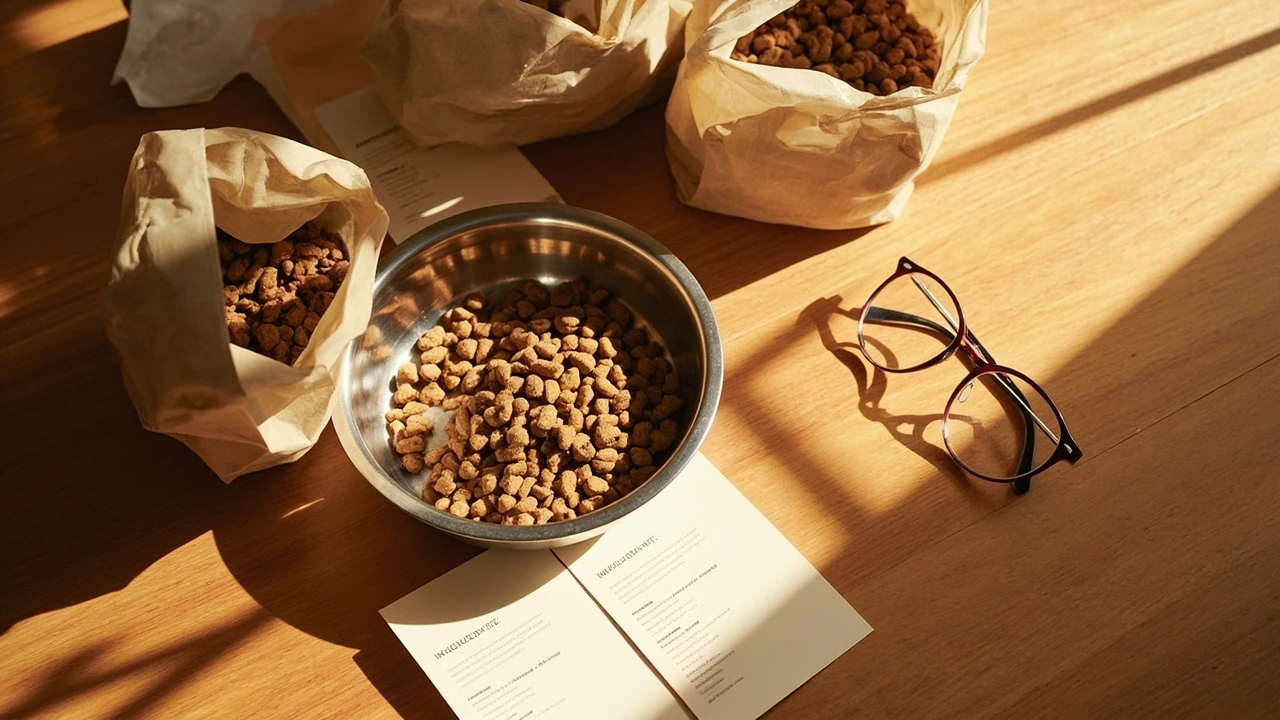
You walk down the pet aisle, see a wall of dog food brands, and notice that the prices range from twelve dollars to ninety for a bag that looks roughly the same size. Two bags claim “real chicken as the first ingredient,” three more use the word “premium,” and one quietly says “grain-free” in a typeface three times larger than anything else on the package. The decision feels like it should be simple, and instead it feels like reading wine labels without drinking the wine.
The reason the aisle feels overwhelming is that dog food brands are not really competing on one product. They are competing on stories about protein, about grains, about “ancestral” diets, about veterinary endorsement, about price, and increasingly about sustainability. Each of those stories pushes a different part of the label forward and a different part into the small print. A practical way through the noise is to ignore most of the front of the bag and learn to read the back, then ask a small set of sharp questions before you switch. That is what this guide is built to do.
Dog food brands: how to actually compare what is inside the bag
There is no single definition of a “good” dog food brand, because dogs vary in age, size, activity level, and health status, and because regulatory definitions vary by country. What you can do is build a personal rubric that you apply to every bag in front of you, and that rubric should weigh evidence over packaging language. The five things that matter most are: nutritional adequacy, ingredient quality and sourcing, the brand’s own quality control, price per useful calorie, and how the food performs in your specific dog.
Dog food brands are also not all built the same way underneath the marketing. Some are made by large multinational pet food companies that own a dozen sub-brands and share manufacturing facilities. Others are made by smaller companies that contract out production to a co-packer. A few brands make every batch in their own kitchen. The ownership and production model changes who is accountable when something goes right or wrong, and it changes how transparent the company can be about sourcing.
What the AAFCO statement really tells you
In the United States, the most important sentence on a dog food label is the nutritional adequacy statement, which is regulated by the Association of American Feed Control Officials (AAFCO). When a label says the food is “complete and balanced” for a specific life stage, it means the formula meets the nutrient profiles that AAFCO publishes for that stage. The two most common stages are “adult maintenance” and “all life stages,” with the latter requiring higher minimums for some nutrients to cover the needs of puppies and pregnant or nursing females.
There is a common misconception that AAFCO “approves” or “certifies” dog food brands. It does not. AAFCO is a model-law organization whose nutrient profiles are adopted state by state, and it does not test or endorse individual products. A company can demonstrate adequacy in two ways: by formulation, where the recipe is calculated to meet AAFCO profiles on paper, or by feeding trial, where the finished food is actually fed to dogs under a protocol and their health is monitored. A feeding trial is stronger evidence, and that is worth knowing when you compare dog food brands that look identical on paper.
Why “ingredients first” reading often misleads
Ingredient lists on dog food are governed by a different rule than human food: ingredients must be listed in descending order by weight before processing, not by the weight that ends up in the finished kibble. Chicken at 70 percent moisture weighs a lot more going in than the dried chicken meal that survives extrusion. A bag whose first ingredient is fresh chicken may end up with less animal protein in the bowl than a bag whose first two ingredients are named meals.
This is why serious comparisons between dog food brands look past the front of the bag and into the guaranteed analysis, and ideally the typical analysis on the company’s website. The moisture content, the crude protein percentage, the crude fat percentage, and the calorie density per cup or per kilogram are the numbers that actually predict what your dog is eating per meal. Ingredient order tells you a story; the analysis tells you the diet.
The four production models behind most dog food brands
Once you start asking how a food is made, most dog food brands fall into one of four production models, and each carries different trade-offs around cost, transparency, and recall risk.
- Vertically integrated manufacturer. The company owns its mills, runs its own research, and often owns the farms or suppliers upstream. Examples in the broader industry include large established pet food companies, but even within that group there is a wide range of investment in facilities and quality control. Vertical integration tends to mean tighter process control and stronger traceability.
- Brand-led co-packing. A small or mid-sized brand designs recipes and contracts a co-packer to produce them. The brand controls the formula, marketing, and often the sourcing, while the co-packer runs the line. The risk is that quality depends on the contract manufacturer’s standards, and a recall can hit multiple brands at once if they share a line.
- Specialty or fresh kitchen. Small-batch producers, often selling refrigerated or frozen fresh food, cook in smaller facilities. These brands can show real kitchen-level transparency, including named farms, and they usually charge a meaningful premium. They are also more vulnerable to supply shocks and cold-chain problems.
- Private label and store brands. Retailers, big-box stores, and membership clubs sell dog food under their own labels. The quality ranges widely. A private label is simply whoever is making the bag this quarter, so the rubric still has to be applied label by label.
What actually separates one dog food brand from another
If every bag has an AAFCO statement, an ingredient list, and a guaranteed analysis, what is the meaningful difference between dog food brands? In practice, five factors show up over and over in how brands position themselves and how they perform in independent testing.
Protein source and named versus generic ingredients
High-quality dog food brands use named animal proteins. “Chicken,” “salmon,” “lamb,” and “duck” tell you exactly which species the protein came from. “Meat meal,” “animal fat,” and “poultry by-product meal” are generic terms that can come from a mix of sources. AAFCO rules require more specificity for named proteins, which is why a label that says “chicken meal” is generally more traceable than one that simply says “meat meal.”
Within those categories, there is another layer. Chicken meal can be a carefully rendered, low-ash protein concentrate, or it can be a lower-grade product with more bone and feather. Dog food brands that are serious about quality will publish the source country and sometimes the supplier for their named proteins. Brands that do not publish sourcing usually have a reason, and that reason is rarely that the source is exceptional.
Carbohydrate strategy: grain-inclusive, grain-free, and the FDA question
For roughly a decade, grain-free dog food brands became the fastest-growing segment of the market, driven by the idea that grains are somehow unnatural or inflammatory for dogs. The nutritional reality is more boring. Whole grains like brown rice, oats, barley, and millet are well digested by most dogs and provide useful fiber and micronutrients. Grain-free formulas replace grains with peas, lentils, chickpeas, and potatoes, which can be perfectly fine for many dogs and are essential for dogs with a diagnosed grain allergy.
What changed the conversation was a series of investigations by the U.S. Food and Drug Administration starting in 2018 into a possible link between grain-free diets and a heart condition called dilated cardiomyopathy, particularly in larger breeds. The FDA has not issued a definitive causal finding, and the underlying research is still debated in the veterinary cardiology community, but the agency’s updates over the years are publicly available and worth reading if you are choosing between grain-free and grain-inclusive dog food brands for an at-risk dog. The conservative position among many veterinary nutritionists is that there is currently no proven benefit to grain-free for the average dog, and a possible, though unproven, risk for some.
Functional additives and the difference between marketing and evidence
Walk the pet food aisle and you will see claims about glucosamine and chondroitin for joints, omega-3 fatty acids for skin and coat, probiotics for digestion, antioxidants for immune support, and various botanical extracts for “vitality.” Some of these have decent evidence behind them in dogs, and some have very little. Glucosamine and chondroitin, for example, have mixed but real evidence in canine osteoarthritis, while many herbal blends on dog food brands are not supported by independent research in dogs at all.
The honest test is whether the additive is included at a level that has been studied and whether the brand will tell you that level on request. A guaranteed analysis gives you the minimum or maximum of a nutrient per batch, but it does not always tell you the specific form. Chelated minerals, for example, are more bioavailable than their inorganic cousins, and the difference matters, but most labels do not specify.
Manufacturing quality, recalls, and the track record
One of the strongest signals you can look at across dog food brands is their recall history, and the way they handled the recall when it happened. Recalls happen to almost every large manufacturer eventually, because the supply chain is long and the tolerance for error is low. What separates the serious brands is whether they have a published, dated recall log, whether they post the lot numbers, and whether they issue a clear public statement about the cause.
Independent testing is another, less common, signal. Organizations like Consumer Affairs and some veterinary teaching hospitals have published independent reviews of dry dog foods, looking at nutrient content versus label claims, contamination with heavy metals, and the presence of undeclared proteins. The most rigorous source is a peer-reviewed publication, but those are rare. For everyday decisions, the FDA’s pet food recall portal and the brand’s own recall log are the two most useful starting points.
Price per calorie, not price per bag
The most expensive-looking bag in the aisle is sometimes the cheaper food per meal, because the kibble is denser, the calorie count per cup is higher, and the bag is heavier. Conversely, a “value” bag with a low price per pound can be one of the most expensive diets you can feed, because you have to feed a lot of it to maintain body condition. To compare dog food brands on a fair basis, divide the bag price by the number of calories the bag contains. That number, the cost per kilocalorie or per megacalorie, is the honest comparison.
| Brand style | Approximate price per 30 lb bag | Calories per cup | Approximate cost per 1,000 kcal |
|---|---|---|---|
| Mass-market value dry | $40-$50 | 300-340 | $1.30-$1.60 |
| Mid-market “premium” dry | $55-$70 | 340-380 | $1.60-$2.10 |
| Specialty grain-inclusive dry | $70-$95 | 380-430 | $2.10-$2.90 |
| Fresh or refrigerated | $80-$150 for smaller packs | 250-320 | $3.50-$6.00 |
| Veterinary prescription dry | $70-$110 | 300-360 | $2.40-$3.60 |
The numbers above are illustrative ranges pulled from typical U.S. retail prices and standard published metabolizable energy values for adult maintenance diets, not from any specific product. The point is not the exact dollar amount, but the gap between per-bag and per-calorie thinking, which is often twenty to forty percent on the same shelf.
How to read a dog food label in five minutes
Most people choose dog food brands in a hurry, often because the current bag ran out. The good news is that a useful reading of a label takes only a few minutes once you know where to look. A simple five-step pass will tell you almost everything you need to know.
- Find the AAFCO statement. Look for the phrase “complete and balanced” and note the life stage. If it says “for intermittent or supplemental feeding only,” the food is not a complete diet and is meant to be mixed.
- Check for a feeding trial. If the AAFCO statement says “animal feeding tests using AAFCO procedures substantiate,” the food passed a real feeding trial. If it says “formulated to meet the nutritional levels,” the food is calculated to meet but not tested.
- Read the guaranteed analysis. Note crude protein, crude fat, crude fiber, and moisture. For dry kibble, moisture is usually around 10 percent. For wet food, it can be 75 percent or higher, which is why the numbers look so different on the label.
- Skim the ingredient list for red flags. Look for named proteins at the top, look for named fats (“chicken fat” rather than “animal fat”), and watch for vague sweeteners like “sugar” or “molasses” near the top of the list.
- Compare on a dry-matter basis. If you are comparing a dry food and a wet food, convert the protein percentage to a dry-matter basis by dividing by one minus the moisture percentage. This is the only way the numbers line up honestly across formats.
Reading a guaranteed analysis across formats
Two dog food brands can look very different on the shelf and very similar in the bowl. A dry kibble at 26 percent crude protein with 10 percent moisture is actually about 29 percent protein on a dry-matter basis. A wet food at 8 percent crude protein with 78 percent moisture is about 36 percent protein on a dry-matter basis, which is higher than the kibble despite the smaller number on the label. Once you learn this conversion, comparing dog food brands across formats becomes much more honest.
| Format | Crude protein on label | Moisture on label | Crude protein on a dry-matter basis |
|---|---|---|---|
| Dry kibble, mid-market | 26% | 10% | 29% |
| Dry kibble, high-protein | 34% | 10% | 38% |
| Wet food, typical | 8% | 78% | 36% |
| Wet food, high-protein | 11% | 78% | 50% |
| Fresh refrigerated | 10% | 70% | 33% |
Special cases: puppies, seniors, and dogs with health conditions
The “all life stages” label sounds convenient, but for most adult dogs it is overkill on calories and minerals. For most puppies, especially large-breed puppies, it can be the wrong fit. A more useful approach is to choose dog food brands that match your dog’s specific stage and condition, and to switch only when the situation genuinely changes.
Large-breed puppies and the calcium question
Large-breed puppies grow slowly on purpose, and overfeeding them, or feeding a diet too rich in calcium, has been linked to orthopedic problems later in life. A large-breed puppy formula should have a controlled calcium-to-phosphorus ratio and a moderate calorie density, and it should be fed to a target body condition rather than free choice. Some dog food brands offer a specific large-breed puppy line; others do not, and it is reasonable to stay with an adult maintenance food for a slower-growing large-breed puppy if your veterinarian agrees.
Senior dogs and the protein myth
For years, senior dog food brands pushed protein down, on the theory that older kidneys could not handle it. Current veterinary nutrition research has largely reversed that view. Healthy senior dogs generally do well on the same or even higher protein levels than they had as adults, as long as the protein is high quality and the kidneys are not already compromised. The real changes in a senior formula are usually calorie density (lower, to prevent weight gain in less active dogs), added joint support, and sometimes adjusted sodium and phosphorus for dogs with known heart or kidney issues.
Prescription and therapeutic diets
For dogs with diagnosed kidney disease, urinary issues, food allergies, diabetes, or certain heart conditions, prescription diets from veterinary lines are not a marketing category. They are clinically formulated, often with peer-reviewed evidence behind them, and they can be the difference between a stable dog and a sick one. This is also where dog food brands diverge most sharply. A prescription diet is typically more expensive per calorie, but it is also the one category where cost is the wrong question. The right question is whether your dog needs it, and the answer almost always comes from your veterinarian, not from the label.
A shortlist of useful questions to ask before you switch
If you are weighing a switch between dog food brands, run the new choice past this checklist. None of these questions is about the bag design or the price tag, and all of them are things you can verify with a phone call or a website visit.
- Does the AAFCO statement match my dog’s life stage, and is it backed by a feeding trial or only by formulation?
- Who actually makes the food, and is the production facility owned by the brand or contracted out?
- Where do the named proteins come from, and will the company tell me on request?
- What is the calorie density per cup, and what does that imply for cost per meal at my dog’s target weight?
- What is the brand’s recall history over the last five years, and how were those recalls communicated?
- Has the food been independently tested or reviewed by a third party, and where can I read that review?
- Is my dog healthy, and could this switch interact with a current health condition or medication?
How to introduce a new food without upsetting your dog’s stomach
The mechanics of switching dog food brands matter as much as the choice itself. A sudden change in protein source, fat level, or fiber can cause loose stool, gas, or a dog that simply refuses to eat. The standard recommendation from most veterinary sources is a seven-to-ten-day transition, gradually replacing a portion of the old food with the new.
- Days 1-2: 75 percent current food, 25 percent new food.
- Days 3-4: 50 percent current, 50 percent new.
- Days 5-7: 25 percent current, 75 percent new.
- Day 8 onward: 100 percent new food if stools and appetite are normal.
For dogs with sensitive stomachs, a slower ramp of two to three weeks is reasonable, and adding a small amount of plain canned pumpkin (not pie filling) to meals can help stool quality during the transition. If vomiting, persistent diarrhea, or a clear loss of appetite lasts more than forty-eight hours, the right call is usually to step back to the previous food and check in with your veterinarian before trying again.
Common myths that get in the way of choosing well
Because the pet food market is so crowded, dog food brands have every incentive to lead with stories that are easy to repeat. Some of those stories are not supported by current evidence, and they can steer you away from a perfectly good food or toward a worse one. A few of the most common deserve a direct look.
“By-products are bad”
Animal by-products in pet food are not the same as the by-products you might imagine. They are usually the organs, bones, and other parts that humans do not typically eat, and they are often more nutrient-dense than the muscle meat that gets the marketing attention. Chicken by-product meal, for example, is a legitimate, well-digested source of protein and minerals. The quality still varies by supplier, but the category itself is not the problem.
“Dogs are wolves, so they need raw”
The raw feeding movement draws on a real argument, which is that domestic dogs share ancestry with wolves. The conclusion some draw from that, which is that a raw, muscle-meat-heavy diet is the natural and therefore best choice, is much weaker. Domestic dogs have been adapting to cooked and grain-inclusive diets for at least ten thousand years, and they carry genetic adaptations for starch digestion that wolves do not. Raw diets also carry real food-safety risks for both the dog and the humans in the household, and there is no peer-reviewed evidence that they outperform a well-formulated cooked diet for the average dog.
“Grain-free is healthier”
For most dogs, there is no evidence that grain-free diets are healthier than grain-inclusive ones, and there is a tentative signal that some grain-free diets, particularly those heavy in peas and lentils, may be associated with a form of heart disease in certain breeds. Until that signal is resolved, the conservative choice for a healthy dog is a grain-inclusive diet from a brand with a transparent ingredient list and a real feeding trial behind it.
“The more expensive the bag, the better the food”
Price is correlated with marketing and ingredient sourcing choices, but not consistently with nutritional quality. A reasonable, well-formulated dry food from a mid-priced brand can be a better fit for your dog than a boutique fresh food at three times the price, especially if the mid-priced food has a stronger feeding trial and a cleaner recall history.
Putting it together: a simple framework for choosing between dog food brands
When you stand in front of a shelf with twenty dog food brands and have to make a choice, the easiest way to keep your head is to apply the same four-step framework every time, regardless of which brand is shouting loudest that week.
- Filter by suitability. Confirm the AAFCO statement matches your dog’s life stage and any health conditions. Anything that does not match drops out immediately.
- Compare the analysis. Convert crude protein, fat, and fiber to a dry-matter basis and compare across the remaining options. Note the calorie density per cup.
- Check the track record. Look up the brand’s recall history and any independent testing you can find. A short, well-handled recall is not a deal-breaker; a long, hidden one is.
- Run the cost-per-calorie math. Calculate the cost per 1,000 kcal for your shortlist, and pick the option that best balances cost with the other three filters for your household budget.
If you do this for a few bags in a row, you will find that your shortlist gets shorter very quickly, and the decision becomes much less about the brand on the front of the bag and much more about the brand behind it. That is the real shift: from shopping dog food brands to evaluating them.
Frequently asked questions
How many dog food brands should I realistically consider?
For most households, a serious shortlist of three to five brands is more useful than trying to compare every bag on the shelf. Once you have filtered by life stage and AAFCO adequacy, the meaningful differences between dog food brands usually narrow to a handful of choices that you can compare on the rubric above.
Is grain-free dog food actually worse for my dog?
The current evidence does not show a clear benefit of grain-free for the average healthy dog, and there is a tentative, still-debated signal from the FDA that diets heavy in peas, lentils, and certain other legumes may be linked to a form of heart disease in some dogs. For most dogs, a grain-inclusive diet is the more conservative choice unless your veterinarian has diagnosed a specific grain-related issue.
Do expensive dog food brands use better ingredients?
Not always. Higher prices often reflect marketing, smaller-batch production, fresh formats with shorter shelf life, or premium protein sources, but they do not automatically mean better nutritional quality. The most reliable signal is independent testing, a real feeding trial behind the AAFCO statement, and a transparent supply chain, not the price tag alone.
How do I know if a dog food brand has had a recall?
The FDA maintains a public pet food recall portal that lists recalls by brand and date. Most reputable dog food brands also publish their own recall history on their website with the lot numbers and the reason for the recall. If a brand does not make its recall history easy to find, that is itself a useful signal.
Should I rotate between several dog food brands?
Rotational feeding is a reasonable idea in theory, because it can reduce the risk of a sensitivity developing to any one protein source. In practice, rotating too often makes it hard to tell which food is causing which effect, and it can upset a sensitive stomach. A better default is to feed one well-chosen food for a meaningful period, then change only if there is a reason, and to switch over the seven-to-ten-day transition.
What is the difference between a feeding trial and a formulated diet?
A feeding trial means the finished food was actually fed to dogs under an AAFCO-defined protocol and the dogs maintained the expected health markers. A formulated diet means the recipe was calculated on paper to meet AAFCO nutrient profiles but was not tested in real dogs. Both can meet the same label, but a feeding trial is stronger evidence that the food performs as designed.
Are by-products in dog food safe to feed?
Named animal by-products, such as chicken by-product meal, are regulated, tested, and commonly used in mainstream dog food brands. They are not equivalent to the inedible parts of an animal. The quality still varies by supplier, so a brand’s sourcing transparency still matters, but the by-product category itself is not a red flag.
Does my dog need a breed-specific or size-specific formula?
For most dogs in good health, breed- and size-specific formulas are a marketing layer more than a nutritional one. The exception is large-breed puppy growth, where controlled calcium and calorie density genuinely matter, and small-breed kibble shape, which can matter for dental comfort. If your dog is healthy and at a good body condition, a well-chosen adult maintenance food from a reputable brand is usually enough.
How long should I trial a new dog food before deciding?
A reasonable trial is at least four to six weeks on the new food, with a controlled transition in and a steady feeding amount based on your dog’s target weight. Look at stool quality, coat condition, energy level, and body condition score over that period rather than day-to-day enthusiasm, which can be misleading.
What is the single most useful question to ask a dog food brand directly?
Ask whether the AAFCO statement is supported by an actual feeding trial, and if so, where the trial was conducted and whether the results have been published. Brands that have done the work will answer that question clearly. Brands that have not usually change the subject, and that is a useful answer too.