When a team lead types “chipotle catering” into a search bar, the question is rarely academic. Someone is feeding a group this week, and they need to know whether the program fits the headcount, the budget, and the room before they commit. Chipotle’s catering service has been around long enough that the broad strokes are familiar, but the details that decide whether lunch actually lands well — portion math, lead time, dietary split, delivery logistics — tend to live in the fine print and in the experience of people who have ordered before. This guide walks through how the program actually works in 2026, what it costs in real situations, and where it tends to surprise first-time buyers.
Chipotle catering at a glance
Chipotle catering is a group-ordering service built around the same ingredients used in restaurant bowls, burritos, and tacos. Instead of individual orders, the restaurant prepares the food in foil trays and delivers everything needed for guests to assemble their own meals at a Build-Your-Own bar. The model is designed to remove the per-person decision fatigue of a typical office lunch while keeping the customization that draws people to Chipotle in the first place.
For most buyers, the appeal is the combination of three things: a per-person price that is often lower than a comparable pizza or sandwich spread, a menu almost everyone already recognizes, and a serving format that scales from a 20-person team meeting to a 200-person company lunch. The trade-off is that Chipotle catering is not a full-service event program. There is no onsite chef, no plated service, and very limited customization beyond the standard build. Buyers who need a more tailored experience usually look at local caterers instead, and the broader principles in how restaurants build an identity guests remember apply just as much to catering as to the dine-in experience.
How the Build-Your-Own catering format works
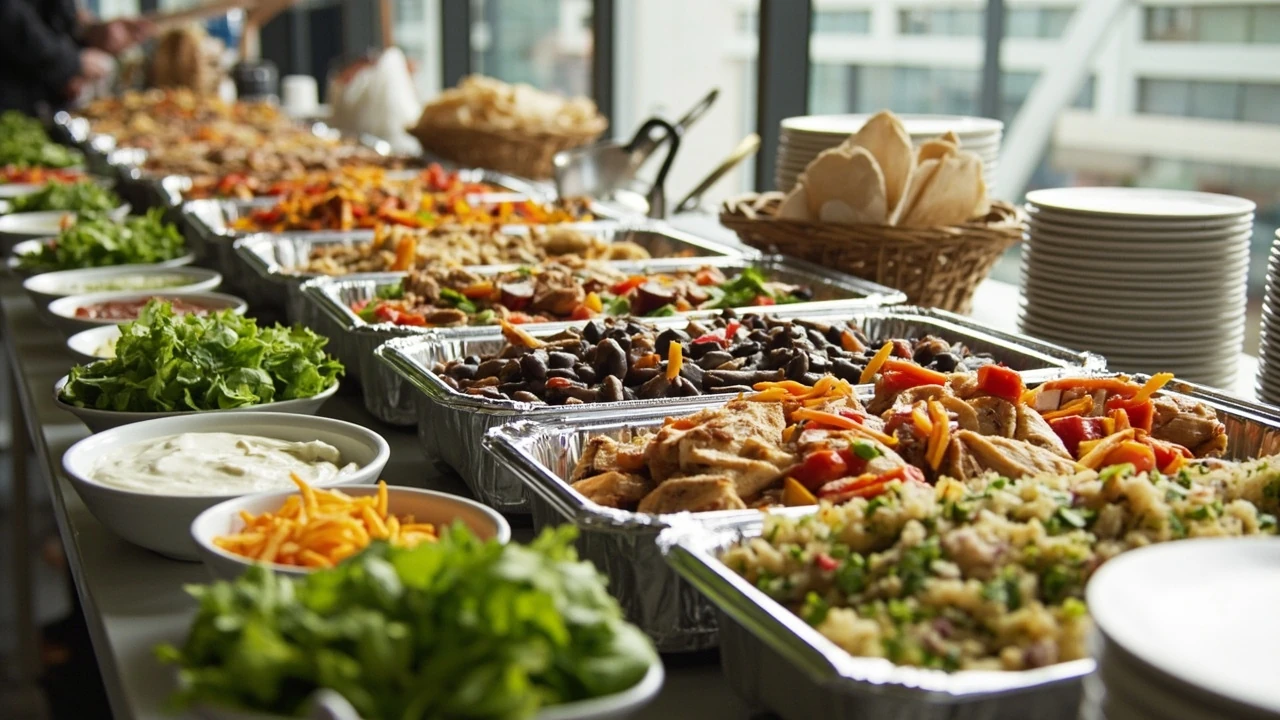
The default Chipotle catering package is a Build-Your-Own bar, which mirrors the in-store line in a buffet layout. Chipotle provides the protein, rice, beans, and toppings in separate trays so each guest can build a bowl, tacos, or a salad. The format is the same whether the order is for 20 people or 200, which is one of the reasons it is so widely used for office lunches, training days, and team celebrations.
What arrives in a standard package
Most catering orders include:
- Two tray options: burritos (with tortillas) or tacos, with bowls as a default alternative
- One or two proteins of choice, such as chicken, steak, carnitas, barbacoa, sofritas, or vegetarian options
- Cilantro-lime rice and brown rice as the standard starch base
- Black beans and pinto beans
- Fajita vegetables
- Toppings: fresh tomato salsa, corn salsa, green tomatillo salsa, cheese, sour cream, romaine, and guacamole when ordered
- Disposable serving utensils, bowls or plates, napkins, and plastic cutlery
Most orders can be configured to feed either 10 or 20 guests, and Chipotle will scale up by stacking additional trays. The exact minimum order, the number of proteins available, and the option to add sides or desserts depend on the location, so the first concrete step is always to confirm what a specific restaurant can provide on the date you need.
How to plan the right order size
Under-ordering is the most common mistake first-time Chipotle catering buyers make, because the portions look smaller in trays than they do on a made-to-order burrito. The catering calculator on Chipotle’s site is a good starting point, but a few rules of thumb hold up across most group sizes.
Portion rules that tend to work
- Assume each guest eats about 1 to 1.25 burritos’ worth of food. The default catering calculator builds in roughly that range.
- For groups with a high proportion of heavy eaters, athletes, or guests who skipped breakfast, size up by 10 to 15 percent.
- For groups with mixed dietary needs, plan for an even split between the two proteins rather than guessing one will dominate.
- If you are ordering for a long meeting that overlaps a regular meal slot, expect portions to disappear faster than at a 30-minute lunch.
For an office of 25, that usually means ordering a package built for 30. For a 50-person training day, it is safer to round up to 60 than to try to land exactly on 50. The same margin logic shows up in menu pricing strategies that protect margin, where overestimating demand tends to be cheaper than underestimating it.
Cost structure: what actually drives the price
The per-person price for Chipotle catering depends on a few variables, and the easiest way to avoid surprises is to separate the fixed parts of the bill from the parts you can tune.
Fixed components
- Minimum order size set by the individual restaurant
- Delivery fee, which scales with distance from the store
- Service fee or platform fee when ordering through the catering website or app
Variable components
- Number of proteins selected (one vs. two)
- Add-ons such as guacamole, queso, chips, or dessert
- Whether the order is delivery, pickup, or a full-service setup
- Group size, since some locations price in tiers
What the per-person price usually includes is the food, serving utensils, and basic disposables. What it usually does not include is gratuity for the driver, any special setup beyond drop-off, or extra sides beyond the standard build. Asking for a written quote that lists each line item — food, delivery, service fee, add-ons, and tax — is the cleanest way to compare two catering options side by side.
Lead times, ordering windows, and scheduling
Lead time is where Chipotle catering diverges the most from a typical restaurant reservation. The kitchens run on the same production schedule as the in-store line, which means capacity is the limiting factor, not the food itself.
Typical scheduling windows
- Small orders (under 25 people) can often be placed 24 to 48 hours ahead, sometimes same-day if the store has capacity.
- Medium orders (25 to 75 people) usually need 48 to 72 hours, and earlier is safer if the date is midweek.
- Large orders (75 to 200+ people) typically require 5 to 7 business days, and some stores need a week or more for very large events.
Holiday weeks and the end of the month tend to be the tightest. If the lunch falls on a day when many other offices are also ordering, the same store that comfortably handles a 50-person drop on a Tuesday may struggle to fit in another one on a Friday. Booking earlier than you think you need to is the simplest way to avoid last-minute scrambling.
Delivery, setup, and what the driver does
Standard Chipotle catering is a drop-off service. The driver brings the food in insulated bags, sets the trays on a table you have prepared, and leaves. For most offices, that is exactly the right level of service. For events where the host wants more help, it is worth asking the location what is available.
What to prepare on your end
- A serving table long enough to hold the trays in roughly the order guests will use them: rice and beans first, then proteins, then toppings, then sides and utensils.
- A nearby outlet if the order includes any hot-hold items that need warming, and a plan to keep cold items cold in a warm room.
- Trash and recycling bins within easy reach, because the disposable service generates more waste than a typical restaurant meal.
- Clear signage for dietary labels if your group includes guests with allergies or strict preferences.
If the venue does not have a prep area, ask the store whether they can deliver in ready-to-serve packaging. Some locations will portion items into individual boxes for an additional fee, which is often worth it for working lunches where guests grab a meal and head back to their desks.
Dietary considerations: vegetarian, vegan, gluten-free, and allergens
One reason Chipotle catering works well for mixed groups is that the Build-Your-Own bar naturally accommodates most common dietary needs. Vegetarians can skip the meat and add beans, sofritas, or fajita vegetables. Vegans can do the same and skip the cheese, sour cream, and any dairy-based toppings. Gluten-free eaters can build a bowl or salad and skip the tortillas, though cross-contact is harder to control on a shared bar.
Allergens to flag in advance
- Gluten, primarily from the tortillas and any cross-contact on the prep surface
- Dairy, from cheese, sour cream, and queso
- Soy, present in sofritas and some marinades
- Tree nuts, which Chipotle’s standard menu does not include but which can appear in add-on desserts at some locations
For guests with severe allergies, the safest path is to set aside a small portion of each topping before the bar opens and label it clearly. Chipotle’s allergen guide is published online and is worth sharing ahead of the event so guests with restrictions can plan their own plate.
Comparing Chipotle catering to the alternatives
Chipotle sits in a specific niche: recognizable food, predictable per-person cost, fast turnaround, low minimums. It is not the right answer for every event, and a quick comparison makes the trade-offs visible.
| Option | Typical per-person cost | Minimum lead time | Customization | Best fit |
|---|---|---|---|---|
| Chipotle catering | Lower than most full-service | 24 to 72 hours typical | Build-Your-Own bar | Office lunches, training days, casual team events |
| Local full-service caterer | Higher, often 2x to 3x | 1 to 4 weeks | Fully customized menus | Client dinners, formal events, dietary-specific menus |
| Pizza or sandwich spread | Comparable to Chipotle | Same day often possible | Limited | Very large groups, tight budgets, last-minute needs |
| Food trucks | Variable, often similar to catering | Days to weeks | Fixed menu | Outdoor events, longer windows where guests can wait |
The most common reason teams choose Chipotle over a local caterer is speed and predictability, not variety. The most common reason they choose a local caterer instead is a need for plated service, signature dishes, or dietary menus that go further than a build bar can support. If the goal is a quick, well-liked lunch that gets the group back to work, Chipotle is usually the right tool. If the goal is an event experience in itself, the conversation shifts.
Where Chipotle catering tends to fall short
No program fits every event, and the honest version of any catering review includes the gaps. The main constraints to plan around are:
- Limited menu variety. The Build-Your-Own format means guests choose from a fixed list, and the kitchen does not generally accommodate custom entrées.
- Service is drop-off only by default. There is no buffet attendant, no on-site carving, and no formal plating.
- Some stores have higher minimums than the published online minimum, especially during peak periods.
- Delivery windows are estimates. Traffic, prior deliveries, and kitchen timing can shift the arrival by 15 to 30 minutes, so the lunch slot should have a buffer.
- Waste is real. Disposable serving ware and leftover trays are the buyer’s responsibility unless the venue handles removal.
Most of these limits can be worked around with a little planning. Some, like the menu ceiling, are simply the price of the format. Knowing where the ceiling sits in advance is what separates a smooth lunch from one that feels like a compromise.
A practical checklist before you place the order
The difference between a catering order that lands well and one that lands flat usually comes down to a few small confirmations. The checklist below is the short version of what experienced buyers run through before they click submit.
| Step | What to confirm | Why it matters |
|---|---|---|
| 1 | Group size and a 10 to 15 percent buffer | Avoids the most common under-order mistake |
| 2 | Dietary split, including vegetarian, vegan, and gluten-free | Determines how many proteins to order and whether sides are needed |
| 3 | Delivery window and a 30-minute buffer on either side | Keeps the meeting on schedule if the driver is early or late |
| 4 | Setup requirements and what the venue provides | Surfaces gaps in tables, outlets, and waste handling |
| 5 | Final quote with fees, tax, and gratuity broken out | Makes it possible to compare options and stay on budget |
| 6 | Cancellation and modification policy | Protects the order if headcount changes at the last minute |
Run through that list once and the lunch tends to take care of itself. Skip any of those steps and the same order can feel like a scramble.
Frequently asked questions
How far in advance should I order Chipotle catering?
For most orders, 24 to 72 hours is enough. For groups over 75 people, plan on a week. Earlier is always safer, especially around holidays or end-of-month dates when many offices order at once.
What is the minimum order for Chipotle catering?
The published minimum is usually 10 people, but individual stores can set higher minimums based on capacity. The specific store handling the order is the right source for the exact number on your date.
Does Chipotle catering include setup?
Standard orders are drop-off. The driver sets the trays on a table you provide and leaves. Some locations offer a fuller setup for an additional fee, which is worth asking about if the venue does not have a clear serving area.
Can guests with dietary restrictions be accommodated?
Yes, within the limits of the Build-Your-Own format. Vegetarians, vegans, and gluten-free guests can build a plate from the standard toppings, and severe allergies are best handled by setting aside labeled portions before the bar opens.
What is included in the per-person price?
Typically the food, basic disposables, and standard delivery. Add-ons like guacamole, queso, chips, or dessert are usually extra, as is gratuity for the driver. Ask for a written quote that lists every line item.
Is delivery available everywhere Chipotle has a restaurant?
Most Chipotle locations offer catering, but delivery range and minimums vary by store. Rural locations and some new stores may only offer pickup. The catering site will reflect what your nearest store can do on a given date.
Can I order both burritos and tacos in the same package?
Most locations allow you to mix the tray types within a single order. Confirm the combination at checkout so the kitchen stages the right balance for the headcount.
What happens if the headcount changes after I order?
Most stores allow modifications up to a cut-off window, usually 24 hours before delivery. After that, changes depend on what the kitchen has already prepped, and a small restocking fee may apply.
Is gratuity expected for the delivery driver?
It is not built into the standard order, and tipping is at the buyer’s discretion. For a smooth drop-off, a small cash tip or an added gratuity at checkout is a reasonable gesture, especially for large or early-morning deliveries.
How does Chipotle catering compare in cost to pizza for an office lunch?
Per-person prices are usually close. Chipotle tends to win on perceived value because the food feels more substantial, while pizza tends to win on the lowest possible per-person spend. The right choice depends on what the group actually wants to eat.