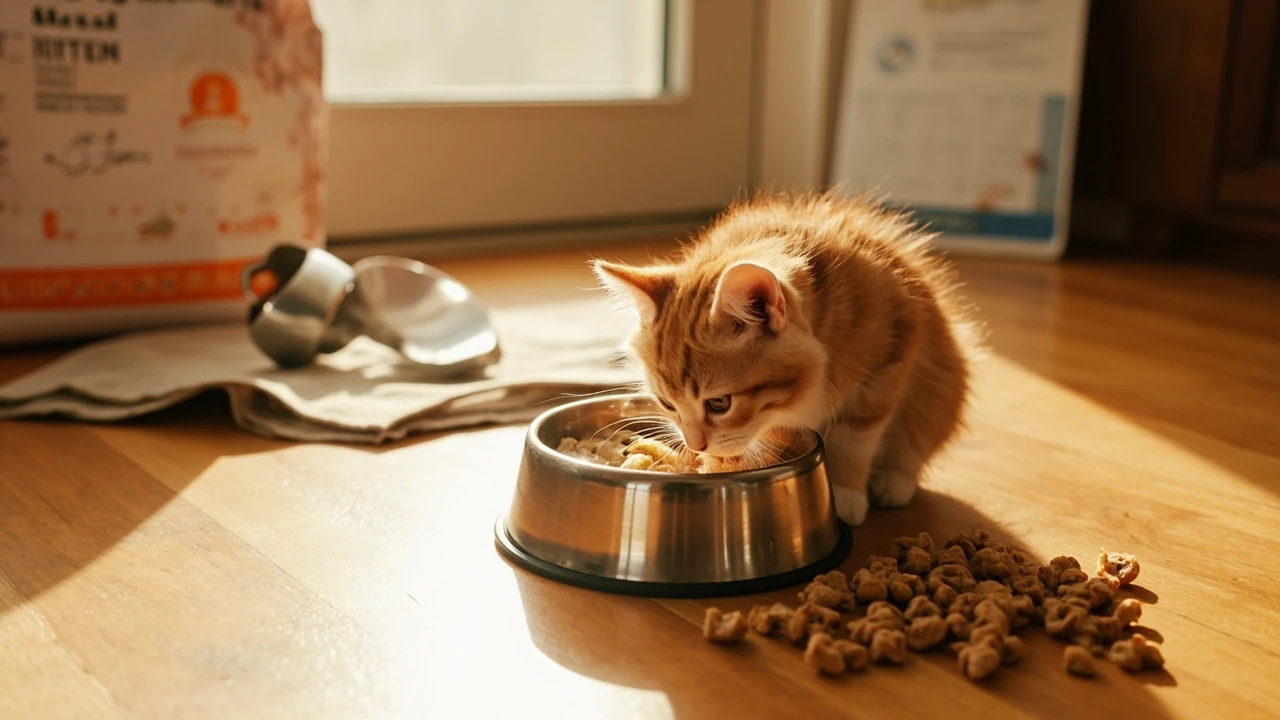
Best kitten food: what actually matters before you buy a single bag
You walk into a pet store, or open a tab online, and you see thirty different bags and cans promising the best kitten food. The kitten is small, opinionated, and growing fast, and you are trying not to make a permanent dietary mistake in the first six months of its life. The honest answer is that “best” is not a brand. It is a match between an evidence-based nutritional standard, your kitten’s specific life stage, and the practical realities of feeding a young animal every day without drama.
This guide walks through the criteria veterinarians and board-certified veterinary nutritionists actually use when they evaluate kitten food, the labels and numbers worth reading, the questions worth asking a vet, and the common traps that lead well-meaning owners to overspend or underfeed. By the end, you should be able to look at any short ingredient list, any guaranteed-analysis panel, and any feeding guide printed on a bag, and judge whether the product is a serious candidate for your kitten.
What “complete and balanced” really means on a kitten food label
The single most important phrase on any kitten food package is “complete and balanced” for growth, or for “all life stages.” In the United States, that claim is regulated. It means the product meets the nutritional levels established by the AAFCO Dog and Cat Food Nutrient Profiles for growth and reproduction, either by passing a feeding trial or by being formulated to meet the published nutrient levels. The Association of American Feed Control Officials (AAFCO) is the body that publishes those profiles, and the wording is not marketing fluff. A product that does not carry this statement for growth is, by definition, not appropriate as a sole diet for a kitten, no matter how promising the front of the bag looks. The AAFCO nutrient profile defines the minimum levels of protein, fat, vitamins, and minerals a growth diet must deliver.
Two practical corollaries follow. First, treats, toppers, and “supplemental” products are not the same category as a complete kitten food, and a kitten fed mostly treats will develop deficiencies. Second, products labeled for “adult maintenance” meet a different, less demanding nutrient profile. A steady diet of adult cat food during the rapid-growth window can leave a kitten short on calories, calcium, phosphorus, and a handful of micronutrients, even if the cat appears to be doing fine for a few months.
Within complete and balanced growth diets, there are still real differences. A product formulated by recipe and supported by a published AAFCO feeding trial is generally a more conservative choice than a product that simply meets the nutrient numbers on paper. Feeding trials catch problems a paper formulation cannot, including palatability issues, digestibility quirks, and the occasional interaction between ingredients that looks fine on a spreadsheet but does not work in a living animal.
The non-negotiable nutrients in a quality kitten food
Kittens are not small adults. They are building bone, muscle, a brain, and an immune system in roughly twelve months, which is why their nutrient requirements per kilogram of body weight are higher than an adult cat’s. The nutrients that matter most are the ones most often skimped on in cheap foods.
Protein quality and quantity
Kittens need more crude protein than adult cats, and the protein has to be highly digestible. Animal-source proteins, such as chicken, turkey, fish, or egg, are the most reliable sources because they contain the full profile of essential amino acids a cat cannot synthesize on its own. The headline AAFCO minimum for growth is 30 percent crude protein on a dry-matter basis, but high-quality growth diets typically run well above that, often in the 35 to 45 percent range. Plant proteins can appear on the label, but they are functionally filler for an obligate carnivore. If the first three ingredients on a dry food are named animal proteins, that is a good early sign.
Fat, including the right fatty acids
Fat is the densest source of calories, and kittens need that density. A growth diet should deliver at least about 9 percent crude fat on a dry-matter basis, with most quality products landing closer to 15 to 20 percent. The fat should provide a balanced omega-6 to omega-3 ratio and should include named sources, such as chicken fat, fish oil, or flaxseed. The brain and retina of a kitten are still developing, and the long-chain fatty acids DHA and EPA from marine oils are worth preferring where the budget allows.
Calcium, phosphorus, and the ratio between them
Skeletal development depends on getting calcium and phosphorus right, and the ratio matters as much as the absolute amount. AAFCO requires at least 1.0 percent calcium and 0.8 percent phosphorus for growth, with a calcium-to-phosphorus ratio somewhere between 1:1 and roughly 2:1. A homemade or unbalanced raw diet that gets this ratio wrong can cause skeletal deformities, particularly in large-breed kittens. With a commercial complete and balanced food, the manufacturer has done this math, which is one of the quiet advantages of staying within regulated products.
Taurine, arginine, methionine, and the rest
Cats have a small set of amino acids they cannot make in adequate quantities, including taurine, arginine, and methionine. Deficiencies cause serious problems: taurine deficiency leads to dilated cardiomyopathy and retinal degeneration, and arginine deficiency can cause severe neurological signs within hours. A balanced growth diet has these covered, but a homemade or “premium raw” plan that has not been checked by a veterinary nutritionist can miss them.
Vitamins, minerals, and the small but important details
Choline supports liver function, and kittens have a higher requirement than adults. Vitamin A must come preformed from animal sources, because cats do not convert beta-carotene efficiently. B-vitamin levels must be high, because grain-based or heat-processed diets can deplete them. None of this needs to be on the front of the bag, but it should be visible in the guaranteed analysis and the ingredient list.
How to read a kitten food label without getting fooled
Pet food labels are heavily designed to push emotion. The trick is to look past the photography and the slogans, and to read the same four sections of the label in the same order every time.
- The nutritional adequacy statement. It must say, in specific words, that the product is complete and balanced for growth, or for all life stages, and it must say whether the claim is based on a feeding trial or on formulation to AAFCO nutrient profiles.
- The guaranteed analysis. This lists minimum crude protein and crude fat, and maximum crude fiber and moisture. It is a starting point, not a verdict, because the moisture content of wet food distorts the numbers. A useful habit is to convert everything to a dry-matter basis before comparing products.
- The ingredient list, in descending order by weight. The first five ingredients carry most of the nutritional weight. Named animal proteins should be near the top, and vague terms like “meat by-products” without a species are a small yellow flag, not a deal-breaker, because well-sourced by-products are nutrient-dense and traditional in cat food.
- The feeding guide, the calorie content, and the contact information for the manufacturer. A serious company publishes a reachable phone number, a website, and ideally a staffed team of veterinary nutritionists. The feeding guide should not assume a free-fed kitten will self-regulate; most will not.
A label that is hard to find any of those four sections on is a label that is working harder on style than substance.
Dry, wet, raw, and home-cooked: comparing the real feeding formats
Format matters as much as brand, because each format changes water intake, calorie density, dental effects, cost, and risk. The table below summarizes the practical trade-offs you actually feel as an owner, not the slogans.
| Format | Typical moisture | Pros for a kitten | Cons and risks | Best use |
|---|---|---|---|---|
| Dry kibble, complete and balanced for growth | Around 6 to 10 percent | Calorie-dense, easy to measure, can be left for short periods, helps mild tartar control through abrasion | Low moisture, so kittens that eat only dry food drink more, which young kittens sometimes do not do reliably | Budget-friendly base of the diet, especially in multi-cat homes, or as one of two formats |
| Wet food, complete and balanced for growth | Around 75 to 82 percent | High water content supports hydration, often more palatable, useful for picky eaters or small kittens | More expensive per calorie, spoils quickly in the bowl, contributes little mechanical dental cleaning | Primary diet for kittens that do not drink well, or as a complement to dry food |
| Raw, commercially prepared and complete | Variable, often around 60 to 70 percent | High palatability for some kittens, owners like the ingredient transparency | Pathogen risk for the kitten and for the humans in the household, expensive, and unproven as superior to cooked complete diets | Households that have consulted a veterinary nutritionist and can manage food safety consistently |
| Home-cooked, formulated by a veterinary nutritionist | Variable | Full control over ingredients, can address specific medical needs | Time-intensive, requires careful supplementation, easy to miss key nutrients without expert formulation | Kittens with allergies or conditions that rule out commercial complete diets, under vet supervision |
A simple rule that holds up in most households: choose one complete and balanced growth product in the format you can actually feed consistently, and then layer in a second format if you want to broaden the diet. A kitten that learns to eat both wet and dry food early has an easier time adjusting to whatever life throws at it later, from a boarding stay to a sudden health issue.
Feeding amount, calorie targets, and why the printed guide is usually wrong
The feeding chart on the back of the bag is a starting point, not a prescription. It is built for an “average” kitten of a given weight, and the average is a statistical fiction. Real kittens vary by 30 percent or more in how many calories they burn, even at the same body weight. A lean, active kitten that races around the apartment will need more calories than a quiet kitten of the same weight, and a kitten that was the runt of the litter will need less at any given age because it is smaller.
A more useful approach is to anchor feeding to a calorie count and a body-condition target rather than to a printed cup count. Most complete growth diets for kittens run somewhere between 350 and 450 kilocalories per cup of dry food, and the metabolizable energy figure is usually printed on the label or on the brand’s website. For a healthy kitten, a rough starting range is about 200 to 250 kilocalories per kilogram of expected adult body weight per day, split into three or four meals for kittens under four months, and two meals after that. You then adjust every two weeks based on body condition.
| Age | Meals per day | Approximate daily calories per kg of expected adult weight | Notes |
|---|---|---|---|
| 4 to 8 weeks | 4 to 5 | Around 250 | Transitioning from mother’s milk, food can be softened with warm water |
| 2 to 4 months | 3 to 4 | Around 230 | Growth is rapid, body condition should be reassessed weekly |
| 4 to 6 months | 3 | Around 210 | Skeletal growth is still intense, avoid calorie restriction |
| 6 to 12 months | 2 to 3 | Around 200 | Body length is approaching adult size, weight is still climbing |
Body condition is checked by feeling the ribs and looking at the waist from above. A kitten at a healthy weight has ribs that are easy to feel under a thin layer of fat, and a visible waist when viewed from above. A kitten where the ribs are hard to find, or where the belly sags, is being overfed, and a kitten where the ribs and vertebrae are visibly protruding is being underfed. Both situations warrant a conversation with the vet.
Ingredients worth preferring, and a few that are mostly noise
Marketing loves to highlight a few ingredients and pretend the rest of the bag does not exist. A few common claims are worth sorting out.
- Named animal protein as the first ingredient. “Chicken” is more informative than “meat,” and a specific cut like “chicken breast” is a more reliable source than a generic “chicken meal,” although both can be part of a quality product.
- Animal fat with a named source. “Chicken fat” preserved with mixed tocopherols is a clean energy source. Generic “animal fat” without a species is a mild yellow flag.
- Marine oils for DHA and EPA. Salmon oil, menhaden oil, and similar sources deliver the long-chain fatty acids a developing brain and retina need.
- Digestible carbohydrate sources. Rice, oats, and barley are well-tolerated by most kittens and provide energy and fiber. Potatoes and peas can be used, but a very high level of peas has been associated in some studies with diet-related heart concerns in dogs, and while the cat picture is less clear, heavy reliance on pulses is a reason to be cautious.
- Chelated minerals. “Zinc proteinate” and “copper proteinate” are more bioavailable than their oxide cousins, and they matter more in a growth diet than in an adult maintenance food.
And a few items that are mostly noise: exotic-sounding “superfoods” in trace amounts, vague phrases like “ancestral diet,” ingredient splits designed to push a less appealing item below the first slot on the list, and “grain-free” claims on a food whose carbohydrate source is potatoes or peas, which is not a meaningful improvement for most kittens.
Common mistakes new owners make with kitten food
Most of the feeding problems vets see in young kittens fall into a small set of patterns. Recognizing them early is the cheapest way to avoid a bill later.
- Feeding an all-adult diet to save money. Adult food is not formulated for skeletal growth, and a few months on it can leave a kitten short on calcium and calories. If budget is tight, a smaller bag of growth food is a better buy than a bigger bag of adult food.
- Free-feeding a dry-food-only diet without tracking intake. Many kittens will overeat, gain too much weight too fast, and develop orthopedic stress on still-soft growth plates. Scheduled meals are easier on the body and easier on the wallet.
- Switching foods too often. A new food every few weeks, sometimes because the kitten seems bored, sometimes because of a marketing promotion, can cause gastrointestinal upset and makes it impossible to tell which food, if any, is causing a problem. Two or three transitions per year is plenty.
- Overusing toppers and mix-ins to the point of unbalancing the diet. A teaspoon of plain cooked egg on top is fine. A few tablespoons of human leftovers on top of a complete diet pushes the overall nutrient balance off-spec, especially for calcium and phosphorus.
- Skipping the first vet visit because the kitten “looks fine.” A wellness check at eight to ten weeks catches dental issues, congenital defects, and parasites that can quietly undermine growth.
How to transition a new kitten onto a different food
Whether you are bringing a kitten home from a breeder, a shelter, or a foster, expect at least a few days of adjustment. The simplest transition plan is a slow one, and it works the same way regardless of which brands or formats you are moving between.
- Days 1 to 2. Feed roughly 75 percent of the previous food and 25 percent of the new food, by volume for dry food and by weight for wet food.
- Days 3 to 4. Move to a 50/50 mix.
- Days 5 to 6. Move to 25 percent previous and 75 percent new.
- Day 7 onward. Full new food, assuming stools are well-formed and the kitten is eating with normal interest.
If stools soften or the kitten goes off food, drop back a step, hold there for two or three days, and then try advancing again. A sudden switch is one of the most common reasons kittens develop short-term diarrhea in a new home, and a slow transition almost always prevents it.
Special cases that change the feeding plan
Most kittens fit the standard plan, but a few situations justify a different conversation with your vet, and possibly a referral to a board-certified veterinary nutritionist.
- Orphaned or very early-weaned kittens. A commercial kitten milk replacer is appropriate until four weeks of age, then a soft, complete growth diet introduced gradually. Cow’s milk is not a substitute and frequently causes diarrhea.
- Kittens with food allergies or chronic GI issues. An elimination diet, often with a novel or hydrolyzed protein, is the standard diagnostic approach, and it should be run under veterinary supervision, not self-prescribed.
- Kittens recovering from illness or surgery. Calorie needs spike, and a highly palatable, energy-dense recovery diet may be needed for a defined period.
- Large-breed or late-maturing kittens. Some breeds, including Maine Coons, take three to four years to fully mature, and their growth diets may need to be sustained longer than the standard twelve months. The vet handling the kitten can advise on breed-specific timing.
A simple decision framework for choosing the best kitten food
Pulling the threads together, the choice of a kitten food is a checklist of small, defensible decisions rather than a single emotional pick.
- Confirm “complete and balanced” for growth. If the bag does not say it, walk away, no matter how nice the photography is.
- Check the manufacturer. A company that employs veterinary nutritionists, publishes feeding trial data, and answers the phone is a more reliable partner than an unknown brand with a slick design.
- Read the first five ingredients and the guaranteed analysis on a dry-matter basis. You want named animal proteins up top, plenty of fat, and a protein level that runs well above the AAFCO floor for growth.
- Pick a format you can feed consistently. A great dry food served reliably is better than an “ideal” wet food that gets skipped on busy days.
- Plan the transition before you need it. Buy a small bag or a few cans of the new food, mix it in slowly, and watch the litter box for the first week.
- Reassess every two to four weeks. Body condition, stool quality, and energy level are the real-time feedback loop that no label can replace.
Where food marketing and real nutrition actually overlap
Reading about the best kitten food is one of those topics where the gap between packaging and biology is unusually wide, which is why a structured approach is worth the time. If you are already running a food-related business, several of the same principles apply to a different audience: From Scratch: Why Specificity Wins Food Marketing makes the case that specific, defensible claims earn more trust than vague enthusiasm, and Food photography that actually sells the dish shows how the same lesson translates to how a product looks in a bowl or on a bag. The same idea is at work here. Specificity, transparency, and a willingness to be checked against a standard are what separate a real growth diet from a polished lookalike.
Frequently asked questions
How long should a kitten stay on a growth diet?
Most kittens can transition to an adult maintenance food at about twelve months of age, once skeletal growth is largely complete. Some larger or late-maturing breeds benefit from staying on a growth diet or a specially formulated “kitten-to-adult” transition food for longer, and your vet can advise on the right timing for your specific cat.
Can I mix wet and dry kitten food in the same meal?
Yes, as long as both products are complete and balanced for growth. Many kittens do well on a mix that uses wet food for hydration and palatability and dry food for calorie density and tartar control. The mix ratio is a matter of preference, budget, and the kitten’s body condition.
Is grain-free kitten food better than food with rice or oats?
For most kittens, no. Whole grains like rice and oats are well tolerated and provide useful energy and fiber. Grain-free foods typically replace grains with potatoes, peas, or lentils, which offer no clear advantage for the average kitten and can complicate the nutrient profile. If your kitten has a confirmed grain allergy, an appropriate grain-free diet is reasonable, but the diagnosis should come from a vet.
How do I know if my kitten is eating enough?
Track body condition rather than just the printed cup count. You should be able to feel the ribs easily under a thin layer of fat, and the kitten should have a visible waist when viewed from above. A kitten that is energetic, growing steadily, and producing well-formed stools is usually eating the right amount, and your vet can confirm growth on the scale at each wellness visit.
Are raw diets safe for kittens?
Raw diets carry real pathogen risks for both the kitten and the humans in the home, and there is no strong evidence that they outperform a cooked complete and balanced growth diet. If you want to feed raw, work with a veterinary nutritionist, choose a commercially prepared product with quality control testing, and follow strict food-safety hygiene.
What should I do if my kitten refuses a new food?
Slow the transition. Drop back a step, keep the new food at a smaller ratio, and try again in a couple of days. Warming wet food slightly, adding a small amount of warm water to dry kibble, and feeding in a quiet spot all help. Persistent refusal lasting more than a few days, especially with weight loss, is a reason to call the vet.
Is cow’s milk a good treat for kittens?
No. Most kittens lose the ability to digest lactose after weaning, and cow’s milk commonly causes diarrhea and bloating. If you want a milk-style treat, choose a commercial kitten milk replacer or a lactose-free cat treat.
How often should I weigh a growing kitten?
Every two to four weeks is enough for most healthy kittens, and your vet will weigh at each wellness visit. A healthy growth curve shows steady, predictable gains, with the rate of weight gain slowing as the kitten approaches adult size. Sudden plateaus or drops in weight are worth a prompt vet call.
Should I leave food out all day for a kitten?
Free feeding is convenient but tends to overfeed kittens and makes it hard to notice appetite changes, which are an early signal of illness. Scheduled meals, two to four per day depending on age, give you much better control over intake and make the kitten easier to monitor.
When should I talk to a vet about my kitten’s diet?
At the first wellness visit, typically within a week of bringing a new kitten home, and again at every vaccination appointment. Outside of scheduled visits, call if you see persistent stool changes, refusal to eat for more than twenty-four hours, rapid weight loss, vomiting, or any sign of discomfort while eating. Diet problems caught early are almost always easier to fix than the same problems caught late.
A practical next step
If you are starting from scratch, choose one complete and balanced growth product from a manufacturer that publishes its nutritional team and its feeding-trial history, and commit to it for at least two months before judging. During that window, weigh your kitten on a kitchen scale every two weeks, photograph it from above once a month, and bring those records to the next vet visit. The “best” kitten food is the one your specific kitten actually thrives on, and the only way to know that is to measure, not to guess.