Tools / Kitchen planning
Recipe scaler
& portion calculator.
Scale ingredient quantities from a tested base recipe to a new serving or production yield, then copy the result as a clean prep list.
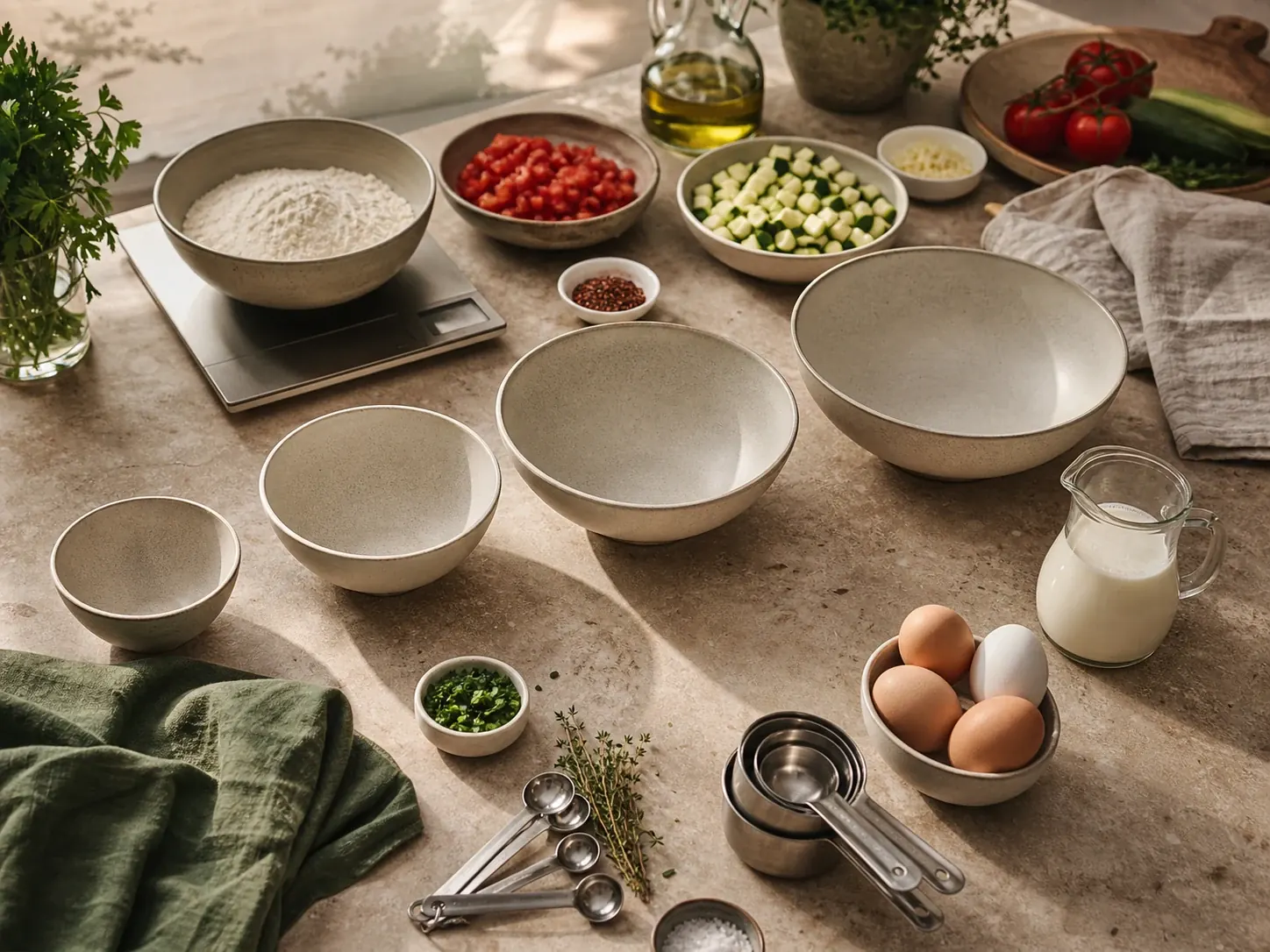
Batch multiplier
Keep the base. Change the yield.
Enter the servings your tested recipe makes and the yield you need. Add ingredient rows with numeric quantities and unit labels; the browser multiplies each quantity by the same factor.
- Scales recipes up or down.
- Keeps the unit entered for every ingredient.
- Copies a plain-text ingredient list without sending data.
Cooking time, pan size, evaporation, leavening and seasoning do not always scale linearly. Test large production changes before service.
4 servings → 10 servings
Scale a tested recipe from one yield to another without losing the base quantities.
A recipe scaler multiplies every entered ingredient by the same factor. Enter the original yield, target yield and one numeric quantity per ingredient row. The browser preserves the unit text and creates a clean list that can be copied for prep.
Arithmetic scales linearly; cooking processes often do not. Pan area, mixer capacity, evaporation, proofing, leavening, seasoning and cooking time require a separate production decision. Keep the tested base recipe as the source of truth and document any rounded quantities after scaling.
Begin with a base recipe that has actually been cooked and yielded a measured amount. If a soup was expected to make ten portions but evaporation left eight, eight is the useful original yield. Scaling from the intended number repeats the error and can create shortages during service or inconsistent retail fill weights.
Consistent units make the scaled list easier to verify. Weigh flour, meat, produce, salt and other important ingredients where practical; measure liquids in millilitres or grams according to the recipe system. Vague units such as a bunch, bag or large onion should be standardised before multiplying a batch for another cook.
After calculation, separate mathematical quantity from production quantity. A result of 2.5 eggs may be measured as beaten egg by weight, while a pan count may need rounding upward and the fill weight adjusted. Record deliberate changes beside the scaled version so they do not silently alter the tested base formula.
Large changes should be staged. Scaling a four-portion recipe directly to two hundred portions can expose equipment, cooling, holding and food-safety constraints that the arithmetic cannot see. Test an intermediate batch, measure the finished yield again and update the production method, critical temperatures and storage plan before relying on the final quantity in service. Label the scaled copy with its target yield, date and version so another cook can trace it back to the tested base instead of scaling an already scaled worksheet. Keep one approved base recipe unchanged for future calculations and careful production comparison.
How to use this tool
- Use the measured base yieldEnter the portions the recipe actually produced after trimming, evaporation and portioning.
- Use one numeric amount per rowKeep units explicit and consistent. Convert incompatible units before scaling.
- Set the target yieldThe tool divides target servings by original servings to create one multiplier.
- Review and copy the resultRound only where the ingredient and equipment allow it, then test large changes before service.
Common scale factors
The same rule increases or reduces ingredients; it does not calculate new pans or cooking time.
| Original yield | Target yield | Factor |
|---|---|---|
| 4 servings | 2 servings | 0.5× |
| 4 servings | 6 servings | 1.5× |
| 4 servings | 10 servings | 2.5× |
| 12 portions | 30 portions | 2.5× |
| 50 portions | 40 portions | 0.8× |
Worked example
Scale four servings to ten
With four original servings and ten target servings, the factor is 10 ÷ 4 = 2.5. A base list of 250 g flour, 300 ml milk and 2 eggs becomes 625 g flour, 750 ml milk and 5 eggs.
The copy button produces a plain-text list with the target yield. If a serving value is zero, the interface reports the correction instead of dividing by zero. Review eggs, seasoning, leavener and equipment before production.
Formula or selection rule
Scale factor = target yield ÷ original yield. Scaled ingredient amount = base amount × scale factor.
Common mistakes and browser limits
- Using intended portions instead of measured finished yield.
- Mixing grams, ounces and cups without converting first.
- Rounding potent ingredients too early.
- Assuming a larger batch uses the same vessel and cooking time.
- Overwriting the tested base recipe with an untested scaled version.
FAQ
Questions people ask about this tool
How do I scale a recipe to more servings?
Divide the target servings by the original servings, then multiply every ingredient by that factor. The tool performs both steps.
Can the recipe scaler reduce a recipe?
Yes. A smaller target creates a factor below one. Four servings reduced to two uses 0.5×.
Does cooking time scale with servings?
Usually not linearly. Vessel size, depth, airflow and equipment capacity change the process.
How should I scale eggs and leavening?
Use the arithmetic as a starting point. Weigh beaten egg for partial units, round late and test potent ingredients carefully.
Does the scaler convert cups to grams?
No. Use the cooking measurement converter first, then enter the converted base quantities here.