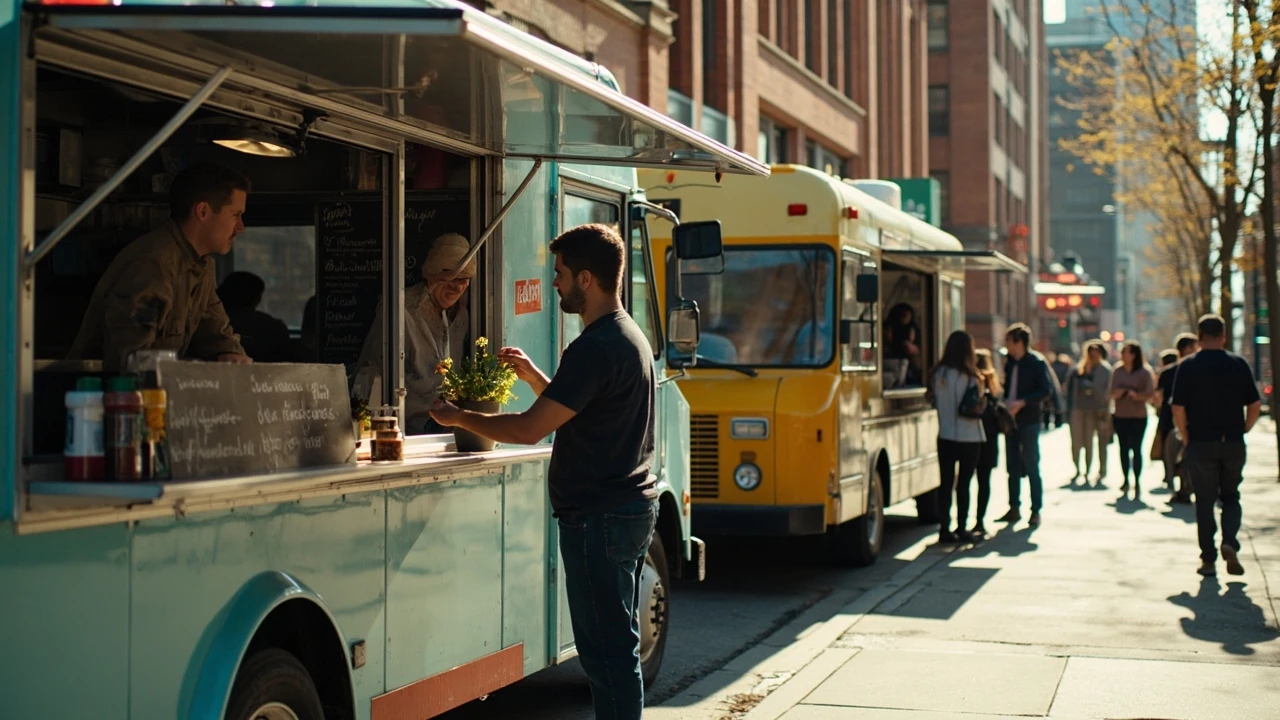
Food trucks: how to launch, run, and grow a mobile food business
A food truck can change your workweek, your income, and your relationship with cooking, but only if the business behind the window is built as carefully as the menu. The most common reason a new mobile kitchen fails in the first year is not bad food. It is a mismatch between the concept, the permits, the cash flow, and the daily hours on the curb. This guide walks through the decisions that actually decide whether a food truck makes money, the costs that quietly eat margins, and the operating habits that keep one running for more than a single summer.
What a food truck actually is in 2026
Mobile food vending is a regulated commercial kitchen on wheels. In most North American cities, a food truck is treated as a licensed food establishment, a commercial vehicle, and a small business, all at the same time. That means you answer to a health department, a motor vehicle or weights and measures office, a fire marshal, a parking or right-of-way authority, and a tax authority. The truck is the smallest part of the operation. The harder part is the paperwork, the schedule, and the discipline of running a kitchen that has roughly 25 to 60 square feet of usable workspace.
Operators often describe a food truck as a restaurant with shorter routes and longer days. The line moves faster, the menu is shorter, and the equipment is engineered for heat, grease, and vibration. Compared with a fixed restaurant, a truck has lower buildout cost, a more flexible footprint, and a faster failure cycle. If a concept is not landing, you can change it in a season rather than a five-year lease.
Choosing a concept that survives the first six months
A concept is not a cuisine. It is the specific promise you make to a customer in the thirty seconds it takes to read a menu board. Strong food truck concepts tend to share three traits: a short menu built around two or three production systems, a flavor profile that is not already saturated in the area, and a service window that can hit a target ticket time in under four minutes during a rush.
Before buying equipment, write down the answers to five questions.
- What is the one dish a customer will travel fifteen minutes for?
- Which two or three cooking processes will you actually run during a rush?
- What is your target ticket size, and what is the highest price a local lunch crowd will accept for it?
- What weather, daypart, and event type will you commit to first?
- What is the concept you are explicitly not trying to be?
The last question matters. “We are a generalist truck” usually means a confused menu, a slow line, and food that sits in a hot box. A truck that decides it is a smashburger truck, or a birria taco truck, or a hand-pulled noodle truck, can train around a narrow skill set, tighten prep, and build a reputation that a generic truck cannot.
The real costs behind a new food truck
New operators often budget for the truck and forget the supporting costs. The truck itself is usually the second-largest line item after commissary and buildout fees. The table below shows a typical range for a small-to-mid market in the United States as of 2026. Actual numbers vary by city, but the proportions are useful for planning.
| Cost line | Low estimate (USD) | High estimate (USD) | Notes |
|---|---|---|---|
| Used truck or van, late model | 35,000 | 90,000 | Drivetrain and generator hours matter more than paint. |
| New or custom buildout | 80,000 | 200,000 | Includes hood, suppression, plumbing, electrical, and finishes. |
| Commissary kitchen (annual) | 6,000 | 18,000 | Often required by health code for cleaning and storage. |
| Initial permits and licenses | 1,500 | 8,000 | Varies sharply by city and county. |
| POS, signage, uniforms, smallwares | 4,000 | 12,000 | Includes initial menu board and decals. |
| Working capital for first 90 days | 10,000 | 30,000 | Covers fuel, payroll, food, and surprise repairs. |
The single most common budgeting mistake is treating the truck as a sunk cost. It is not. Generators, fryers, hoods, and refrigerators all fail. A useful rule is to set aside at least 5 percent of revenue every week for maintenance and repairs, not as profit, but as a dedicated line item that only gets spent on the truck.
Permits, licenses, and the regulatory map
Regulation is the part of food trucks that punishes operators who treat it as a final step. In most cities, you need at least the following categories of approval before you can legally serve a customer.
- A mobile food facility health permit from the local or county health department.
- A business license and a food dealer registration where required.
- A commissary agreement showing where the truck is cleaned, stored, and restocked overnight.
- A vehicle-related registration and any weight or dimension permits.
- Fire department sign-off for suppression and ventilation.
- Location-specific permits for private lots, public streets, parks, or events.
Each city publishes its own fee schedule, inspection checklist, and operating rules. The U.S. Small Business Administration maintains a state-by-state portal for business licensing that is a reasonable starting point, but the local health department is always the final authority. Apply for licenses and permits is the SBA’s overview of the federal and state layers that sit on top of city rules.
Plan on a lead time of 60 to 180 days from the day you submit a complete application to the day you can legally operate. Build that into your launch date and your cash plan.
Picking the right truck, van, or trailer
Three formats dominate the market, and each has tradeoffs. A step van, the classic “bread truck” shape, gives the most interior space and the cleanest workflow but costs more to buy and insure. A cargo van conversion is cheaper and easier to park, but it forces a very tight galley. A pull-behind trailer has the lowest entry cost, no engine to maintain, and the most flexibility on footprint, but it requires a tow vehicle that is rated for the loaded weight and a parking footprint long enough for both.
| Format | Best for | Tradeoffs | Typical interior length |
|---|---|---|---|
| Step van (e.g., 18 to 26 ft) | Full menus, grills, fryers, hood systems | Higher purchase and fuel cost | 14 to 22 ft |
| Cargo van conversion | Short menus, espresso, smoothies, grab-and-go | Very limited cooking line | 8 to 12 ft |
| Concession trailer | Events, fairs, and low-frequency vending | Needs a tow rig and long parking | 10 to 20 ft |
Whichever format you pick, the buildout drives the long-term cost more than the chassis. A poorly designed galley will slow service forever. When you walk a candidate truck, pay attention to the route between the cold line and the hot line, the distance from the order window to the pass, and whether the operator can reach the register without crossing a hot surface.
Designing a menu the truck can actually execute
A short menu is not a sacrifice. It is a survival strategy. Trucks run small crews, and each line of the menu should share a production system. If your taco truck is also running a full rice bowl program, a custom salad program, and a pressed sandwich program, you are running three different kitchens in a space built for one.
Menu design for trucks usually follows a few simple rules.
- Lead with two or three signature items that define the concept.
- Add two or three rotating specials that let you test new ideas without committing to a permanent line.
- Match every menu item to a specific cooking station and a specific holding time.
- Keep the menu board to a number of items that a customer can read in under 30 seconds.
Holding time deserves special attention. A truck that holds a product in a hot box for 12 minutes is selling a worse version of the product it cooked. A menu designed for hold times under 4 minutes is a menu that tastes like it was cooked to order, even when it is not.
Pricing for margin, not for the lowest menu board on the block
Trucks have a different cost structure than restaurants. There is no dining room, but there is a generator, a commissary, a higher labor ratio, and more waste from weather and cancellations. A common mistake is to price as if a food truck is just a small kitchen. It is not. It is a kitchen with a higher cost of every minute it operates.
A useful pricing approach starts from a target food cost and works backward. The table below shows a worked example for a 7.50 USD target ticket. Adjust the numbers for your local ingredient prices, but keep the relationships.
| Item | Target food cost (percent) | Target food cost (USD) | Menu price (USD) | Contribution per sale (USD) |
|---|---|---|---|---|
| Signature sandwich | 28 | 2.10 | 7.50 | 5.40 |
| Side | 25 | 0.75 | 3.00 | 2.25 |
| Drink | 18 | 0.45 | 2.50 | 2.05 |
| Combo average | 26 | 3.30 | 13.00 | 9.70 |
Contribution per sale is the number that has to cover labor, fuel, commissary, permits, and truck payment. If the combo above sells 200 times in a service, that is 1,940 USD in contribution toward fixed costs. If your fixed costs for that day are higher than that, you either need a stronger average ticket, a higher volume location, or a shorter route home.
For a deeper framework, the existing post on menu pricing strategies that protect margin without losing guests is a useful companion to this section.
Finding the right commissary and the right locations
Most cities require a commissary, which is a licensed commercial kitchen where a truck parks overnight, fills water tanks, dumps wastewater, preps, and stores dry goods. The commissary is not optional, and a cheap commissary that is far from your service area will quietly drain hours from your week. A good commissary is closer than you think, lets you stage prep in the same building, and has predictable access hours that match your service schedule.
Locations are where the truck actually makes money. Three categories of spot are worth considering.
- Anchor lunch spots: office districts, industrial parks, hospitals, and universities with predictable foot traffic.
- Event spots: breweries, farmers markets, festivals, and private catering jobs that pay a guaranteed minimum.
- Night spots: bar districts and late venues where the truck is the only food option for a few hours.
For each spot, track the same data: average ticket, tickets per hour, total revenue, drive time, and the time the truck spent waiting. After a month, the data will show which spots are worth returning to and which are costing more in fuel than they return in sales. The post on the 15-minute food business website audit is a useful way to make sure your online presence supports the locations you choose, since the website is where most first-time customers look you up before they walk up to the window.
Daily operations: a realistic hour-by-hour
Most successful trucks follow a daily rhythm that looks roughly like this. The exact times shift, but the structure is consistent.
- Arrive at commissary by 7:00 a.m. for prep and truck check.
- Stage the truck, load prepped food, refill water, and start the generator by 9:30 a.m.
- Drive to the first location and set up by 10:45 a.m. for an 11:00 a.m. open.
- Run the lunch service from 11:00 a.m. to 2:00 p.m. with a two-person line.
- Break for 30 to 60 minutes to restock, clean, and reset.
- Run a second service from 4:00 p.m. to 8:00 p.m. or transition to an event spot.
- Return to commissary by 9:30 p.m. for cleaning, dish, and end-of-day counts.
That is a 14-hour day for a one-truck operation. It is more hours than a restaurant shift, and it is part of why burnout is real in this business. Build a schedule that respects your crew, and pay attention to fatigue on long event weekends, when mistakes in a hot kitchen are expensive.
Hiring, training, and the two-person line
Most trucks run with two to four people on the line during a service. The roles tend to be cash, front of window, and one or two cooks. The smallest viable crew is two people, and it works only if both are cross-trained on register, prep, and dish. Anything smaller is fragile, and any single absence can shut down a service.
When hiring, the single most useful interview question for a truck cook is, “How do you reset a flat top in the middle of a rush without closing the line?” The answer tells you almost everything about whether the candidate can handle the speed and the heat.
For a deeper look at how training and prep routines affect a food business, the article on menu engineering without killing the soul of the menu is a useful adjacent read for managers who are scaling beyond a single truck.
Marketing that actually moves a line
Truck marketing is local, fast, and visual. A truck is essentially a billboard that moves, and a good marketing plan treats it as one. The first 90 days should focus on three channels that have the highest return for a mobile vendor.
- A simple website that lists the current schedule, the menu, and a way to book the truck for private events.
- An Instagram and a Google Business Profile that are updated every service day with location and hours.
- An email or SMS list of regulars, built from a simple signup at the window.
Press and food media matter, but they are a long game. Early on, the most useful marketing is a clean, readable menu board, a recognizable wrap, and a posted schedule that customers can rely on. Reliability of location is a marketing strategy, because regulars will only return if they trust that the truck will be where it says it will be.
For operators who want to think more carefully about how their brand shows up online, the post on restaurant branding and identity guests remember translates well to trucks, since a truck is a brand with a smaller footprint and a faster feedback loop.
Common mistakes that close food trucks in the first year
The failure patterns are well documented, even if the numbers shift year to year. The list below is a working checklist of the most expensive mistakes, and a useful pre-launch audit for any new operator.
- Underestimating working capital. A truck needs at least three months of operating runway, not one.
- Overbuilding the menu and under-training the crew. A confused line is a slow line.
- Picking a truck that is too large for the route. A 26-foot step van on a narrow bar district is a daily headache.
- Ignoring generator and fuel costs. Fuel can swing daily contribution by 10 to 20 percent.
- Skipping the commissary contract review. A bad commissary creates a daily time and labor tax.
- Refusing to drop a low-performing location out of pride or habit.
None of these mistakes is fatal on its own, but they compound. A new operator who avoids most of them and reacts quickly to the ones that show up is in a strong position by the end of year one.
How to grow from one truck to two
The most common growth path is a second truck, either a clone of the first or a complementary concept. The decision to add a second truck is not about success. It is about repeatable systems. If the first truck runs on checklists, written prep sheets, and a clean P&L, a second truck is possible. If it runs on the memory of a single owner-operator, a second truck is a fast way to lose money on two units at once.
A useful gating test is whether you can hand the keys of the first truck to a trusted manager for two weeks without the numbers moving. If the answer is yes, you have a system. If the answer is no, the system is you, and a second truck will not fix that.
Frequently asked questions
How much does it cost to start a food truck in 2026?
A realistic all-in budget for a new food truck in a typical U.S. market ranges from about 80,000 USD for a used vehicle with a modest buildout to roughly 250,000 USD for a new step van with a custom build, plus 10,000 to 30,000 USD in working capital. Costs vary sharply by city, commissary, and equipment list. A used vehicle with a tight menu and a focus on anchor lunch locations is the lowest-risk entry point.
Do I need a commissary to run a food truck?
In most cities, yes. A commissary is a licensed commercial kitchen where the truck is cleaned, restocked, and parked overnight. The commissary is a regulatory requirement in many counties, and it is also the practical backbone of a daily prep routine. Before buying a truck, confirm which commissaries serve your target service area and what they charge.
What permits does a food truck need?
At a minimum, a mobile food facility health permit, a business license, a commissary agreement, and a fire department sign-off. Many cities also require a food handler certification for at least one operator, a vehicle permit, and a separate right-of-way or private lot permit for each location. The exact list is city-specific, and the local health department is the final authority.
What kind of food works best on a food truck?
Food that cooks fast, holds well for a short window, and is easy to eat standing up. Tacos, smashburgers, fried chicken, hand-pulled noodles, sandwiches, and rice bowls all work because they share those traits. Concepts that depend on complex plating, long braises, or waitstaff service tend to translate poorly to a truck window.
How profitable is a food truck compared with a restaurant?
Profit margins on a food truck are similar to a small restaurant once the business is mature, but the absolute revenue is lower and the operating hours are longer. A well-run single truck can produce healthy owner income, but it is rarely passive. The advantage over a restaurant is lower buildout cost, faster concept change, and a more flexible real estate footprint.
How do food trucks deal with weather and slow seasons?
Most operators build a year-round calendar with a winter mix of indoor venues, breweries, and private events that replace outdoor lunch volume. Catering and event minimums are a useful hedge against a rainy week, and a strong catering pipeline can carry a truck through the slow months that crush a fixed restaurant.
How long does it take to launch a food truck?
From the day you commit to the concept to the day you open for service, plan on three to nine months. The longest variable is usually the health permit and any buildout delays. Buying the truck before you have a permit pathway in mind is a common reason launches slip from spring to fall.
What is the biggest operational risk for a food truck?
Equipment failure and crew shortages. A truck with a dead generator, a broken hood, or a no-call cook on a Saturday is a truck that is not making money. The mitigation is preventive maintenance on the truck and a written backup plan for crew, including a list of trained per diem help who can step in on short notice.
Can a food truck run on renewable power or all-electric equipment?
All-electric trucks are growing in 2026, especially for short routes and menus that are not built around open flame. Induction and high-draw electric appliances work, but battery range and recharging time still favor diesel or hybrid systems for trucks that do long days or event weekends. The decision is largely about menu and route, and it is worth modeling before you commit to a buildout.
Where can I learn more about running a mobile food business?
Local health department workshops, regional small business development centers, and operator associations are the most practical starting points. National industry groups, including the Wikipedia overview of food trucks, offer useful context on the history and current structure of the industry. After that, the most useful education is the daily P&L of your own truck.