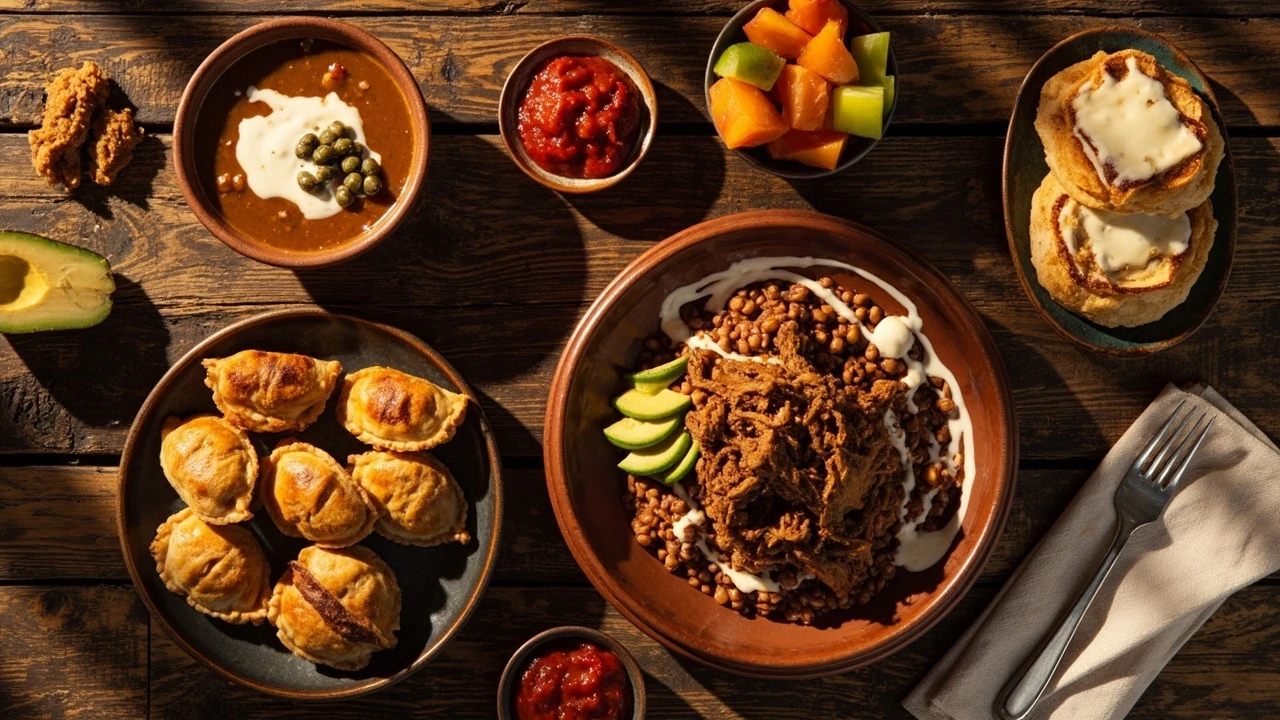
A lunch in Medellín can start with a bowl of sancocho, a plate of red beans, a glass of fresh lulo juice, and a small dish of aji so bright that it looks like it should come with a warning. The same day, a dinner in Bogotá might mean ajiaco, a chicken-and-potato soup that locals eat three times a week without thinking twice. Both meals qualify as Colombian food, and both explain why the country’s cuisine is hard to summarize in a single dish.
Colombian food is regional, layered, and shaped by altitude, climate, and the rhythms of rural and coastal life. It borrows from Indigenous, Spanish, and African cooking, then filters those influences through specific places: the coffee axis, the Caribbean coast, the Andean highlands, the Amazon border, and the Pacific lowlands. A useful guide does not flatten those differences. It walks through the dishes that define each region, the building blocks that appear again and again, and the practical decisions a reader actually has to make: what to order in a Colombian restaurant, what to cook at home, and which pantry staples unlock most of the cuisine.
Colombian food: how a single country produces so many cuisines
Colombia sits at the crossroads of the Andes, the Caribbean, the Pacific, the Amazon, and the Orinoco plains. Each region has a different climate, a different agricultural base, and a different colonial history, so each one developed its own way of eating. A working definition of Colombian food is therefore not a list of recipes but a set of recurring techniques, ingredients, and meal patterns that show up in different combinations depending on where you are.
Three threads run through almost every regional kitchen:
- Starches cooked in many forms: potatoes, cassava, plantains, corn, and rice, prepared boiled, fried, baked, or ground into dough.
- Beans, whether red, black, or fríjol cacha, paired with rice or with meat and plantain.
- Fresh aji sauces built on tomato, onion, cilantro, and either aji dulce or a small amount of hot chili, served on the side rather than stirred in.
Beyond those threads, the country’s geography creates distinct flavor profiles. The highlands favor hearty soups, roasted meats, potatoes, and cheese. The Caribbean coast leans toward coconut rice, fried fish, and plantain. The Pacific coast is a fish and seafood cuisine with African and Afro-Colombian roots. The eastern llanos and the Amazon bring grilled meats, cassava, and tropical fruits into the rotation.
Why altitude matters more than you might expect
Colombian food is unusually sensitive to altitude because so much of the population lives in the Andes. Bogotá sits at roughly 2,640 meters, which changes how long beans take to soften, how wheat behaves in dough, and how long stews need to simmer. Many of the country’s signature soups, including ajiaco and sancocho, are designed to cook for hours over a low flame. That is not an accident. It is a practical response to high-altitude cooking, where water boils at a lower temperature and tougher cuts of meat benefit from patient heat.
For travelers and home cooks, the lesson is simple: do not try to rush a traditional Colombian stew. Plan the meal around the cook time rather than the other way around.
The dishes that define Colombian food across regions
Rather than cataloging every recipe, it helps to anchor Colombian food in a small set of dishes that show up in guidebooks, family kitchens, and restaurant menus. Once you know these, the rest of the cuisine becomes easier to place.
Bandeja paisa: the Andean plate that says “I am from here”
Bandeja paisa is the signature dish of Antioquia and the coffee axis. A traditional plate includes white rice, red beans cooked with pork, ground beef, chicharrón, a fried egg, a small arepa, sweet plantain, avocado, and sometimes a slice of blood sausage. It is built to fuel a long morning of physical work, which is exactly the role it still plays in rural households.
The dish is polarizing because it arrives as a feast on a single plate. Portions are large, components are rich, and almost every element is fried or stewed. For first-time visitors, the practical move is to share one plate between two people, then order a soup or a salad alongside.
Ajiaco: the soup that defines Bogotá
Ajiaco is a chicken and potato soup made with three varieties of potato: sabanera, pastusa, and criolla. The sabanera potato breaks down and thickens the broth, while the other two hold their shape. The soup is served with capers, heavy cream, and avocado on the side, and diners add them to taste at the table. Ajiaco is comfort food in the literal sense: warm, filling, and central to how the capital eats on cold, rainy afternoons.
A useful test of an ajiaco is whether the three potatoes are actually present. Many shortcuts use only one or two varieties, which produces a thinner, blander result.
Sancocho: the everyday stew of rural Colombia
Sancocho is a family of stews, not a single recipe. Every region has its own version, and many families have their own. The basic structure is meat (chicken, beef, fish, or goat), starchy vegetables (cassava, plantain, potato, ñame), cilantro, and sometimes corn on the cob, simmered for hours until the broth is rich and the meats are tender.
Sancocho is the dish most likely to be eaten on a Sunday at a grandmother’s house. It is also the dish most likely to be served to a guest who needs feeding, regardless of the hour.
Arepas: the everyday bread that travels everywhere
Arepas are round, flat corn cakes made from ground maize. They look simple, but the texture and flavor vary sharply by region. In Bogotá and the eastern highlands, arepas are white, soft, and slightly sweet, often served with cheese or eaten alongside soup. On the Caribbean coast, they are larger, flatter, and grilled until crisp on the outside. In Antioquia, arepas are small, thick, and cooked on a griddle, often split open and filled with cheese or pork rinds.
For a home cook, the practical takeaway is that pre-made arepa dough has improved significantly. If you do not have access to fresh ground maize, a refrigerated or frozen arepa round will still produce a reasonable result, especially if you toast it twice.
Empanadas and patacones: the street food layer
Empanadas in Colombia are typically made from a yellow corn dough rather than a wheat dough, which makes them denser and slightly chewier than their Argentine or Chilean cousins. They are usually filled with a seasoned potato and beef mixture, fried until crisp, and served with aji.
Patacones are twice-fried green plantain slices, smashed flat, salted, and often topped with hogao (a tomato and onion sauce), cheese, or shrimp. They are common on the Caribbean and Pacific coasts, where plantains grow in abundance.
Other dishes worth knowing
A short list of additional plates that come up constantly in Colombian food coverage:
- Lechona: a whole pig stuffed with rice, peas, and spices, slow-roasted, served with arepa and a wedge of lime.
- Tamales: corn dough filled with meat, vegetables, and sometimes egg or chickpea, wrapped in plantain leaves and steamed. Colombian tamales are larger and more layered than Mexican ones.
- Changua: a milk and egg soup with cilantro, eaten for breakfast in the Bogotá area.
- Cazuela de mariscos: a creamy coconut and seafood soup common on the Pacific coast.
- Sobrebarriga a la llanera: flank steak braised with vegetables, garlic, and sometimes beer, served with rice, plantain, and salad.
Regional breakdown: what Colombian food looks like in each corner of the country
Colombia is not a single cuisine. It is a set of regional cuisines that share pantry staples but disagree on most other things. The table below summarizes the dominant flavors, staple starches, and signature dishes for the main regions.
| Region | Climate and terrain | Staple starches | Signature dishes | Flavor profile |
|---|---|---|---|---|
| Antioquia (Paisa region) | Mountain valleys, coffee country | Red beans, rice, arepa, plantain | Bandeja paisa, sancocho antioqueño, arepa de chócolo | Hearty, bean-forward, often fried |
| Bogotá and Cundinamarca | High Andean plateau, cool | Three potato varieties, corn | Ajiaco, changua, fritanga | Warm soups, mild heat, dairy-rich |
| Caribbean coast (Atlántico, Bolívar, Magdalena, Cesar, Córdoba, Sucre, La Guajira) | Hot lowlands and beaches | Plantain, cassava, rice, coconut | Arroz de coco, fried fish with patacones, mote de queso, suero costeño | Bright, acidic, coconut and cilantro driven |
| Pacific coast (Chocó, Valle del Cauca, Cauca, Nariño) | Rainforest, rivers, ocean | Cassava, plantain, coconut | Cazuela de mariscos, tapao de pescado, empanadas de papa | Seafood-forward, coconut-based, Afro-Colombian roots |
| Llanos (Meta, Casanare, Arauca, Vichada) | Flat grasslands, hot | Cassava, rice, plantain | Mamona, ternera a la llanera, hallacas | Grilled meat, open-fire cooking, cassava side dishes |
| Amazon region (Putumayo, Caquetá, Guainía, Vaupés, Amazonas) | Rainforest, rivers | Cassava (especially fariña), plantain, fish | Fish wrapped in bijao leaf, fariña, game stews | Smoked and steamed, tropical fruits, native ingredients |
If you are planning to eat your way through Colombian food, this table is the most useful map. Most travelers will only encounter the first three or four regions, but each one rewards going beyond the standard menu.
What the Caribbean coast does differently
Caribbean Colombian food uses plantains and cassava the way the highlands use potatoes. Coconut rice replaces plain white rice as a default. Suero costeño, a thin, tangy sour cream, appears on the table almost automatically. Fried fish with patacones is the everyday meal rather than a treat, and the aji served alongside tends to be sharper and more acidic than in the highlands.
This is also the region where Afro-Colombian and Indigenous cooking have shaped the menu the most. Fish stews like ceviche de río and coconut-based soups reflect techniques that long predate Spanish contact.
What the Pacific coast specializes in
The Pacific coast of Colombia is one of the wettest places in the Americas, and the cuisine leans heavily on rivers and ocean. Cazuela de mariscos, a thick seafood soup with coconut and peanut base, is the headline dish, but simpler preparations like fried whole fish with rice, plantain, and salad show up at every beachside restaurant.
This is also the region where cumbia, marimba, and Afro-Colombian food traditions are strongest. The cooking tends to be less meat-heavy and more seafood-heavy than the rest of the country.
The pantry: ingredients that unlock most of Colombian food
Most home cooks do not need to stock a full Colombian pantry to make the food well. A small set of ingredients covers the majority of recipes, and a few additional items unlock regional specialties.
| Pantry tier | Items | What they unlock |
|---|---|---|
| Essential | White rice, red or black beans, yellow cornmeal, potatoes, plantains, onions, garlic, cilantro, tomato, limes, salt, oil | Arroz con frijoles, basic aji, arepas, sancocho, soups, basic stews |
| Strongly recommended | Aji dulce (or a mild red chili), comino (cumin), color (annatto/achiote), hogao base, panela, suero costeño or sour cream, avocado | Authentic flavor depth, aji sauces, soups with proper color, traditional accompaniments |
| Regional unlockers | Cassava (yuca), ñame, fresh herbs like guascas and cilantro cimarrón, fresh corn for choclo, coconut milk, panela, bocadillo, lulo or maracuyá | Ajiaco (guascas), Caribbean and Pacific dishes, fresh fruit juices, regional desserts |
Guascas deserve a special note. They are an herb essential to ajiaco and a few other soups, and the dish does not taste right without them. Dried guascas are widely available online and in Latin American grocery stores outside Colombia. If you cannot find them, the closest substitute is a mix of parsley and a small amount of dried oregano, but it will not fully replicate the flavor.
Ajis and sauces: the condiment layer
Colombian food without aji on the table is unusual. Most meals include at least one sauce, and the choice of aji can change a dish more than any other variable. A few that are worth knowing:
- Aji pico de gallo: chopped tomato, onion, cilantro, lime, and chili. Fresh, sharp, and the default at most family tables.
- Aji de maracuyá: passion fruit based, with a sweet-sour heat that pairs well with fish and seafood.
- Aji costeño: vinegar-based, with onion, cilantro, and chili, sharper and more acidic than the highland versions.
- Hogao: cooked tomato and onion sauce, used in the eastern highlands as a side for beans, arepas, and meat.
The practical advice is to keep two ajis at the table: a mild one for general use and a sharper one for those who want heat. Many Colombian families have a small jar of each within arm’s reach at every meal.
Drinks and desserts: the parts of Colombian food most visitors miss
Drinks are central to Colombian food rather than an afterthought. Fresh fruit juices, called jugos, are a daily staple, and the variety is large because the country produces an unusually wide range of tropical and temperate fruits.
What to order when you sit down
Useful default drinks in Colombian restaurants:
- Lulo juice: tart, slightly green, refreshing.
- Maracuyá (passion fruit) juice: sweet-sour, slightly perfumed.
- Mora (blackberry) juice with milk: a highland classic, more like a milkshake than a juice.
- Avena (oatmeal drink): cooked oats blended with milk, sugar, and cinnamon, sold in plastic bags as a breakfast street drink.
- Chocolate completo: hot, often watered-down hot chocolate served with a side of bread, cheese, and a small plate of almojábanas, eaten in the morning or late at night.
For something stronger, aguardiente (anise-flavored spirit) and rum from the Caribbean coast are both standard. Coffee is its own category, and Colombia’s high-altitude arabica is served strong, often as a tinto in small cups.
Desserts worth planning around
Colombian desserts lean toward simple combinations of milk, sugar, and fruit. A few staples show up everywhere:
- Posta negra: a slow-cooked braised beef in a sweet-savory sauce of panela, spices, and Worcestershire.
- Natilla: a firm cinnamon and panela custard, served at Christmas and often alongside buñuelos.
- Brevas con arequipe: small green figs stuffed with dulce de leche, served chilled.
- Bocadillo con queso: a firm guava and panela paste, sliced thin and served with a wedge of fresh white cheese. The combination of sweet and salty is the point.
- Rosquillas: small fried corn rings from the coffee region, especially Valledupar and the Santander area.
Eating Colombian food: practical decisions for visitors and home cooks
Most of the questions readers actually have about Colombian food are practical, not historical. Where should I eat, what should I order, and how do I avoid the tourist-trap version? A short guide to the most common decisions:
Choosing a restaurant
Colombian cities have a wide range of options, from high-end restaurants to corner lunch counters. The middle of the market, called a corrientazo or a menú ejecutivo, is usually the most useful for travelers. It offers a soup, a main course with rice, a drink, and sometimes a small dessert for a set price, usually at lunch. The food is generally fresh, the portions are generous, and the menu changes daily.
For higher-end experiences, Bogotá, Medellín, and Cartagena have all built strong restaurant scenes over the last decade, with chefs revisiting regional cooking using modern technique. Reserve ahead, especially in Cartagena and on weekends in Medellín.
What to order if you are eating out for the first time
A practical default order in a traditional Colombian restaurant:
- Start with ajiaco or sancocho if the day is cool, or with a cazuela de mariscos if you are on the coast.
- Pick one main plate: bandeja paisa if you are hungry and patient, sobrebarriga if you want something balanced, or a fish preparation if you are near the ocean.
- Ask for aji on the side and try it before adding more.
- Drink a fresh jugo, not a soda, as the default.
- Skip dessert unless you specifically want to try one, since the portions tend to be large.
Common mistakes visitors make
- Ordering bandeja paisa every day because it is famous. The dish is rich, and eating it daily will wear out even enthusiastic eaters.
- Assuming all Colombian food is spicy. Most of it is not. The chili is on the side, and diners add it themselves.
- Drinking tap water without checking. Outside major hotels and restaurants, stick to bottled or filtered water.
- Ordering dinner too early. Colombians tend to eat late, and many restaurants do not open for dinner until 7 p.m.
- Skipping the aji. Even if you do not like heat, a mild aji pico de gallo adds a lot of flavor to beans, soups, and grilled meats.
Cooking Colombian food at home: a starter plan
For home cooks, the easiest way into Colombian food is to build a small rotation rather than a long list of ambitious recipes. Most of the everyday cooking in Colombian households repeats the same handful of dishes, made well.
A practical weekly menu
- Monday: arroz con frijoles (rice and beans), salad, fried plantain.
- Tuesday: ajiaco or sancocho, depending on altitude and time, with a side of avocado and rice.
- Wednesday: sobrebarriga or another braised meat, with potatoes and a simple salad.
- Thursday: arepas with cheese, served with a small bowl of hogao and a soft-boiled egg.
- Friday: cazuela de mariscos or a simpler coconut fish stew, with white rice and patacones.
- Saturday: bandeja paisa or a simplified version, shared family-style.
- Sunday: sancocho, served as the centerpiece of a long lunch.
Where to start if you are new to the cuisine
Three recipes give a balanced introduction to the flavors and techniques of Colombian food:
- Arroz con frijoles: teaches the basic bean-and-rice combination that underlies most lunch plates.
- Arepas: teaches corn dough handling and gives you a side dish you can reuse for breakfast, lunch, and dinner.
- Ajiaco: teaches high-altitude soup technique, the three-potato layering, and how to use guascas.
Once those three are reliable, move to sancocho, bandeja paisa, and a regional specialty from outside the highlands.
How Colombian food is changing in 2026
The cuisine is not frozen in tradition. Several shifts are visible across restaurants, markets, and home cooking:
- Chefs in Bogotá, Medellín, and Cartagena are increasingly working with Indigenous and Afro-Colombian producers, sourcing rare ingredients like Amazonian fruits, native potatoes, and heirloom corn.
- Plant-based versions of bandeja paisa and sancocho are showing up on restaurant menus in the major cities, typically using mushrooms, jackfruit, or beans as the protein anchor.
- Regional cooking is getting more attention outside its home region. Caribbean and Pacific dishes, which were historically hard to find in Bogotá or Medellín, are now part of the rotation in many modern restaurants.
- Coffee culture continues to evolve, with a stronger focus on single-origin beans, light roasts, and the geography of specific municipalities within the coffee axis.
For travelers and home cooks, the practical implication is that the version of Colombian food served in 2026 is broader and more regional than the version that was standard a generation ago. Asking for a regional dish in a major city is now a reasonable expectation, not a stretch.
Frequently asked questions
What is the most typical Colombian food?
There is no single national dish, but the most commonly cited representatives are bandeja paisa, ajiaco, and sancocho. Bandeja paisa comes from Antioquia and is the most photographed, while ajiaco is the daily soup of Bogotá and sancocho is the family stew of rural households across the country.
Is Colombian food spicy?
Most dishes are not spicy on their own. The heat comes from aji, a sauce served on the side that diners add themselves. If you do not want heat, you can usually skip the aji entirely and still eat well.
What is the difference between Colombian and Mexican food?
Both cuisines use corn, beans, and chilis, but they handle them differently. Colombian food leans on soups, stews, and side dishes built around rice, beans, and plantain, with relatively few heavily spiced sauces. Mexican food is more sauce-driven, with a wider use of chilis, masa-based dishes like tacos and tamales, and a stronger presence of complex mole sauces.
What is bandeja paisa, and should I order it?
Bandeja paisa is a traditional plate from Antioquia with rice, red beans, ground beef, chicharrón, fried egg, arepa, plantain, avocado, and sometimes blood sausage. It is rich and large. Order it on a hungry day, share it if possible, and pair it with a light drink rather than a heavy dessert.
What is ajiaco?
Ajiaco is a chicken and potato soup from Bogotá made with three potato varieties, guascas (an herb), and corn on the cob. It is served with capers, heavy cream, and avocado on the side. It is one of the defining dishes of highland Colombian food.
What drinks go with Colombian food?
Fresh fruit juices are the default pairing, with lulo, maracuyá, and mora being the most common. Hot chocolate with cheese and bread is a traditional breakfast drink. Coffee is strong, often served in small cups as a tinto. For alcohol, aguardiente (anise-flavored) is the classic pairing for hearty meals, while rum and beer are common on the coast.
Is Colombian food safe for vegetarians?
It can be challenging in traditional restaurants because many dishes are built around meat, but it is not impossible. Vegetarian-friendly options include arroz con frijoles, arepas with cheese, empanadas with potato filling, patacones with hogao, and many soups. Major cities now have dedicated vegetarian restaurants, and modern restaurants increasingly offer plant-based versions of traditional plates.
Where should I eat Colombian food in Bogotá?
For a working introduction, the Zona G and Chapinero neighborhoods have a mix of traditional and modern options. The La Perseverancia market is a good place to try ajiaco in its home context. Outside the main tourist zones, neighborhood lunch counters called corrientazos are usually the most authentic and least expensive way to eat well.
How is Colombian food different in coastal versus mountain regions?
Coastal Colombian food relies heavily on fish, seafood, plantain, and coconut, with brighter, more acidic flavors. Mountain Colombian food centers on soups, beans, red meats, and potatoes, with milder, more dairy-rich flavors. The aji served on the coast is also typically sharper than the highland version.
Can I make Colombian food with ingredients from a regular supermarket?
Most of the basic pantry is available in any large supermarket outside Colombia, including rice, beans, plantains, potatoes, cornmeal, and standard produce. Harder-to-find items like guascas, aji dulce, and suero costeño can be ordered online from Latin American grocery stores. Arepas are increasingly available as pre-made rounds, which makes the rest of the cuisine much easier to cook at home.