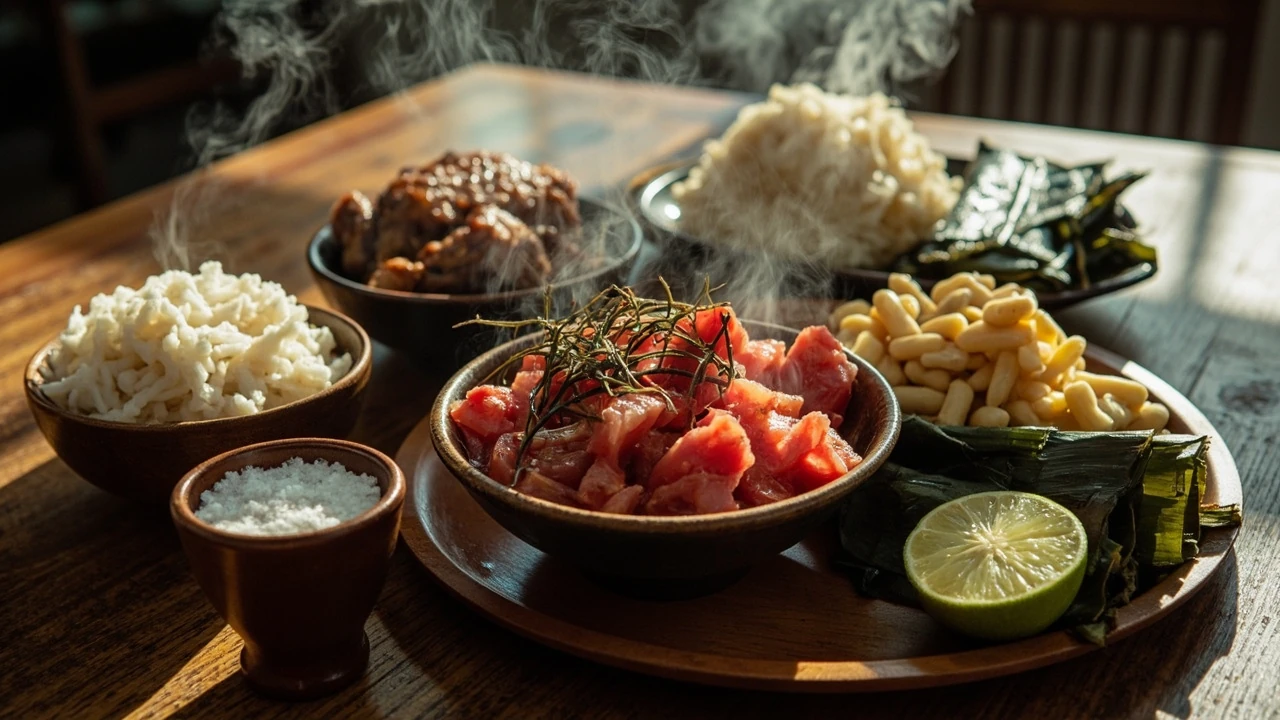
Hawaiian food: a practical guide to the islands’ signature dishes
A diner at a small plate-lunch counter in Hilo watches a worker scoop rice, lay a scoop of macaroni salad beside it, and drop a mound of kalua pork on top. Three colors, three textures, and the meal is already balanced before the customer adds a splash of shoyu. That is the thing about hawaiian food: it tends to arrive in recognizable, repeatable patterns. Once you can read the patterns, the menu stops being a list of unfamiliar words and starts looking like a small system of components that move from island counters to mainland kitchens with surprising consistency.
This guide is built for restaurant operators, food writers, and curious diners who want a working understanding of hawaiian food rather than a postcard description. It walks through the core ingredients, the canonical dishes, the regional differences between islands, and the practical choices that come up when those dishes are adapted outside Hawaii. There is no single “official” hawaiian cuisine, so the goal is to give you a clear framework for evaluating menus, recipes, and adaptations.
What defines hawaiian food in a kitchen context
Defining hawaiian food in a kitchen context is less about one sacred canon and more about a shared set of inputs, techniques, and plate logic. Most working menus in the islands lean on the same pantry, the same cooking methods, and the same lunch structure. Even when a chef is being creative, the building blocks tend to come from a recognizable list.
- A salt-friendly pantry: soy sauce, Hawaiian sea salt, sesame oil, oyster sauce, fish sauce in some modern kitchens, and a long history of using seaweed for both flavor and texture.
- A short list of starches: steamed white rice as the base, taro in several forms, and sweet potato in both traditional and modern preparations.
- Two protein traditions living side by side: ocean-based proteins (fish, octopus, shellfish, seaweed) and land-based proteins cooked low and slow in an imu, a traditional underground oven.
- Plate-lunch structure: a protein, a starch, and a cold side such as macaroni salad, served in generous portions, often to-go.
- Cross-cultural layering: Japanese, Chinese, Filipino, Portuguese, Korean, and American mainland influences folded into local cooking over several generations.
That last point matters. The cuisine most people call hawaiian food is technically the modern local cuisine that grew out of Native Hawaiian cooking after waves of immigration. On a menu, the distinction is rarely made, and most operators use “hawaiian” as the umbrella term. When you read a menu through the lens above, you can usually predict what a kitchen is going to do with a given ingredient before you order.
The core ingredients you will see again and again
Most hawaiian food menus can be built from a surprisingly short ingredient list. If you are stocking a kitchen or evaluating a supplier list, this is the pantry that anchors the majority of dishes, and the list also tells you what a “traditional” plate is supposed to taste like at a basic level.
| Category | Common ingredients | Where they show up |
|---|---|---|
| Starches | Calrose-style white rice, taro (as poi, paiai, or taro leaf), sweet potato, bread | Plate lunches, laulau, poi pairings, desserts, brunch dishes |
| Proteins from the ocean | Ahi tuna, aku (skipjack), marlin, opah, octopus, squid, aku-style dried fish, limu (seaweed) | Poke, pipikaula-adjacent dried preparations, poke bowls, raw plates |
| Proteins from the land | Pork shoulder, pork belly, chicken, beef, spam | Kalua pig, laulau, huli huli chicken, loco moco, spam-based breakfasts |
| Seasonings | Soy sauce (shoyu), Hawaiian sea salt, sesame oil, oyster sauce, gochujang in modern kitchens, furikake, inamona (roasted kukui nut) | Almost every savory dish, finishing salts, marinades, poke sauces |
| Sides and accents | Macaroni salad, lomi salmon, haupia, pineapple, pickled vegetables, green onion | Plate lunches, pupu (small plates), desserts, condiments |
Two things stand out. First, the protein column is unusually long for such a compact cuisine, and the cooking methods split neatly into raw, cured, smoked, and slow-cooked. Second, the seasoning list leans heavily on umami-rich, salty, and slightly sweet profiles. Hawaiian cooking without shoyu and without a smoke or slow-cook step is rarely recognizable as hawaiian food, even when every other ingredient is present.
Anchor dishes that show up on most menus
If you are scanning a hawaiian food menu for the first time, the dishes below are the ones most likely to appear and the ones most often used to judge whether a kitchen “gets it.” They are also the dishes that travel most reliably to mainland markets, because the components are familiar and the prep is forgiving for non-island kitchens.
Poi
Poi is steamed taro that has been pounded and thinned with water until it reaches a paste somewhere between yogurt and wet clay. It is a traditional starch in hawaiian food, served as a side or used as a dip. Fresh poi is mildly tangy and slightly sweet; older poi ferments into a more sour version that some diners love and others find challenging. On a menu, poi is usually offered in a small cup beside a meat dish, especially laulau or kalua pig.
For a mainland kitchen, the most important poi decision is sourcing. Real poi is perishable, has a short shelf life, and cannot be frozen and thawed the same way many starches can without changing the texture dramatically. Most operators outside Hawaii use shelf-stable taro poi shipped in pouches and serve it cold or at room temperature, which is acceptable but rarely the same as the freshly made product.
Kalua pig
Kalua pig is pork shoulder cooked low and slow, traditionally in an underground imu oven, until the meat shreds easily and takes on a smoky, slightly earthy flavor. In modern commercial kitchens it is usually smoked in a conventional smoker, slow-roasted, or braised with liquid smoke to mimic the imu profile. It is the protein most people picture when they think of a hawaiian luau.
The main practical concern is moisture. Kalua pig is only satisfying when the meat is juicy and tender; dry kalua is a common failure mode. If you are running a mainland version, plan a holding setup (covered pan, low oven, steam table) and avoid holding it for more than a few hours at service temperature.
Laulau
Laulau is pork (and often butterfish or chicken) wrapped in taro leaves and ti leaves, then steamed for several hours. The leaves flavor the meat and keep it moist. The dish is sometimes described as hawaiian food’s version of a dumpling, which is not quite right, but the logic of a protein held in a leaf bundle and slowly steamed is a useful comparison for menu planning.
Outside Hawaii, laulau is one of the more difficult dishes to scale because the leaf wrap is part of the presentation. Some operators serve a “deconstructed” version with the components plated separately; this is acceptable as long as the cooking method stays the same.
Poke
Poke is cubed raw fish seasoned with sea salt, shoyu, sesame oil, onions, and often limu or scallions. In a modern context, poke is more of a category than a single recipe: spicy ahi, shoyu ahi, salmon poke, tofu poke, and dozens of bowl variations are all on menus. In a hawaiian food context, the most traditional version is simple: ahi, salt, shoyu, onions, and maybe a little seaweed.
The two main food-safety considerations are sourcing sushi-grade fish and keeping the temperature cold from receipt to service. The two main flavor considerations are salt balance (poke should taste seasoned, not briny) and the freshness of the aromatics. Furikake, avocado, edamame, and spicy mayo are common additions but they push the dish toward a fusion style rather than a traditional one.
Loco moco
Loco moco is a bowl of rice topped with a hamburger patty, a fried egg, and brown gravy. It is one of the most adapted hawaiian food items in the world because every component is familiar to mainstream diners. Quality comes from the patty (a well-seared beef patty, not a frozen puck), the gravy (a meat-based gravy, not a generic brown sauce), and the egg (a runny yolk that ties the dish together).
Plate lunch
Plate lunch is not a single dish but a format: a protein, two scoops of rice, and a scoop of macaroni salad. The protein can be kalua pig, teriyaki chicken, beef stew, fried fish, katsu, or a long list of others. Plate lunch is the dominant lunch architecture across Hawaii, and any restaurant that wants to be taken seriously as a hawaiian food operator needs to be able to execute the format consistently.
The macaroni salad is the most underrated element. It should be a creamy, slightly sweet, macaroni salad that holds its shape when portioned but still feels generous. A dry or overly vinegary mac salad will undercut the entire plate, even if the protein is excellent.
Huli huli chicken
Huli huli is a rotisserie-style chicken marinated in a sweet-savory sauce of shoyu, brown sugar, ginger, and pineapple juice. The name means “turn turn” because the chicken is basted repeatedly as it turns on the spit. It is one of the most recognizable fundraising dishes in Hawaii and a common catering item. The two failure modes are dry meat (the sugar-based glaze burns fast) and a sauce that is too sweet to function as a main flavor.
Spam musubi and spam-based breakfasts
Spam musubi is a slice of grilled spam on top of a block of rice, wrapped with nori. It is the single most common grab-and-go item in hawaiian food and one of the easiest to produce at scale. Spam also shows up in breakfast plates alongside eggs and rice, in fried rice, and in saimin (a hawaiian noodle soup). It is hard to overstate how central spam is to local savory cooking.
Regional differences across the islands
“Hawaiian food” tends to flatten regional differences, but the islands have distinct identities that show up in ingredient choice, portion size, and dish emphasis. Operators who want to claim specificity should know at least the broad strokes of how the islands differ, because the difference is what gives a menu credibility with travelers and hawaiian food enthusiasts.
| Island or region | Style emphasis | What to look for on a menu |
|---|---|---|
| Oahu (Honolulu) | Dense plate-lunch culture, strong Japanese influence, large variety of poke styles | Long plate-lunch counters, multiple poke options per restaurant, musubi, saimin, and a heavy mix of Japanese-Hawaiian fusion |
| Maui | Farm-driven menus, more resort dining, regional produce (onion, pineapple, sugar cane) | Locally grown vegetables, regional beef, more plated presentations, farm-to-table flavor |
| Big Island (Hawaii Island) | Heavier luau and traditional cooking, strong taro and breadfruit cultivation | More laulau and kalua pig, more poi, more traditional luaus, Big Island beef and lamb |
| Kauai | Taro farming heartland, strong poi tradition, smaller plate-lunch scene | Hand-pounded poi, taro-based desserts, more traditional presentations |
| Lanai, Molokai | Smaller-scale kitchens, more hunting and gathering influences, limited menus | Wild axis deer, more breadfruit (ulu), fewer chain-style operations |
The pattern that emerges is that the more tourist-heavy the island, the more the menu leans on plate lunch and Japanese-Hawaiian fusion. The more agricultural the island, the more traditional the dishes. This is a useful diagnostic when you are evaluating how a mainland restaurant is positioning its hawaiian food menu. A place that only offers plate lunch and poke is signaling a Honolulu-style interpretation. A place that serves laulau, poi, and kalua pig with a focus on the slow-cook process is signaling a more traditional approach.
How hawaiian food shows up on mainland menus
Outside Hawaii, hawaiian food tends to be filtered through a few high-recognition dishes. Most mainland operators do not attempt the full range of traditional cooking. Instead, they focus on items that travel well in supply chains and that diners recognize, and they build a menu around those items rather than the broader cuisine.
The most common mainland adaptations are poke, plate lunch, loco moco, spam musubi, and huli huli chicken. Kalua pig appears often but is usually made in a smoker or slow cooker rather than an imu. Laulau and poi are rare outside Hawaii because of the sourcing and labor involved, though canned or pouch poi is a workable substitute if the operator sets expectations clearly.
From a restaurant growth perspective, this is where the menu engineering matters. A mainland hawaiian food concept is rarely going to be a destination restaurant on the strength of one dish. The format works best as a multi-item menu where the customer can mix a poke bowl, a plate lunch, and a musubi in one visit. If you are running a small kitchen, that mix also keeps prep manageable, because most of the components can be made in batches and held. The deeper logic of building menus around shared components is the same as in any other cuisine, and the menu engineering work behind hawaiian food menus is the same work that helps you protect margin on a small menu.
One more practical note. If you are using photography to sell these dishes, the food has to look like food, not like a tropical-themed graphic. Strong food photography of hawaiian food depends on the same principles as any other cuisine: real texture, honest portions, and lighting that lets the food read as food rather than as a stage prop.
Common mistakes when adapting hawaiian food
There are a few recurring mistakes that mainland operators make with hawaiian food. None of them are catastrophic, but each one erodes credibility with diners who know the cuisine, and credibility is what keeps a niche menu alive in a competitive market.
- Treating it as decoration, not cooking. Adding a ti leaf, a flower lei, or a hibiscus-printed menu does not make a dish hawaiian. The cooking process and the components do.
- Over-sweetening savory dishes. Huli huli sauce, kalua pig glaze, and teriyaki-style marinades all walk a line between savory and sweet. Pushing the sugar content too high turns the dish into something closer to a barbecue glaze than to a hawaiian preparation.
- Serving cold, dry, or stale poi. Poi has a specific texture expectation, and a bad poi experience is what most diners remember. If you cannot source good poi, leave it off the menu rather than serving a poor version.
- Skipping the mac salad on a plate lunch. Plate lunch without macaroni salad is just a protein and two scoops of rice. The format is defined by the side, and diners notice when it is missing.
- Using the wrong rice. Calrose or a Calrose-style medium grain is the standard. Long-grain rice does not behave the same way on the plate, and jasmine or basmati throws off the entire meal.
- Calling spam “authentic hawaiian” as a marketing line. Spam is a real and beloved part of the cuisine, but it is also an imported product. Treating it as a sacred tradition rather than what it is can come across as inauthentic to people who actually know the history.
What to check before you add hawaiian food to a menu
If you are a restaurant operator thinking about adding hawaiian food to a menu, or building a new concept around it, the decision is mostly about supply chain, labor, and the kind of customer you are trying to attract. The cuisine is friendlier to small kitchens than many people think, but the specific dishes you choose will determine how much of your operation is dedicated to a few slow-cook processes and how much stays on a normal service line.
Start with a short list of questions.
- Do you have access to sushi-grade fish from a supplier you trust, or will you build a menu around cooked proteins instead?
- Can you source Calrose-style rice, good shoyu, and Hawaiian sea salt in the volumes you need, or do you have to rework your pantry?
- Are you set up for a slow-cook or smoker workflow for kalua pig and laulau, or will you use a braise?
- What does your local labor look like for hand-rolled musubi, hand-pounded poi, or leaf-wrapped laulau?
- How will you handle the mac salad, and do you have a recipe that holds up over a service shift?
- Is your customer likely to come for a bowl or for a plate, and does your kitchen support both?
For most operators, the answer is a menu that centers on plate lunch and poke, with one or two slower-cooked items on the side. That mix gives you hawaiian food credibility without forcing the kitchen into processes you cannot sustain. A common pitfall is trying to do too much traditional cooking on a small team; the slow items tend to dominate the labor budget and stall the rest of the menu.
Comparing the most-traveled hawaiian food dishes
For a quick reference, the table below compares the dishes that show up most often outside Hawaii on ease of execution, food-safety risk, and how recognizable they are to a diner who has never been to the islands.
| Dish | Ease for a mainland kitchen | Food-safety risk | Diner recognition | Notes |
|---|---|---|---|---|
| Poke | Medium | High (raw fish) | Very high | Quality depends on fish sourcing and temperature control |
| Spam musubi | High | Low | Very high | Cheap to produce, scales well, good grab-and-go item |
| Loco moco | High | Medium (egg, gravy) | High | Good entrée anchor for a plate-lunch menu |
| Kalua pig | Medium | Low | High | Best in a smoker; holding moisture is the main challenge |
| Plate lunch format | High | Low to medium | High | Format, not a dish; define with your protein and mac salad |
| Huli huli chicken | Medium | Low | Medium to high | Watch the sugar-to-soy balance; easy to over-sweeten |
| Laulau | Low | Low | Medium | Leaf sourcing and labor are the main hurdles |
| Poi | Medium | Low | Medium | Use a reliable pouch supplier; keep expectations clear |
That table is a reasonable starting heuristic. If you are building a brand-new concept, the safest path is to anchor the menu on three or four items from the top half of the list, where diner recognition is high and food-safety risk is manageable, and use the lower half as specials or seasonal items.
Pairing hawaiian food with the rest of a menu
For restaurants that are not fully hawaiian, the question is usually which dishes to add and how to integrate them without making the menu feel like two different restaurants on one page. There is no single right answer, but there are a few patterns that tend to work.
- Add one anchor item, not a section. A well-executed loco moco or a tight plate lunch on a non-hawaiian menu can pull in new customers without confusing the regulars. Building a full hawaiian section is a different commitment.
- Use the format, not just the dishes. The plate-lunch format (protein, two scoops rice, mac salad) can be used for non-hawaiian proteins. It is a service-friendly structure that holds up across cuisines.
- Watch the beverage and dessert side. Haupia (coconut pudding) is one of the easiest hawaiian desserts to scale and a natural fit for most concepts. Pineapple-based drinks and tropical-leaning mocktails extend the theme without forcing the kitchen.
- Match the photography, not just the recipe. If the rest of your menu is photographed in a clean, modern style, your hawaiian dishes should match. A sudden shift to tropical staging can undercut the rest of the brand.
How hawaiian food fits into broader food business growth
For operators, hawaiian food is most useful as a recognizable format that can carry signature dishes and a clear point of view. A single kalua pig plate or a single poke bowl is rarely enough to build a brand on, but a coherent set of dishes built around the plate-lunch structure is enough to anchor a small concept. The way to extend one signature dish into a month of content is the same exercise in hawaiian food as it is in any other cuisine: identify the components, build variations, and turn the format into a content system. The work behind turning one signature hawaiian dish into a month of content is a useful framework if you are trying to scale the marketing without scaling the kitchen.
More broadly, the hawaiian food category behaves like other regional cuisines: it rewards specificity, it punishes vague execution, and it has a few dishes that are easier to scale than the rest. If you can do three of the dishes on this page well, you have a credible hawaiian food menu. If you can do all of them well, you have a concept that can travel beyond its first neighborhood.
Frequently asked questions
What counts as hawaiian food versus hawaiian-inspired food?
Hawaiian food is generally understood as the local cuisine of Hawaii, which includes Native Hawaiian cooking and the cross-cultural dishes that grew out of it. Hawaiian-inspired food is anything that borrows from the cuisine without following the traditional components or methods. The boundary is fuzzy in practice, but a useful rule is that a dish is hawaiian food when it uses the canonical ingredients and techniques of the cuisine, not just the names.
Is poke actually hawaiian food?
Yes. Poke is a traditional preparation that pre-dates most outside contact, and it is one of the strongest examples of hawaiian food in its most original form. The bowl-based versions that spread to the mainland are modern adaptations, but the underlying dish is a hawaiian staple.
What is the difference between hawaiian food and polynesian food?
Polynesian food is a broader category that includes the cuisines of many Pacific islands, including Samoa, Tahiti, Tonga, and the Cook Islands, alongside Hawaii. Hawaiian food is specific to the Hawaiian Islands. Some dishes overlap, but the cooking methods, ingredients, and plate structures are not identical across the region.
Is spam musubi really hawaiian food?
Yes. Spam was introduced during World War II and became a local staple, and musubi as a format (a filling wrapped with rice and nori) is an old island pattern. The combination is now a defining part of hawaiian food, particularly for grab-and-go service.
What is the easiest hawaiian food dish to make at home?
Spam musubi, loco moco, and a basic shoyu ahi poke are the easiest starting points. All three use a small number of ingredients and forgiving techniques. Kalua pig and laulau are more involved because of the cooking time and, in laulau’s case, the leaf wrapping.
How do you make a credible plate lunch outside Hawaii?
Use Calrose-style rice, build a reliable macaroni salad, choose one or two proteins you can execute well, and keep the portions honest. The format is forgiving; the components are not. A plate lunch with dry rice, a weak mac salad, and a frozen patty will not read as hawaiian food no matter what the menu says.
What is the best rice for hawaiian food?
Calrose, or a Calrose-style medium-grain rice, is the standard. It holds moisture, clumps slightly on the plate, and absorbs sauces in a way that long-grain rice does not. Jasmine and basmati are not substitutes in this cuisine.
Is poi an acquired taste?
For most diners who did not grow up with it, yes. Fresh poi is mildly tangy, slightly sweet, and has a paste-like texture that some diners find unfamiliar. If you are serving poi outside Hawaii, set expectations on the menu and offer a small portion rather than a large one.
What beverages pair with hawaiian food?
On the islands, the common pairings are simple: iced tea, passion fruit (lilikoi) juice, guava juice, and a wide range of local beers. Mainstream wine pairings tend to be light, slightly sweet whites or low-tannin reds. Strong, tannic wines clash with the salt and sweetness of most hawaiian food plates.
Why is macaroni salad on every hawaiian food plate?
The macaroni salad is part of the plate-lunch format, which is the default lunch structure in Hawaii. It is meant to be a cool, creamy counterpoint to the warm protein and rice, and it balances the meal. Removing it from a plate lunch turns the meal into a different format, and diners notice the absence.