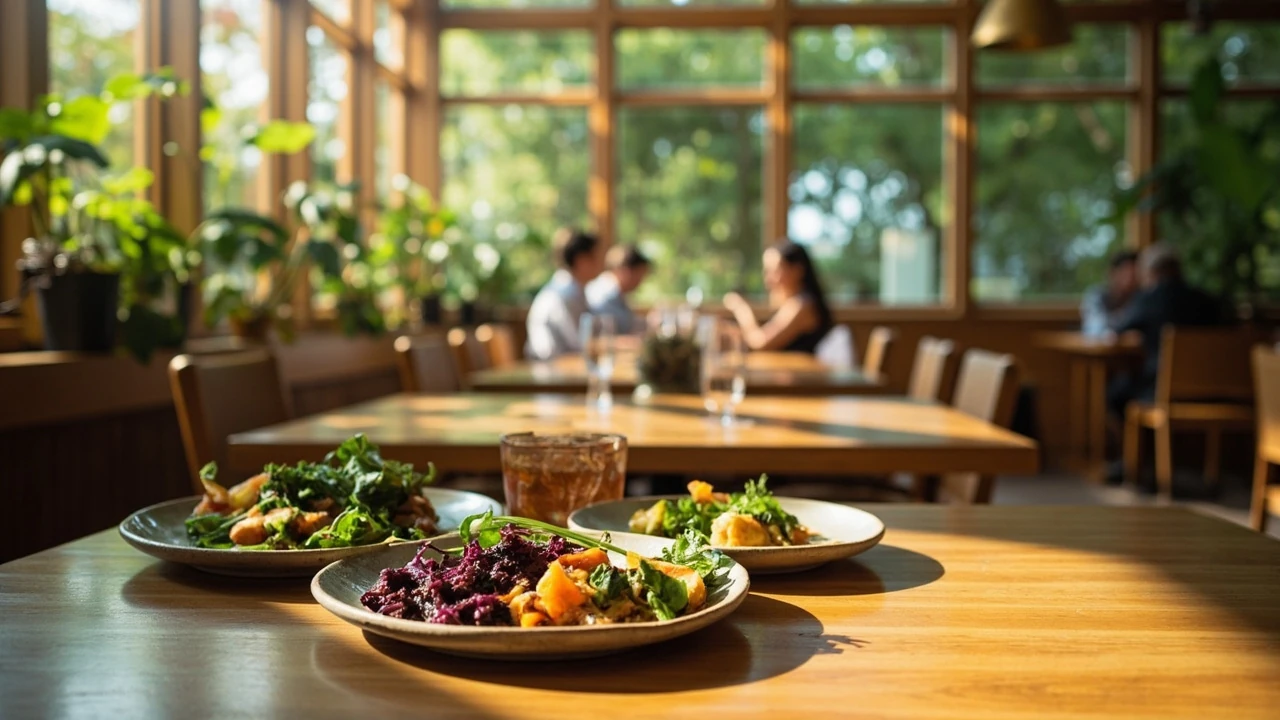
Vegan restaurants: how to evaluate one before you book
A group of four friends sits down at a table, scans the menu, and realizes that half the entrées are pasta in cream sauce, the wine list runs to three options, and the only thing labeled “vegan” is a side of fries. The group had searched for vegan restaurants in a new city and assumed the listing was safe. Within fifteen minutes the assumption has fallen apart, and one diner is quietly Googling whether the kitchen uses butter in the bread.
This kind of mismatch is common. The phrase “vegan restaurants” covers a wide range of kitchens, from fully plant-based tasting menus with dedicated prep stations to traditional restaurants that simply keep a few clearly marked dishes on the menu. Both can rank for the same search term, both can appear identical in a map listing, and the difference between a careful kitchen and a careless one is rarely visible from a photo. The goal of this guide is to give you a practical framework for sorting out which is which before you commit a Saturday night, a work dinner, or a visit from a strict relative.
You will learn how to read a menu the way an experienced vegan diner does, what questions are worth asking a host stand, which kitchen practices quietly disqualify a place, how to use reviews without being misled, and how to compare a dedicated plant-based kitchen with a mainstream restaurant that offers vegan options. By the end, you should be able to look at a listing and form a defensible opinion in a few minutes rather than discovering problems at the table.
What actually counts as a vegan restaurant
The term “vegan restaurants” is used loosely, and that ambiguity is the source of most dining disappointments. Three categories cover almost every place you will find in a search result, and the practical differences between them are large.
- Fully vegan kitchens. No animal products are used in any dish, including stocks, sauces, or desserts. Cheese alternatives, plant milks, and egg replacements are part of the core menu. This is the safest category for strict vegans and the easiest to evaluate, because the menu is the policy.
- Vegetarian with vegan options. The kitchen is dairy- and egg-free on some dishes, but dairy and eggs appear elsewhere. The challenge is that cross-contact is more likely, and staff training may be thinner.
- Omnivorous restaurants with a vegan section. A traditional kitchen that has added a few plant-based entrées to capture a growing market. Animal products dominate the supply chain, the staff may be less familiar with plant-based ingredients, and the vegan selection may be the same two dishes it has been for two years.
A useful heuristic is to look at the menu shape, not just the labels. A fully vegan kitchen usually has at least eight to ten plant-based entrées, a dessert selection that does not depend on dairy, and a drink program that includes more than one plant milk. An omnivorous restaurant with a vegan corner usually has two or three marked entrées, dessert limited to sorbet, and a single plant milk. Neither is automatically bad, but they are very different experiences.
The first thirty seconds: signals you can read before you sit down
Before you book, the listing itself will tell you a surprising amount. The signals below are visible on a website, a delivery app, or a Google profile, and they hold up reasonably well across cities and cuisines.
- Menu specificity. Look for named ingredients rather than vague phrases. “Cashew cream, charred leeks, lemon oil” is a real dish. “Vegan plate” is a placeholder. Specificity correlates with care, because a kitchen that has thought about each component usually has a program, not an afterthought.
- Allergen and dietary language. Restaurants that take vegan diets seriously tend to use the same vocabulary across the menu, often including explicit statements about dairy, eggs, honey, and sometimes even refined sugar or palm oil. Generic “GF” and “V” tags without context are weaker signals.
- Photography. You are not judging the food as art, but as evidence. Do the plated dishes look like the menu description, or do the photos look like stock imagery? Real, consistent photography is a quiet indicator that the kitchen is proud of what it sends out.
- Hours and reservation policy. A fully vegan restaurant in a major city is often booked two to three weeks out on weekend evenings. If a place advertising a tasting menu has tables open at 7 p.m. on a Saturday, that is not automatically a red flag, but it is worth a closer look at reviews.
- Press and awards. A “best of” list in a credible local outlet, a James Beard nod, or a regional hospitality award is a stronger signal than a five-star Google average, which can be inflated by a small number of enthusiastic reviews.
None of these signals is conclusive on its own. Together, they form a pattern. Two or three strong signals and no contradictions is a good sign. One strong signal and several warnings means you should ask more questions before you commit.
Reading a menu the way an experienced vegan diner does
Once you are looking at the actual menu, the work of evaluation gets faster. There is a small set of items and patterns that separate a thoughtful plant-based menu from a dressed-up omnivorous one.
| Menu feature | What it usually indicates | Questions to ask if you are uncertain |
|---|---|---|
| Stock and broth base described on the menu | Vegetable or mushroom stock rather than chicken or beef | “Is the risotto cooked in a vegetable stock, and is that stock house-made?” |
| Multiple plant milks for coffee and tea | Oat, soy, almond, and at least one less common option | “Which plant milks do you charge for, and is there a default for cappuccinos?” |
| Cheese alternatives listed by ingredient | Cashew, coconut, or cultured nut cheese rather than a vague “vegan cheese” | “Is the cheese house-made, and does it contain nuts?” |
| Desserts without dairy or eggs | Sorbet, coconut cream, aquafaba meringue, or olive oil cakes | “Are the desserts made in the same kitchen as the dairy desserts?” |
| Wine and beer list with vegan-friendly notes | Some producers flag vegan-friendly filtering; ask staff | “Do you have a list of vegan-friendly wines, or a producer you trust on that point?” |
The pattern is the same as in any other area of restaurant evaluation: specifics beat labels. A menu that names its broth, cheese base, and dessert fat is more likely to be running a real program. A menu that simply stamps a “V” on three dishes is running a marketing line.
Another quiet tell is what is missing. If a menu has no clear plant-based dessert, the dessert program is almost certainly built on dairy. If the only non-alcoholic drinks are soda and a single espresso, the bar is probably not equipped for spirit-forward plant-based cocktails, even if the menu says “vegan friendly.” These absences are not failures, but they help you set expectations.
The questions that reveal the most about a kitchen
When you call or message a restaurant, the quality of the answer often matters more than the answer itself. You are trying to learn whether the staff has thought about vegan diets as a recurring concern or as a once-a-week accommodation.
- “Is the kitchen fully vegan, or do you have a separate plant-based prep area?” A clear, confident answer is a good sign. A long pause, a transfer to a manager, and a vague “we can usually accommodate” is weaker. A kitchen that takes this seriously has rehearsed the answer.
- “Is the bread vegan, and is it baked or toasted on shared equipment?” This is a small question that exposes how the kitchen thinks. Baguettes baked in-house with oil, water, salt, and yeast are easy. Brioche brushed with egg wash is a different problem. A good answer names the bread and the butter alternative.
- “Can the chef do a tasting menu with no animal products, and how much notice do you need?” Some fully vegan restaurants design their menu to flex. Some need 24 to 48 hours. A flexible kitchen is usually a thoughtful one.
- “Which desserts are safe, and which contain refined sugar that has been filtered with bone char?” This is a strict-vegan question. A kitchen that answers cleanly has likely been asked before. A confused answer is a normal answer and does not mean the kitchen is careless, but it does mean you are on your own at the table.
- “Do you have a written allergen sheet I can look at?” In many jurisdictions, an allergen sheet is a legal requirement. The willingness to produce one quickly is a good general signal about how the front of house is run.
You do not need to ask all of these. Pick two or three, and pay attention less to the words than to the tone. Confident, specific answers from a host or a manager are usually the product of a kitchen that has built vegan service into its standard operation.
Kitchen practices that quietly disqualify a place
Most vegan diners are not looking for perfection. They are looking for a kitchen that has thought about cross-contact, ingredient sourcing, and training. A few practices are common in casual kitchens and create real problems.
- Shared fryer oil. If a kitchen fries chicken in the same oil it uses for fries, the fries are no longer safe for a strict vegan. This is a common issue in pubs and casual American restaurants that have added a Beyond Burger without rethinking the fryer.
- Butter in the vegetable prep. Vegetables roasted on the same sheet pan as butter-brushed bread, or steamed vegetables finished with butter, are a frequent silent failure. Many kitchens will not think of this unless asked.
- Egg wash on the bread. Focaccia, brioche, and even some baguettes are brushed with egg wash before baking. The egg is invisible in the finished product and is a common reason a strict vegan ends up eating something they did not intend to.
- Honey on the cheese plate or in the dessert. Honey is an animal product and is widely used in plant-based kitchens. A vegan menu that uses honey without flagging it is signaling that the kitchen has not thought carefully about the term.
- Cross-contamination on prep surfaces. If the only plant-based dish is prepared on the same board used for cutting chicken, the result is technically vegan but uncomfortable for many diners. A dedicated prep area or a clear separation routine matters.
None of these issues is a moral failure, and many restaurants are happy to adapt once the problem is named. The question is whether the kitchen has already thought about them. A kitchen that lists “no shared fryer” or “dedicated vegan prep area” on its website is signaling that the work has been done. A kitchen that pauses at the question is signaling that it has not.
How to read reviews without being misled
Reviews for vegan restaurants are a noisy signal. Vegan diners write passionate reviews, and omnivores who tried one dish write frustrated ones. The aim is not to find a five-star average, but to read between the lines.
| Review pattern | What it usually means | How to weight it |
|---|---|---|
| Multiple reviews praising a single signature dish | The kitchen has a clear strength, which is a positive signal | Strong positive |
| Reviews from non-vegans saying “I didn’t even miss the meat” | The food translates well outside the vegan community, suggesting skill | Strong positive |
| Complaints about small portions | Often a portion-size mismatch with price, common in upscale plant-based kitchens | Neutral; depends on your expectations |
| Complaints about long wait times on busy nights | Often a function of a small kitchen, not a service failure | Neutral; book an off-peak table |
| One-off complaints about a server not knowing the menu | Probably a training gap, common in newer kitchens | Mild negative; call ahead to check |
| Repeated complaints about cross-contact or hidden dairy | A real program problem that the kitchen has not fixed | Strong negative; avoid |
| Five-star reviews with no detail | Likely promotional or new accounts | Treat as weak evidence at best |
Look for the third paragraph. The first paragraph of a review often reflects the experience of arriving. The third paragraph is usually where the diner describes what actually happened, including the small problems. Reviews that quietly mention staff by name, return visits, or specific dishes are more reliable than reviews that simply rate the place a number.
Comparing a dedicated plant-based kitchen with a mainstream restaurant
Not every meal has to happen in a fully vegan restaurant. Sometimes the right choice is an omnivorous kitchen with a strong vegan program. The comparison below is a starting framework rather than a verdict.
| Dimension | Dedicated plant-based kitchen | Mainstream kitchen with vegan options |
|---|---|---|
| Ingredient sourcing | Usually built around plant proteins, seasonal produce, and alternative dairy; suppliers are well known | Plant-based options often use commercial substitutes; produce is shared with the rest of the menu |
| Cross-contact risk | Low by design; no animal products enter the kitchen | Variable; depends on the prep routine, fryer policy, and training |
| Wine and beverage program | Often more thought put into non-alcoholic options, natural wines, and cocktails | Standard bar program, sometimes with one or two plant milks and a single mocktail |
| Service knowledge | Servers can answer ingredient questions quickly and accurately | Server knowledge ranges from excellent to limited; call ahead for strict diets |
| Group compatibility | Works well if the whole group is plant-based or open-minded; can feel awkward for committed carnivores | Strong fit for mixed groups, business dinners, and families |
| Price relative to peers | Often slightly higher, because ingredient costs for plant-based proteins and alt-dairy are real | Usually in line with the rest of the menu |
For a special occasion, a dedicated plant-based kitchen is often the safer bet. For a business dinner with mixed diners, a strong mainstream kitchen with a real vegan program may be the more comfortable room. Neither choice is wrong, but they produce different evenings, and it helps to choose deliberately.
How vegan restaurants handle groups, kids, and skeptics
Many people arrive at a vegan restaurant with a table of mixed diners. The room’s ability to absorb that mix is a real test of its program. A few patterns are worth watching for.
- Shared plates designed for groups. Many plant-based kitchens lean into small plates, which makes a mixed table easier. If the menu is heavy on individual entrées, a skeptic at the table may struggle to find something to commit to.
- Familiar anchors on the menu. Burgers, pizza, ramen, and pasta are universal anchors. A vegan kitchen that takes a familiar form and rebuilds it carefully tends to be more comfortable for first-time visitors than a kitchen that leans into unfamiliar techniques.
- Kids and picky eaters. A vegan kitchen with at least one simple, mild dish on the menu is more likely to work for families. A tasting-menu-only format is often a poor fit for children and for adults who are uneasy about the format.
- Skeptics at the table. Watch for menu items that name their inspiration. “Our take on a French onion soup, with miso and caramelized onions” is easier for a skeptic to engage with than an abstract list of vegetables. The framing matters.
If you are hosting a mixed group, a quick word with the host stand about the table is worth the call. A good kitchen will help you navigate the menu; a weak one will treat it as your problem.
What to ask about reservations, deposits, and cancellation policies
Vegan restaurants, especially in larger cities, often run on small floors with limited covers. Reservations are usually a real commitment rather than a free option, and the policies around them are part of the experience.
- Deposit or card guarantee. Many fully vegan tasting-menu restaurants require a credit card guarantee or a deposit per person. This is standard for small restaurants and not a warning sign.
- Cancellation window. Twenty-four to forty-eight hours is typical. A 72-hour window usually means a tasting menu with a tight prep cycle.
- Dietary needs at booking. A good reservation form asks about dietary needs, not just name and phone number. Filling that section out in detail is a quiet way to test whether the kitchen will treat your needs seriously.
- No-show charges. Standard in the industry. Read the policy before you book, especially for a group of six or more.
- Walk-in availability. If you are planning a last-minute visit, calling ahead about bar seating is usually more productive than arriving and hoping.
These are not vegan-specific issues, but they matter more in plant-based kitchens because the cost of a missed prep cycle is higher when every dish is custom.
Common mistakes when judging a vegan restaurant from a listing
The most common error is to treat a high Google rating as evidence of a strong vegan program. Ratings are noisy, and a few enthusiastic reviews from non-vegans can mask a kitchen that struggles with strict diets. Other frequent mistakes are worth naming.
- Trusting a “vegan-friendly” label without checking the menu. “Vegan-friendly” is a marketing phrase, not a standard. A look at the actual menu is faster and more reliable.
- Assuming a dedicated vegan kitchen is always better. A dedicated kitchen is usually safer, but a strong mainstream kitchen with a chef who cares can outcook a mediocre vegan restaurant on any given night. Skill matters more than category.
- Confusing vegan with gluten-free, halal, or kosher. The labels overlap sometimes and not at all other times. A vegan restaurant that cannot guarantee a gluten-free prep is common, especially in kitchens that rely on soy sauce, seitan, or wheat-based meat alternatives.
- Judging by price alone. Higher prices in plant-based kitchens usually reflect ingredient costs, particularly for nuts, plant proteins, and alt-dairy. A high price tag is not a guarantee of quality, but a very low price tag is sometimes a signal of a frozen, reheated program.
- Ignoring the bar. The bar is often where the kitchen’s care shows up first. A thoughtful cocktail program and a few real non-alcoholic options are usually signs of a kitchen that pays attention to detail.
None of these errors is fatal. They just slow you down. A few minutes of attention at the listing stage saves an awkward table conversation later.
Tools and resources that make the search easier
Several categories of tool are worth keeping in your back pocket. None of them is a substitute for looking at the menu and reading the reviews, but they make the initial search faster.
- HappyCow and similar directories. Curated lists of vegan and vegetarian restaurants, with user reviews filtered for relevance. Useful for unfamiliar cities, although the listings lag behind opening dates.
- Google Maps filters. Less curated, but useful for spotting fully vegan restaurants in a given neighborhood. The reviews are noisier, so pair the result with a menu check.
- Instagram and TikTok. The fastest way to see what a kitchen actually plates. Search the restaurant’s name and look for recent posts rather than the curated grid, which can be months old.
- Wine and beer apps. Several apps now flag vegan-friendly wines and beers, which is useful when the bar program is the part of the menu you most want to understand.
- Restaurant websites and allergen sheets. Increasingly required by law, and a useful first read before you book. A well-built site with a real allergen sheet is a quiet but real signal.
Used together, these tools cut the time it takes to go from “vegan restaurants near me” to a shortlist of two or three places. They are not a substitute for showing up, but they make showing up more likely to be a good evening.
A short checklist before you book
Before you confirm a reservation, run through this list. It takes about two minutes and catches most of the common problems.
- Is the kitchen fully vegan, or does it offer vegan options within a larger menu?
- Are there at least three plant-based entrées, a dessert, and a real drink option beyond soda?
- Does the menu name its stocks, its cheese alternatives, and its bread?
- Are there recent reviews from diners whose standards you can infer, and do they mention specific dishes?
- Has the kitchen been reviewed in any credible local outlet, and does the press match the listing’s claims?
- Is the reservation policy clear, and does the booking form ask about dietary needs?
- Is the kitchen reachable by phone or message, and does the host stand answer cleanly to a dietary question?
If you can answer yes to most of these, book with confidence. If two or more are unclear, pick another place or call ahead to clarify before you commit a group.
Frequently asked questions
What is the difference between a vegan restaurant and a vegetarian restaurant?
A fully vegan restaurant uses no animal products in any dish, including dairy, eggs, and honey. A vegetarian restaurant uses dairy and eggs but not meat or fish. Most so-called “vegan” listings in map apps are actually vegetarian, so it is worth checking the menu and the ingredients rather than relying on the label alone.
Are vegan restaurants usually more expensive than regular restaurants?
They can be slightly more expensive because plant-based proteins, nuts, and alt-dairy ingredients are real cost items, and many fully vegan kitchens operate as small independent restaurants with higher food costs. The price premium is usually modest and tends to show up in the protein-forward dishes rather than across the menu.
How can I tell if a non-vegan restaurant is serious about its vegan options?
Look for a menu that names its plant-based proteins and stocks, a kitchen that can describe its fryer policy, and a front of house that answers dietary questions without transferring you three times. A kitchen that takes vegan service seriously will not need to think hard about the question.
Do vegan restaurants usually handle allergies well?
The best ones do, because they have already thought about ingredient lists. The risk is usually with nuts, soy, and gluten, which appear often in plant-based cooking. A short call to the kitchen before booking is the fastest way to find out how a particular restaurant handles a specific allergy.
Is it appropriate to bring a non-vegan group to a vegan restaurant?
Usually yes, especially if the kitchen has familiar anchors on the menu, such as pizza, burgers, or pasta, and a bar program that can absorb a meat-eater’s preferences. A quick word with the host stand about the table is worth more than any general rule.
Are tasting-menu vegan restaurants a good choice for first-time visitors?
Often, yes, because a tasting menu is the cleanest way to see what a kitchen can do. The format also forces the kitchen to plan for dietary restrictions, which usually means better communication at booking. The downside is that the format is unforgiving for picky eaters and small children.
How reliable are online reviews for vegan restaurants?
They are useful as a starting point, but they are noisy. Look for reviews that name specific dishes, mention staff, and describe return visits. Be skeptical of five-star reviews without detail, and pay close attention to repeated complaints about cross-contact or hidden animal products.
What should I do if I arrive and the kitchen is not what I expected?
Speak to the manager calmly and specifically. Most kitchens will do their best to adapt once a problem is named clearly. If the kitchen cannot adapt, ask for a partial charge and leave. A good restaurant will not make this difficult; a poor one will, and that is itself useful information.
Do vegan restaurants usually have good non-alcoholic drink programs?
The stronger ones do, because the audience tends to drink less alcohol, and a thoughtful bar program is a real differentiator. Look for at least one house-made soda, one or two zero-proof cocktails, and a small selection of teas and coffees with multiple plant milks.
Is it worth traveling for a particularly well-regarded vegan restaurant?
Sometimes. A kitchen with a clear point of view, a serious tasting menu, or a real chef at the stove is often worth a trip, especially if the rest of your day is built around it. The trade-off is the same as with any destination restaurant: you commit the evening, and you arrive with realistic expectations.