Peruvian food: a working field guide for chefs and restaurant teams
Most operators who try to add peruvian food to a menu end up stuck in the same place: a list of “exotic” ingredients, a few viral dishes they have seen on television, and no real sense of how the cuisine actually fits together. The gap between a tasting-menu novelty and a coherent peruvian food program is wider than it looks, because peruvian cooking is less a single style and more a regional assembly kit with very specific rules about acid, heat, starch, and protein.
This field guide is written for chefs, culinary directors, and restaurant owners who want to take peruvian food seriously as a menu category rather than a one-off special. It walks through the geographic structure of the cuisine, the core techniques that show up across regions, the ingredient stack you actually need, the dishes that carry a program, the sourcing and cost realities, and the menu-engineering decisions that decide whether a peruvian section pays for itself. It is meant to be read once, marked up, and then kept within reach when you sit down with your team to plan a section, a pop-up, or a full concept.
The regional structure of peruvian food
Peruvian food is easier to navigate once you stop thinking of it as one cuisine and start thinking of it as a stack of overlapping regional cuisines with a coastal capital city on top. The country has three main geographic zones, and each one contributes a distinct set of ingredients, techniques, and flavor priorities. A working menu can lean on one region or borrow across them, but the borrowed elements need to be understood as regional or the plate starts to feel invented.
| Region | Core environment | Signature ingredients | Dishes that travel well to a restaurant menu |
|---|---|---|---|
| Costa (coast) | Pacific shore, desert-fed valleys, Lima as the capital | Lime, ají limo, red onion, cilantro, fish and shellfish, cancha corn, sweet potato, choclo | Ceviche, tiradito, causas, leche de tigre, chicharrón de pescado, arroz con mariscos |
| Sierra (Andes) | High-altitude valleys, potato and corn biodiversity zones | Native potatoes, oca, mashua, quinoa, ají panca, alpaca, pork, huacatay | Causa limeña with native potato, lomo saltado, ají de gallina, pachamanca, ocopa |
| Selva (Amazon) | Rainforest lowlands, river systems, tropical agriculture | Yuca, plantain, ají charapita, paiche, tilapia, jungle herbs, cocona | Juane, tacacho with cecina, patarashca, inchicapi, river fish in bijao leaves |
The coast dominates how peruvian food is understood abroad because Lima is where most of the country’s restaurants, critics, and food media live, and because the Pacific gives the cuisine an unusually direct relationship with raw fish. The Andes and the Amazon still matter, though. A menu that ignores them ends up repeating the same five coastal dishes and missing the depth that makes peruvian food interesting in the first place.
Core techniques every peruvian food program depends on
Techniques are where peruvian food separates itself from a generic Latin American playbook. Several of these methods look simple, but each one carries specific conditions that change the result if you skip them. Treat them as techniques to train on, not as assembly steps.
Curing raw fish with citrus
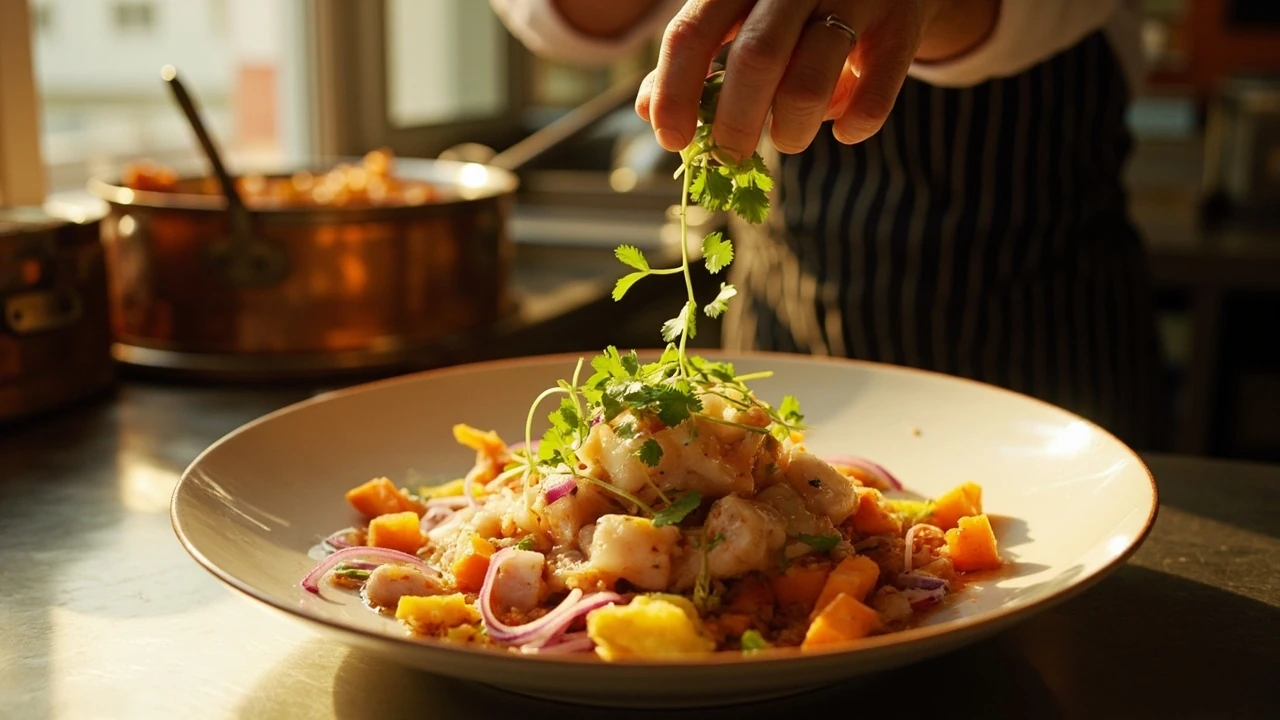
The defining technique of coastal peruvian food is the leche de tigre cure: thin slices of fish, freshly squeezed lime juice, sliced red onion, ají, salt, and a small amount of fish stock or milk. The acid denatures the protein on the surface, turning the fish opaque and firm in roughly five to fifteen minutes. The texture should be a clean “cooked on the outside, raw in the middle” feel, not a fully cured ceviche-style ceviche that has sat in lime for an hour.
Chefs who run into problems with ceviche almost always have one of three issues: fish that is not fresh enough, lime juice that is not freshly squeezed, or a cure time that has stretched into a holding period. The fix is operational, not creative. Source same-day fish where possible, juice limes within an hour of service, and treat the cure as a ticket-time step, not a prep step.
Wok-style high-heat cooking
Lomo saltado and similar stir-fried beef dishes come from a long-standing Chinese-Peruvian exchange in Lima’s Chinatown, which is why the technique looks like Cantonese wok cooking. The pan must be ripping hot, the protein must be cut thin and patted dry, and the vegetables must hit the heat in stages so they char without going limp. Soy sauce, ají amarillo paste, and a splash of pisco or red wine go in at the end with a quick toss. The dish is finished with rice and a thick-cut fried potato, never a thin fry.
Slow braising with dried ají
Dishes like ají de gallina and carapulcra depend on long, gentle braises in a sauce built from dried ají amarillo or ají panca, bread soaked in milk, and stock. The dried peppers are the soul of the sauce, and skipping the step of toasting, soaking, and blending them properly produces a flat, dull result. This is the technique most likely to suffer in a busy kitchen where the cook is tempted to open a jar. The honest version is built in a pot, not poured from one.
Chicha-based and corn-based ferments
Corn appears in peruvian food in forms that have no real equivalent in U.S. or European kitchens: chicha morada (a purple corn drink), chicha de jora (a fermented corn beer), and choclo (a large-kernel, low-sweetness corn served as a side). Most of these are not strictly required, but a peruvian food menu feels more honest when at least one corn element shows up beyond chips and tortillas.
The ingredient stack you actually need
Most of the panic around peruvian food is a sourcing problem, not a cooking problem. If you build a pantry of the right core ingredients, you can build a meaningful peruvian section without a dedicated supplier. The list below is what a working restaurant needs, not what a peruvian cookbook tells you to have.
- Fresh ají: ají amarillo paste (in jars as a baseline, with fresh ají limo for finishing), ají panca paste, and where you can get them, fresh ají amarillo and rocoto.
- Dried ají: dried ají amarillo and dried ají panca for sauces that need a deeper, toasted flavor than the jar pastes give you.
- Citrus: heavy lime volume, with key limes as a backup. Plan for roughly 2 to 3 kilograms of limes per kilogram of fish in ceviche service.
- Red onion: the standard slicing onion for ceviche, marinades, and salsas. Cut thin, soak in cold water for ten minutes, and drain before use to reduce harshness.
- Herbs: cilantro, huacatay (black mint) paste or dried leaves as a backup, and fresh mint for juanes and cebiche variations.
- Native starches: sweet potato (yellow and purple if available), yuca, large-kernel choclo or hominy, and canchita (toasted corn kernels) for garnish.
- Proteins: a clean, lean white fish for ceviche (corvina-style, sea bass, or similar), shellfish for tiradito and causas, beef tenderloin or skirt for lomo saltado, and chicken thighs for ají de gallina.
- Pantry: evaporated milk for the ají de gallina sauce, plain white bread, soy sauce, red wine vinegar, fish stock, quinoa, and a neutral oil with a high smoke point.
You do not need every item on this list on day one, but you do need the ají stack, the lime volume, the red onion, and at least one usable starch. Everything else can be layered in as the menu grows.
Dishes that carry a peruvian food program
Every peruvian food menu needs a few anchor dishes that guests recognize, a few bridge dishes that feel familiar to a non-peruvian audience, and a few quiet dishes that show the kitchen actually understands the cuisine. The mix below is a working baseline that scales from a single pop-up night to a full restaurant concept.
| Role on the menu | Dish | Why it earns the slot | Operational notes |
|---|---|---|---|
| Anchor | Ceviche clásico | Defines the cuisine for most guests; sets the standard for fresh fish, lime, and ají | Treat the cure as a ticket-time step; do not pre-batch |
| Anchor | Lomo saltado | Crowd-friendly, high-margin, works as a shared plate or entrée | Requires a real wok station and a serious sear |
| Bridge | Causa limeña | Cold, layered, visually strong; works for catering and plated service | Build the day before; lemon-juice the potato to keep color |
| Bridge | Arroz con mariscos | Familiar rice dish that lets the kitchen use shellfish trim and kitchen stock | Cook in a wide pan so the rice gets a bottom crust |
| Quiet | Ají de gallina | Shows the dried-ají technique; converts skeptics who think peruvian food is “just ceviche” | Shred the chicken fine; do not skip the bread-and-milk base |
| Quiet | Anticuchos | Beef heart skewers that introduce a peruvian street-food register without gimmicks | Brine overnight; marinate in ají panca, vinegar, and cumin |
| Quiet | Picarones | Squash-and-sweet-potato fritters with cane syrup; gives the menu a real dessert | Fry to order; serve within five minutes of leaving the oil |
Once those dishes are stable, you can add regional depth with a juanes plate, a pachamanca special for a weekend, or a tiradito that changes weekly. The point is to anchor first, then deepen. A peruvian food section built entirely on rotating specials looks creative for about a month and then falls apart in the kitchen.
How peruvian food reads on a non-peruvian menu
Most guests in most cities will arrive at a peruvian food section with three reference points: ceviche, lomo saltado, and a vague idea of pisco sour. That is the ceiling, not the floor, but it is the ceiling you design against. If a guest has to read three lines of explanation to understand a dish, you are asking them to learn peruvian food on their first visit, and most of them will not.
Two patterns work well. The first is to give each dish a one-line description that names the technique or main flavor, not the history. “Ceviche: sea bass cured in lime, ají, and cilantro” tells a guest what they are about to eat. “A traditional dish from Lima that dates to the Moche civilization” tells them something, but not what they need to know. The second is to lead the section with the two dishes guests will recognize, then place the quieter dishes next to them so the eye moves from known to unknown on the same page.
For a detailed look at how a few signature dishes can be turned into a full content calendar, the piece at How to Turn One Signature Product Into a Month of Content lays out a useful framework that applies directly to peruvian food. Once you have one strong peruvian dish, the rest of the marketing writes itself.
Sourcing reality and food cost
The cost question is where most peruvian food concepts quietly die. A few practical notes from kitchens that have actually run the numbers:
- Fish cost is the line item that decides everything. Ceviche cannot be built around a fish that costs more than the dish price allows. Lean, clean, day-boat white fish at $9 to $14 per pound will work in most markets; anything above that and the peruvian food section starts losing money on every plate.
- Ají pastes are cheap; the wrong ají paste is expensive. A 7-ounce jar of good ají amarillo paste can flavor forty to sixty portions. The expensive mistake is buying a cheap, sweetened, single-ingredient paste and serving a flat, candy-sweet ají de gallina. Buy a paste with a short ingredient list.
- Native potatoes, choclo, and cancha are nice, not required. They lift the menu visually and culturally, but they are not where the food cost lives. Substituting a Yukon Gold and a hominy pack is fine on a small section.
- Pisco cost can be controlled by the bar program. A peruvian food section pulls naturally toward pisco sour, chilcano, and pisco-based dessert. Build the bar program with at least one working pisco and a sour mix before the food menu launches, or you will end up serving a peruvian menu with no peruvian drink to anchor it.
As a rough working target, a peruvian food section built on ceviche, lomo saltado, ají de gallina, and a causa should be able to land in the 28 to 34 percent food cost range on a peruvian-leaning menu, which is normal for a seafood-and-rice concept. The mistake to avoid is using a peruvian section as a way to push premium proteins; the cuisine is fundamentally built on technique, not luxury ingredients.
Menu engineering for a peruvian food section
Menu engineering is where a peruvian food section either pays rent or quietly bleeds money. The standard four-quadrant framework (stars, plowhorses, puzzles, dogs) applies, but a peruvian section has a few specific behaviors worth calling out.
| Dish | Margin behavior | Menu placement | Engineering move |
|---|---|---|---|
| Ceviche | High perceived value, moderate margin | Top of the section, ideally with a price anchor above it | Hold price; protect margin by sourcing discipline |
| Causa | High margin, low volume | Middle of the section, paired with a drink special | Train the team to mention it; it converts well when described |
| Lomo saltado | Strong plowhorse, mid margin | End of the section, next to a familiar rice plate | Slight price increase or portion tune to push into star quadrant |
| Ají de gallina | Quiet star candidate, high margin once trained | Just below lomo, framed as a comfort dish | Build into a lunch special; it travels well for takeout |
For a deeper look at how to design a menu that protects margin without losing the personality of the food, the guide on Menu pricing strategies that protect margin without losing guests is a useful companion. Perurian food has a natural tendency to feel generous on the plate, which means the operator has to be deliberate about what is actually on the plate, not just the price.
Building the team around the cuisine
The hardest part of a peruvian food program is not the recipes. It is the team. A line cook with no exposure to peruvian cooking will read a ceviche recipe and treat it like a poke bowl. The cure time, the ají balance, the red onion prep, the sweet potato garnish, the leche de tigre as a sauce and a drink, all of it is invisible until someone explains why each piece matters.
Two practical moves help. First, run a two-week peruvian food trial with a single chef owning the section end to end, so the rest of the team watches the technique in real time. Second, write a one-page playbook for each anchor dish that lists the most common mistakes, not the recipe. Most line cooks can read a recipe. The thing they cannot read is the failure mode.
For teams that need help framing the cuisine to a non-peruvian audience, the piece on Food photography that actually sells the dish is worth reading alongside the menu engineering work. Perurian food sells itself in photos when the acid, color, and garnish are right, and it dies in photos when the dish looks flat.
What to test before you commit
Before launching a permanent peruvian food section, run a small, controlled test. The shape of the test matters more than its size.
- Pick three to four dishes that span the menu: ceviche, a causa or tiradito, lomo saltado, and one quiet dish like ají de gallina.
- Run them as a four-night-per-week special for six to eight weeks, with a small table tent and a simple one-line description.
- Track the same four numbers every week: covers, average ticket, food cost, and the percentage of guests who order a peruvian dish when they see the special.
- Talk to ten guests per week at the door. Ask what they recognized, what they did not, and what they would have ordered if the special had not been on.
- At the end of the test, promote the two dishes that held steady and retire the one that needed explaining every time.
This is a small test, but it answers the real question: does your specific room, with your specific guests, at your specific price point, actually want a peruvian food section. The answer is often yes, but not always in the shape the chef expected.
Common mistakes when adding peruvian food to a menu
A short list of patterns that show up again and again in kitchens that are new to peruvian food. None of these are about recipe execution. They are about the operational shape of the cuisine.
- Treating ceviche as a prep dish. Ceviche that sits in lime juice for an hour is not peruvian ceviche. It is a texture mistake served with the right name on top.
- Using sweet ají pastes. Ají pastes with added sugar or starch are a common shortcut and they flatten the sauces that should be carrying the dish.
- Skipping the dried-ají step. Toasting and soaking dried ají is a 30-minute job that nobody wants to do on a busy night, which is why the quiet dishes on a peruvian food menu so often taste wrong.
- Forgetting the garnish stack. Cancha, sweet potato, and a single leaf of lettuce are not decorative; they are the starch and texture the dish is built around. Removing them removes the architecture.
- Building the bar program last. A peruvian food menu without pisco, chicha morada, or a thoughtful non-alcoholic lineup feels like half a concept.
Where peruvian food goes next
Peruvian food is still a growth cuisine in most markets outside Lima, New York, and a few large cities in between. That is good news for operators because it means the audience is curious and the reference points are not yet locked. The cuisines that grew fast in the last twenty years grew because a small number of operators took them seriously as a working concept, not as a seasonal theme.
The opportunity is to be one of the kitchens in your market that builds a real peruvian food program, with regional depth, a serious pantry, and a menu that holds up two years in. That is the version of peruvian food that survives past the food-trend cycle and becomes a real part of how a city eats.
Frequently asked questions
What is peruvian food in simple terms?
Peruvian food is the cooking of Peru, built from three regional traditions: the Pacific coast, the Andes, and the Amazon. It is known for dishes like ceviche, lomo saltado, ají de gallina, and causas, and for a flavor base built on lime, ají peppers, red onion, cilantro, corn, and native potatoes.
Is peruvian food spicy?
It can be, but it does not have to be. Most ají pastes used in peruvian food are more about aroma and color than heat. A ceviche or a causa served to a guest who is nervous about spice is built on a mild ají amarillo base that gives the dish warmth without chili burn.
What is the most famous peruvian food dish?
Ceviche is the most recognized peruvian food dish worldwide. It is raw fish cured in lime juice with ají, red onion, and cilantro, served with sweet potato and cancha corn. Lomo saltado is a close second and is the most recognized peruvian food dish in stir-fry form.
What is the difference between ceviche and tiradito?
Both are raw fish preparations common in peruvian food. Ceviche is cut into small cubes, while tiradito is sliced into thin sashimi-like pieces with no marinade other than the sauce it is served under, usually a yellow ají sauce.
Do I need a peruvian food supplier to cook this cuisine?
No. A working peruvian food menu can be built from ají pastes, fresh limes, red onion, and standard proteins, all of which are available through most broadline distributors. Native ingredients like choclo, ají limo, or huacatay help, but they are not required to start.
What drinks pair with peruvian food?
Pisco sour, chilcano, and chicha morada are the classic peruvian food pairings. For non-alcoholic options, a fresh lime and mint cooler, or simply agua de maracuyá, works well with most of the menu.
Is peruvian food healthy?
Many peruvian food dishes are built around fresh fish, lime, herbs, and native starches, which makes the cuisine naturally light. Dishes like ceviche, causas, and quinoa-based plates are well suited to a health-leaning menu, while lomo saltado and ají de gallina sit in the comfort-food range.
How is peruvian food different from mexican food?
Peruvian food uses different ají peppers, a different starch base (sweet potato, native potatoes, and choclo rather than corn tortillas and beans), and a different acid structure built on lime. The cuisines share an emphasis on bold flavor, but the specific flavor vocabulary is distinct.
What is a good first peruvian food dish to learn?
Ceviche is the most common starting point, but causes are a more forgiving first plate for a home or a training kitchen. They teach the ají amarillo base, the lemon-juice potato technique, and the layered plating style that shows up across peruvian food.
Is peruvian food expensive to run as a menu section?
A peruvian food section built around ceviche, a causa, lomo saltado, and ají de gallina can land in the same food-cost range as a typical seafood-and-rice section. The cost is driven by fish quality and ají sourcing more than by exotic ingredients, which is why discipline at the purchasing step matters more than a specialty supplier.